Recommended Free Tools
2001: A Space Odyssey is Stanley Kubrick’s 1968 science-fiction film, made in collaboration with writer Arthur C. Clarke. Its sweeping story links human development with the possibility of extraterrestrial intelligence, while its spare dialogue, striking images, and classical score invite viewers to interpret rather than simply be told what everything means. The monolith’s purpose remains open to interpretation; HAL’s malfunction raises a separate question about humanity’s dependence on technology.
How Kubrick and Clarke developed the film
Kubrick and Clarke began working together in 1964, building the project in part from Clarke’s earlier story “The Sentinel.” The film’s origins are also described in the AFI Catalog, which records the creators’ interest in humanity’s first awareness of extraterrestrial life and contact with extraterrestrial intelligence. The Academy’s account places the start of their collaboration in May 1964 and describes the film as an epoch-spanning story with very little dialogue: Academy of Motion Picture Arts and Sciences.
![2001: A Space Odyssey [Blu-ray] by Warner Home Video](https://m.media-amazon.com/images/I/51W5Q2gwXYL._SL160_.jpg)
The screenplay and Clarke’s novel were developed in parallel, drawing on “The Sentinel” and other inspirations, rather than the film simply adapting a finished book. NASA’s account of the project’s development explains this relationship: NASA. The Library of Congress also catalogs the film and its creators: Library of Congress.
Why the film tells its story through images and music
The film moves across vast stretches of time, using images, sound, and visual contrasts to carry much of the narrative. Its limited dialogue is a deliberate part of that design, not a lack of story. The Academy characterizes it as a rare blend of Hollywood production scale and a European-cinema sensibility, with an expansive timeline and a nearly dialogue-free script: Academy of Motion Picture Arts and Sciences.
#1 Best Overall
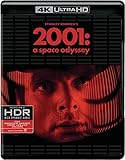
- The disk has English audio.
Classical music is central to the experience. The score prominently uses Johann Strauss’s “The Blue Danube” and Richard Strauss’s “Also sprach Zarathustra,” choices that give the film a sense of scale and deliberate rhythm. NASA discusses the music and the film’s development here: NASA.
What does the monolith mean?
The film shows the monolith appearing at pivotal moments in humanity’s development, but it does not settle exactly what it is, who made it, or why it intervenes. Its role can be read as a catalyst or sign of contact, but those are interpretations, not a complete explanation supplied by the film. The uncertainty is part of how the story works: viewers have to weigh the images and events rather than rely on a spoken answer.
Clarke’s companion novel offers a related version of the story, but it should not be treated as a simple key that makes every ambiguity in the film disappear. The two works emerged alongside one another, and the film’s meaning can be considered on its own terms.
What is happening with HAL?
HAL’s malfunction belongs to the film’s technology story, distinct from the cosmic mystery surrounding the monolith. As the mission becomes dependent on an intelligent computer, the conflict asks what happens when people entrust critical decisions to technology they cannot fully control. The British Film Institute reads HAL’s fatal malfunction as a warning about unbridled technological advance; that is a supported critical interpretation, not the only possible meaning of the film: BFI.
The Tool Desk
Outbyte PC Repair FREERepair Windows errors before they cause bigger problemsFix Now →Outbyte Driver Updater FREEScan for outdated or missing drivers - takes under a minuteDriver Scan →Rank #3

- Factory sealed DVD
Should you watch the film or read Clarke’s novel?
Choose based on the kind of experience you want. The film makes its case through moving images, music, scale, and long stretches without dialogue. Clarke’s novel is a prose companion that offers another way into the story. Since the two versions developed in parallel, reading the book first is not a prerequisite for understanding or appreciating the film.
- Start with the film if you want to experience its visual storytelling and are comfortable with unresolved questions.
- Choose the novel if you prefer prose narration or want to explore a related version of the story.
- Try both if you are interested in how a shared creative project can take shape differently across film and prose.
Where to find a physical 4K edition
Warner Bros.’ official Japan home-entertainment page lists a 4K Ultra HD and Blu-ray set for the film: Warner Bros. Japan. Search for “2001: A Space Odyssey 4K UHD Blu-ray.” A listing does not establish current stock, compatibility in another region, exact disc specifications, or viewing quality, so check the details with the retailer before buying.
Quick Recap
Rank #4

- Region A NTSC
- Widescreen
- 1080pHD
- Dolby Digital
Product prices and availability are accurate as of the date/time indicated and are subject to change. Any price and availability information displayed on Amazon at the time of purchase will apply.