Recommended Free Tools
In Sidney Lumet’s 1957 film 12 Angry Men, the jurors are identified mostly by number, not by personal name. Henry Fonda plays Juror 8, the first to vote not guilty; Lee J. Cobb plays Juror 3, the final guilty holdout; and Joseph Sweeney’s Juror 9 is the first to join Juror 8. Here is the full juror cast and what each character contributes to the deliberation.
The 12 jurors and the actors who play them
The film’s number-based convention keeps attention on the group’s deliberation rather than on a dozen backstories. AFI records surnames for only two jurors: Juror 8 is Davis and Juror 9 is McArdle. The other jurors are identified by number in the film’s credits and principal cast listings. [AFI Catalog; Criterion]
| # | Preview | Product | Price | |
|---|---|---|---|---|
| 1 |

|
12 Angry Men | $17.54 | Buy on Amazon |
| 2 |

|
12 Angry Men | $19.99 | Buy on Amazon |
| 3 |
![12 Angry Men (The Criterion Collection) [DVD]](https://m.media-amazon.com/images/I/51RtHhtLvkL._SL160_.jpg)
|
12 Angry Men (The Criterion Collection) [DVD] | $17.68 | Buy on Amazon |
| 4 |

|
12 Angry Men (Decades Collection) | $9.99 | Buy on Amazon |
| 5 |
|
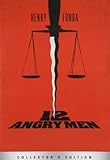
12 Angry Men (50th Anniversary Edition) with Special Features | $9.47 | Buy on Amazon |
| Juror | Actor | Character and role in the deliberation |
|---|---|---|
| 1 | Martin Balsam | The foreman, a genial high-school football coach charged with keeping the discussion moving. |
| 2 | John Fiedler | A shy, stammering bank clerk who begins intimidated by stronger voices and becomes more confident as the evidence is examined. |
| 3 | Lee J. Cobb | A businessman and the final guilty holdout. His estrangement from his son becomes explicit near the end, shaping his anger without explaining away everything he says or does. |
| 4 | E. G. Marshall | An articulate, analytical stockbroker who takes the prosecution’s case seriously and changes his vote after reconsidering an eyewitness’s reliability. |
| 5 | Jack Klugman | A man raised in a slum who challenges prejudiced assumptions about its residents and brings practical knowledge of knife fights to the discussion. |
| 6 | Edward Binns | A blue-collar worker who engages with the evidence and eventually moves away from his first vote. |
| 7 | Jack Warden | A fast-talking salesman eager to finish in time for a baseball game; his impatience and desire for a quick outcome affect his votes. |
| 8 (Davis) | Henry Fonda | The initial lone dissenter. He does not say he knows the accused is innocent; he asks the others to examine the evidence and decide whether reasonable doubt remains. |
| 9 (McArdle) | Joseph Sweeney | An elderly, observant juror and the first to join Juror 8. He notices details that raise questions about an eyewitness’s age and possible need for glasses. |
| 10 | Ed Begley | A garage owner whose explicit prejudice against people from slums becomes a central source of conflict in the room. |
| 11 | George Voskovec | An immigrant watchmaker who treats jury service as a serious civic duty and presses the group to consider the responsibility of its decision. |
| 12 | Robert Webber | A young advertising executive who proposes a procedure for hearing each juror’s reasoning. |
Who is Juror 8, and what is he arguing?
Juror 8, played by Henry Fonda, is the first and initially only juror to vote not guilty. His position is not that the defendant must be innocent. He asks the group to take time with the evidence and consider whether the prosecution has removed reasonable doubt. That distinction drives the film: a vote for acquittal in the deliberation is not presented as certainty about what happened, but as a judgment about whether the case has been proved beyond reasonable doubt. [AFI Catalog; TCM]
Who is the last holdout?
Juror 3, played by Lee J. Cobb, is the final juror to change his guilty vote. The film reveals that he is estranged from his son, and the conflict between that personal pain and the case before him intensifies the ending. His role is more than simply being “the angry one”: the deliberation shows how certainty, resentment, and personal experience can become entangled, while the other jurors test the actual evidence.
Quick wins for a faster PC:
Fix the driver behind crashes, sound loss and screen glitchesFind Drivers →Repair Windows errors before they cause bigger problemsFix Now →Scan for outdated or missing drivers - takes under a minuteDriver Scan →#1 Best Overall
- 12 Angry Men - DVD Brand New
How do the jurors’ views change?
The shifts in the room are not a simple march from prejudice to enlightenment. Different jurors reconsider different things: evidence, credibility, responsibility, or the reasons behind their own votes.
- Juror 9: Sweeney’s McArdle is the first to join Juror 8. His attentiveness to the eyewitness helps the room consider whether testimony should be taken at face value.
- Juror 4: Marshall’s analytical stockbroker changes his vote when he recognizes reasonable doubt about an eyewitness.
- Juror 5: Klugman’s experience challenges assumptions about life in the slum and informs the discussion of knife-fighting technique.
- Jurors 2 and 6: Fiedler’s initially timid clerk gains confidence, while Binns’s working-class juror engages with the evidence and eventually revises his first vote.
- Juror 7: Warden’s salesman is driven in part by the prospect of missing a baseball game, making expediency part of the group’s conflict.
- Juror 10: Begley’s garage owner voices prejudice against people from slums, exposing how bias can masquerade as judgment of the accused.
- Juror 11: Voskovec’s watchmaker repeatedly emphasizes the seriousness of the duty and the meaning of reasonable doubt.
- Juror 12: Webber’s ad executive suggests a way to hear each juror’s reasoning, giving the group a more orderly procedure.
Juror 1, the foreman played by Balsam, manages the process rather than serving as the central advocate for either side. Together, the jurors’ differing temperaments make the room a study of how a group handles evidence and pressure.
Rank #2
Is this the 1957 film or the original TV version?
This guide covers Sidney Lumet’s 1957 feature film, adapted from Reginald Rose’s 1954 Studio One teleplay—not the original television production or later stage and screen versions. AFI dates the CBS broadcast of the teleplay to September 20, 1954, and the feature’s release to April 1957. AFI credits Rudy Bond as the judge, James A. Kelly as the guard, Billy Nelson as the court clerk, and John Savoca as the defendant. [AFI Catalog; Criterion]
The story’s stated setup is a New York murder trial in which a guilty verdict would bring an automatic death sentence. That is the film’s dramatic premise, not a guide to current criminal procedure. Most of the action unfolds in the jury room, framed by brief courthouse scenes. AFI and Criterion list different runtimes, so there is no single duration to give without specifying the catalog or edition. [AFI Catalog; Criterion]
Outdated Drivers Are Slowing You Down
One free scan finds every outdated or missing driver and matches the right update for your exact hardware.Free scan · exact hardware matchPC Slower Than It Used to Be?
A free scan shows the junk files, broken settings and background clutter dragging Windows down - then fixes them in one click.Free scan · Windows 10 & 11Quick Recap
Best Value
- Condition: New
- Format: DVD
- Black & White; Subtitled; Widescreen
Rank #4
- The Decades Collection of 12 Angry Men is the only one to contain the booklet, music CD and DVD
- The 2nd Disc (the music CD) contains 8 songs from the 50s by the original artists:
- Rock Around the Clock (Bill Haley & His Comets) * At The Hop (Danny & The Juniors) * Come Go With Me (The Del Vikings)
- Tammy (Debbie Reynolds) * That'll Be The Day (Buddy Holly) * Sh-Boom (The Crew Cuts)
- Smoke Gets In Your Eyes (The Platters) * Who's Sorry Now (Connie Francis)
Rank #3
Product prices and availability are accurate as of the date/time indicated and are subject to change. Any price and availability information displayed on Amazon at the time of purchase will apply.




