This ranking covers all 13 Star Wars films released theatrically through The Mandalorian and Grogu, including the animated Star Wars: The Clone Wars. It excludes television series and made-for-TV specials. The order below is my judgment of each film’s storytelling, characters, emotional payoff, craft, franchise contribution and ability to stand on its own—not a ranking of box-office impact or critical consensus.
For a common critical benchmark, Rotten Tomatoes’ guide, updated May 19, 2026, ranks the theatrical films by Tomatometer. Those percentages summarize counted critic reviews; they are not the verdict of every viewer, and scores can change. Three films display 93%, for example, without that tie establishing a meaningful difference in reception. Rotten Tomatoes’ Star Wars guide provides the current comparison.
![Star Wars Original Trilogy: 3 Movie Collection Set (IV V VI) (A New Hope / The Empire Strikes Back / Return of The Jedi) - [4K UHD + Blu-Ray, Region Free]](https://m.media-amazon.com/images/I/410qxY1auTL._SL160_.jpg)
![Star Wars: The Complete Saga (9-Disc Collection) [Blu-ray]](https://m.media-amazon.com/images/I/51KTKxL-sTL._SL160_.jpg)
![Star Wars Original Trilogy: 3 Movie Collection Set (IV V VI) (A New Hope / The Empire Strikes Back / Return of The Jedi) - [4K UHD + Blu-Ray] [Region Free]](https://m.media-amazon.com/images/I/51DI1z-jpDL._SL160_.jpg)
Every theatrical Star Wars movie, ranked worst to best
-
Star Wars: The Clone Wars (2008) — Tomatometer: 18%
The theatrical animated film has a clear place in the franchise’s timeline, but it feels more like an extended episode than a fully shaped feature. Its episodic conflicts and brisk introductions do little to build a satisfying arc for viewers who do not already know the characters. The animation gives the film its own look, yet the storytelling is the weakest of the theatrical releases.
-
Star Wars: The Rise of Skywalker (2019) — Tomatometer: 51%
There is energy in its set pieces and a genuine effort to give the sequel trilogy a large-scale finale. But the movie races through revelations and reversals so quickly that character choices and emotional consequences often struggle to land. It offers spectacle more reliably than coherence, leaving its many callbacks to do work the central story should be doing.
Do these 3 things before closing this tab:
1Scan for outdated or missing drivers - takes under a minute2Repair Windows errors before they cause bigger problems3Fix the driver behind crashes, sound loss and screen glitchesSpecial offer. See more information about Outbyte and uninstall instructions. Please review EULA and Privacy policy.#1 Best Overall
-
Star Wars: The Phantom Menace (1999) — Tomatometer: 54%
The first prequel brings striking environments, memorable designs and a confident sense of galactic scale. Its political setup and young Anakin’s introduction are more compelling as franchise groundwork than as a single, balanced drama; the characters can feel remote, and the pacing is uneven. The film’s world-building earns its place above the two entries below it, even if its emotional story is less effective.
-
Star Wars: Attack of the Clones (2002) — Tomatometer: 62%
The mystery surrounding the clone army and the growth of the conflict give the film a stronger engine than its predecessor. Yet the romance at its center is difficult to invest in, and stiff dialogue undercuts scenes meant to show Anakin and Padmé falling in love. Its effects-heavy settings can make the world feel less tangible than the practical environments and lived-in textures that distinguish the strongest films.
-
Solo: A Star Wars Story (2018) — Tomatometer: 69%
Solo is an easygoing adventure with a likable ensemble and enough momentum to make its heist-and-escape plot work. Its main limitation is also its premise: explaining the backstory of a beloved character narrows the room for surprise. It is a more complete standalone watch than the lower-ranked prequels, but it rarely makes its familiar destination feel newly necessary.
-
The Mandalorian and Grogu (2026) — Tomatometer: 60%
This theatrical continuation brings the title characters to the big screen and gives the ranking a new entry beyond the nine saga episodes and earlier spin-offs. Its Tomatometer percentage is lower than Solo’s in the May 19, 2026 Rotten Tomatoes guide, but critic scores are not my sole measure: the question here is how successfully a film works as a film. It lands in the middle of this list, where its place reflects my overall balance of story, character, craft and standalone impact rather than a claim that the guide’s score predicts every viewer’s response.
Free tools Windows power users keep installed
One-click scans. No signup required.
Special offer. See more information about Outbyte and uninstall instructions. Please review EULA and Privacy policy. -
Revenge of the Sith (2005) — Tomatometer: 79%
The prequel trilogy’s conclusion has a strong tragic destination: Anakin’s transformation gives the story a clear emotional spine, and the film’s imagery makes that fall feel momentous. Some transitions are abrupt and the dialogue remains a weakness, but the choices carry consequences that the earlier prequels were building toward. Its dramatic payoff lifts it above the more episodic middle entries.
-
Return of the Jedi (1983) — Tomatometer: 83%
The original trilogy’s finale earns its place through Luke’s confrontation with Vader and the resolution of their family story. Its lighter stretches and the Ewok-centered battle are less compelling than the film’s strongest character scenes, so it does not match the sustained force of the two original films above it. But the climactic choices give the trilogy a deeply satisfying emotional close.
-
Rogue One: A Star Wars Story (2016) — Tomatometer: 84%
Rogue One turns a brief piece of franchise history—the theft of the Death Star plans—into a self-contained wartime story. Its ensemble needs time to cohere, but the film’s grounded visual approach and increasingly consequential mission give it a distinct identity. The ending connects directly to A New Hope without making the spin-off feel like it exists only to point toward another movie.
-
Star Wars: The Last Jedi (2017) — Tomatometer: 90%
This is the sequel trilogy’s boldest attempt to make familiar Star Wars ideas uncomfortable again. Its story challenges inherited notions of heroism and failure, and its visual set pieces have a strong sense of composition. The detours and tonal shifts do not work equally well for every viewer, but the film gives its characters meaningful tensions rather than merely moving them between action scenes.
Recommended Free Tools
Special offer. See more information about Outbyte and uninstall instructions. Please review EULA and Privacy policy. -
Star Wars: The Force Awakens (2015) — Tomatometer: 93%
The Force Awakens introduces a new generation with clarity and warmth, and its mix of mystery, humor and forward motion makes it an especially inviting rewatch. Its return to familiar story shapes is both its comfort and its constraint: the film rekindles the original trilogy’s appeal more than it breaks new ground. It sits just below the top two because its strongest achievement is renewal, not reinvention.
-
Star Wars: The Empire Strikes Back (1980) — Tomatometer: 93%
The second film in the original trilogy deepens its characters rather than simply enlarging the spectacle. Luke’s training, Han and Leia’s relationship, and the story’s revelations all build toward an ending that changes how the heroes understand their struggle. Its emotional turns and assured filmmaking make it the most dramatically rich entry, even if its cliffhanger means it is not as self-contained as the film at number one.
-
Star Wars: A New Hope (1977) — Tomatometer: 93%
The original film is the strongest all-round feature: a clean, complete adventure that introduces a world without requiring prior knowledge and gives its heroes a satisfying arc. Its visual imagination and memorable sound make the galaxy feel larger than the story’s simple structure. Where The Empire Strikes Back reaches greater emotional complexity, A New Hope is the more complete standalone film—and the best starting point for a first watch.
What this ranking measures—and what the scores measure
The order weighs story coherence, character development, emotional and thematic payoff, visual and sonic invention, contribution to the franchise, standalone completeness and rewatchability. It is a reasoned personal ranking, not a claim that one film is objectively best for every viewer.
PC Slower Than It Used to Be?
A free scan shows the junk files, broken settings and background clutter dragging Windows down - then fixes them in one click.Free scan · Windows 10 & 11Outdated Drivers Are Slowing You Down
One free scan finds every outdated or missing driver and matches the right update for your exact hardware.Free scan · exact hardware matchBest Value
- Brand New in box. The product ships with all relevant accessories
The Tomatometer is a separate critic-review benchmark. Rotten Tomatoes’ current guide, updated May 19, 2026, displays A New Hope, The Force Awakens and The Empire Strikes Back at 93%; its ordering of those tied scores does not show a meaningful critical gap. The same guide places The Mandalorian and Grogu at 60% and The Clone Wars at 18%. Because scores may change, consult the guide for its latest values rather than treating these as permanent measurements.
Historical averages need the same care: Rotten Tomatoes reported a 75% average Tomatometer for 11 theatrical Star Wars films in 2019, and listed The Empire Strikes Back at 95% in that snapshot. That is not the current 13-film average or the current score for the movie. A different ranking, such as Space.com’s May 2026 list, reflects its authors’ own judgments—for example, its criticism of Attack of the Clones and praise for The Empire Strikes Back—rather than a universal consensus.
How to watch the Star Wars movies in order
For a first film-only watch: release order
Release order follows how the theatrical stories were presented and lets the prequels’ revelations land in their intended context. Begin with A New Hope, continue through the original trilogy, then watch the prequel trilogy, sequel trilogy and theatrical spin-offs. StarWars.com provides both a release-order and chronological viewing guide.
For the in-universe timeline: chronological order
Chronological order follows events in the Star Wars universe rather than the films’ release history. The official guide interleaves movies with television series, so it is a broader franchise path, not a film-only list. You can follow its timeline while skipping series if you want to keep the watch limited to theatrical features; StarWars.com’s guide describes both approaches and notes that either order is valid.
What’s actually slowing this PC down?
Pick the symptom - the matching free tool is one click away.
What counts as a Star Wars movie here?
The list includes theatrical feature releases: the nine numbered saga films, the live-action theatrical spin-offs, the 2008 animated theatrical film and the 2026 theatrical release The Mandalorian and Grogu. It leaves out TV series, made-for-TV specials and direct-to-video productions. This matches the theatrical scope used by Rotten Tomatoes’ guide and the film-only approach described by ScreenCrush, while making clear that an older list that predates the 2026 release cannot represent the current theatrical lineup. ScreenCrush’s theatrical-film ranking also distinguishes theatrical features from direct-to-TV or direct-to-video titles.
Collecting the films on disc
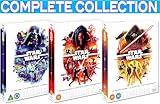
Lucasfilm documented a Blu-ray collector set bringing together Episodes I–VI in 2011, then announced 4K UHD and Blu-ray/DVD editions for The Rise of Skywalker and first-time 4K UHD editions for eight films in 2020. Those announcements establish that physical editions and collections exist, not that a particular box set is currently in stock or contains every film in this ranking. Before buying, check the product’s exact title, included films, format, region and present availability; an older “Skywalker Saga” set may omit theatrical spin-offs, the animated feature or the 2026 release.
Quick Recap
Product prices and availability are accurate as of the date/time indicated and are subject to change. Any price and availability information displayed on Amazon at the time of purchase will apply.




