The Tool Desk
Outbyte Driver Updater FREEFix the driver behind crashes, sound loss and screen glitchesFind Drivers →Outbyte PC Repair FREERepair Windows errors before they cause bigger problemsFix Now →The best rotary speaker pedal depends on what you need it to do: the Neo Instruments Ventilator II is the most Leslie-focused choice here, the Strymon Lex V2 is a premium guitar-oriented option, and the BOSS RT-2 is the most flexible live all-rounder. For a lower-cost dedicated pedal, consider the Keeley Rotary; for a brighter, more unusual revolving-speaker sound, look at the Dawner Prince Pulse. Keyboardists should also consider the Electro-Harmonix Lester G.
Quick comparison: five current rotary pedals
These are use-case picks, not a universal sound-quality ranking. The playing instrument, stereo monitoring, amp and use of speed changes all affect how a rotary effect works in a mix.
| Pedal | Best for | Character and controls | Stereo and external control | Price and availability signal |
|---|---|---|---|---|
| Neo Instruments Ventilator II | Leslie 122-style realism and detailed adjustment | Separate bass and treble rotor behavior; adjustable acceleration and deceleration, drive, balance, distance and an 800 Hz crossover. | Works in mono or stereo; supports remote footswitch, half-moon switch or expression pedal. | Official product page does not state a current US price. Neo Instruments |
| Strymon Lex V2 | Premium guitar rotary and polished stereo use | Models the rotors, tube-driven amplifier and microphone placement; includes dedicated slow/fast and bypass switches. | Stereo outputs; supports expression, MIDI and other external control options. | $349 USD shown on Strymon’s US product page. 9 VDC, minimum 300 mA; supply not included. Strymon |
| BOSS RT-2 Rotary Ensemble | Live control and broad instrument use | Three tuned modes, drive, slow/fast controls, rise/fall-time adjustment and brake options. | Stereo I/O, wet/dry output mode, CTL/EXP input and external footswitch support. | BOSS announced $239.99 USD launch pricing in 2025; check current retailer pricing. 115 mA draw. BOSS |
| Keeley Rotary | A dedicated option for a simpler, compact board | A rotary effect at a lower listed price than the Lex V2 or Pulse; detailed technical specifications are less extensively documented on the official pages cited here. | Official shop lists the pedal, but the cited page does not establish specific routing or external-control details. | $229 USD shown on Keeley’s official shop. Keeley |
| Dawner Prince Pulse | Doppola/Rover-inspired, spatial guitar textures | Seven onboard controls and an open-cabinet revolving-speaker character rather than a conventional Leslie 122 focus. | Stereo input and outputs; expression pedal or remote speed switch can control speed. | $339.95 USD shown by the manufacturer; approximately 70 mA, 9 VDC center-negative. Dawner Prince |
The prices above are figures displayed or announced by the named manufacturers, not a guarantee of today’s retailer price or stock.
What a rotary speaker pedal emulates
A Leslie-style cabinet does more than pan a sound from side to side. In the classic design, a high-frequency horn and low-frequency rotor turn at different speeds. Their movement changes pitch and volume over time, while the cabinet, amplification and microphone position shape the result. Changing from slow to fast does not usually happen instantly: the motors take time to ramp, and that transition is a central part of the sound. BOSS describes the separate horn and bass rotor; Strymon outlines the amplifier and microphone elements modeled by the Lex.
#1 Best Overall

- Stereo/mono in/out
- Tube emulated overdrive
- Adjustable Fast and Slow modes
- Classic rotary speaker speed up and down
- Power adapter included
- Leslie 122-style rotary: A two-rotor, cabinet-oriented sound strongly associated with organ.
- Vibratone-style effect: A rotating-speaker coloration that can suit guitar particularly well.
- Doppola/Rover-style revolving speaker: A different, often brighter and more open spatial character; the Pulse is designed around this territory.
- Uni-Vibe: A related source of psychedelic swirl, but not a literal rotating-speaker simulation.
- Chorus or tremolo: Can supply some movement or pulsing, but does not necessarily reproduce independent rotor speeds or mechanical ramping.
Which pedal fits each instrument?
Guitar
Guitarists may prefer some midrange focus, compression or drive so the effect remains audible in a band. The Lex V2 models a tube-driven rotary amplifier; the RT-2 has a drive control; the Lester G adds compression and tube-style overdrive. The Pulse is worth considering when a more unusual revolving-speaker texture is the goal. A richly detailed organ-style model can sound diffuse or bass-heavy on guitar, so judge it through the amp and monitoring setup you actually use.
Organ, electric piano and synth
Keyboard players should prioritize clean low-frequency handling, useful stereo routing and convincing slow/fast transitions. A guitar-voiced pedal may add coloration or compression that is welcome on guitar but unwanted on keys. EHX positioned the Lester K for organ-type keyboards and the Lester G for guitar; the G adds guitar-oriented compression and other features. EHX’s product announcement explains that positioning.
Bass
Do not assume a guitar demo proves a pedal will preserve bass tone. Listen for low-end loss, phase changes and whether the bass rotor remains convincing in your register. The available product information here does not establish equivalent bass performance across all five finalists.
Reviews: which rotary pedal should you choose?
1. Neo Instruments Ventilator II: best for Leslie-focused realism
The Ventilator II is the specialist choice for a player who wants a detailed Leslie 122-style effect and is willing to spend time shaping it. Its official feature set includes independent bass and treble rotor behavior, adjustable acceleration and deceleration, drive, balance, distance, mode and speed controls, plus an 800 Hz crossover modeled after the original. It also offers relay true bypass and slow/fast/stop operation.
Do these 3 things before closing this tab:
1Clear out junk files and repair common Windows errors2Scan for outdated or missing drivers - takes under a minute3Repair Windows errors before they cause bigger problemsRemote footswitch, half-moon switch and expression support make it suitable for performance control as well as studio dialing. Neo states that the modeled mechanical movement works in mono and stereo. Its official product page does not state a current US price, so compare a seller’s current price and availability rather than relying on an old listing. See the Ventilator II specifications.
2. Strymon Lex V2: best premium guitar-oriented choice
The Lex V2 combines detailed system modeling with performance controls: dedicated slow/fast and on/off footswitches, stereo outputs, and support for expression, MIDI and additional Strymon control options. Strymon lists 24-bit/96 kHz converters, a 20 Hz–20 kHz frequency response and 1 MΩ input impedance. Its modeled tube-driven amplifier behavior makes it a natural option for guitarists seeking rotary motion with saturation rather than a strictly clean effect.
Rank #2

- Authentic rotary speaker sounds and behaviors condensed into a space-saving BOSS compact pedal
- Three versatile modes include a vintage rotary sound and two modified tones with enhanced spatial effects
- Virtual rotor display with lights that indicate treble and bass rotor speeds
- Fast/slow rotor speed control
- Drive knob to add vintage tube saturation
The trade-offs are a $349 USD price shown on Strymon’s US product page and a minimum 300 mA, 9 VDC power requirement; the power supply is not included. Check your board supply before buying. See Strymon’s Lex V2 details.
3. BOSS RT-2: best live all-rounder
The RT-2 is the current compact BOSS rotary model and the successor to the RT-20. It offers three tuned modes, slow and fast rotor controls, drive, a rise/fall-time switch, and a virtual rotor display showing bass and treble movement. Its switch modes and CTL/EXP input support different live-control setups, including speed and brake functions; expression can be assigned to parameters such as speed, drive, balance or level. Stereo I/O and a selectable wet/dry output mode broaden its routing options.
Recommended Free Tools
BOSS announced a US launch price of $239.99 in 2025, so treat that as launch pricing rather than a current street-price quote. The RT-2 draws 115 mA and supports a 9 V battery or PSA-series adapter, but BOSS estimates about 2.5 hours of continuous alkaline-battery use. Regular users should plan on a suitable adapter or pedalboard supply. It has buffered bypass and a five-year BOSS warranty. See the RT-2 specifications and BOSS’s announcement for launch details.
4. Keeley Rotary: a lower-priced dedicated option
Keeley’s official shop lists the Rotary at $229 USD, below the listed prices of the Lex V2 and Pulse. That makes it a sensible product to investigate if you want a dedicated rotary pedal without paying premium-model prices. The official shop page cited here provides less technical detail than the pages for the Ventilator II, Lex and RT-2, so confirm current routing, power and control behavior from Keeley or the current manual before purchase rather than assuming features that are not documented there. Check Keeley’s shop listing.
5. Dawner Prince Pulse: best for a different revolving-speaker character
The Pulse is the deliberate alternative to a conventional Leslie-focused pedal. Dawner Prince describes it as inspired by the Doppola and Gibson Maestro Rover RO-1, giving it an open-cabinet, bright and spatial direction. It has seven onboard controls, stereo input and outputs, and an input for expression or remote speed control. When an external controller is connected, it takes over speed control and the onboard slow/fast switch is disengaged.
The manufacturer lists it at $339.95 USD, with 9 VDC center-negative power and approximately 70 mA consumption. Choose it for its distinctive spatial identity; if your target is the familiar Hammond/Leslie association, the Ventilator II, Lex or RT-2 is a more direct fit. See Dawner Prince’s Pulse details.
Rank #3
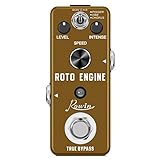
- [Classic 60's Sound]: Classic 60s sound, which takes you into the retro psychedelic trip. Three modes: Chorus, Vibrato, Phaser. We use sophisticated algorithms to simulate these three modes, which makes the Sound an unparalleled one, with storage of timbre sound pedal.
- [Three modes: Phaser / Vibrato / Chorus]: Phaser: Modern feeling phaser, rich and deep. Vibrato: Vintage 60s vibrato sound, ensuring that a wide- range vibrato effect could be achieved. Chorus: A high quality standard chorus, with warm and psychedelic chorus effect.
- [Easy to Control]: Three knobs for you to creat your ideal tone. Level knob: Adjust the level of effects. Intense knob: Adjust the depth of effects. Speed knob: Adjust the speed of effects. With True bypass switch, can minimize tone loss.
- [Whole Zinc Alloy Housing]: Zinc alloy casing with stoving varnish finish, stable and strong. Mini and exquisite, easy to take and operate.
- [Notice]: DC 9V Adapter power supply is not included.
A notable alternative: Electro-Harmonix Lester G
The Lester G merits consideration if you want compression and overdrive built into a guitar-oriented rotary pedal. EHX lists adjustable slow and fast modes, acceleration control, mono input with mono or stereo output, and an included EHX9.6DC-200 power supply. Its official US MAP is $272.10, but the official shop says it is not sold online and directs buyers to dealers; availability may therefore depend on local stock. Check EHX’s Lester G listing.
The Lester K is the keyboard-oriented sibling, but EHX marks it discontinued. The BOSS RT-20 is also a predecessor rather than the current BOSS recommendation. Both can make sense on the used market if condition and price are right; used prices vary, and neither should be mistaken for a current production model. EHX’s Lester K page and BOSS’s RT-20 page provide product lifecycle context.
Controls that matter when playing
- Slow and fast speed: Set the two operating ranges. Slow can add a gently moving texture; fast produces more pronounced pulsing and pitch movement.
- Acceleration and deceleration: Set how quickly the rotors change speed. Longer ramps make transitions feel more mechanical; shorter ramps are easier to deploy abruptly in a live arrangement.
- Brake or stop: Stops or holds the rotor motion for a distinct texture. The way a pedal handles stopping is model-specific.
- Balance: Changes the prominence of bass rotor versus treble horn, where provided.
- Drive: Adds saturation associated with the amplifier stage. It can help a guitar part sit in a mix, but may duplicate an existing overdrive.
- Distance: Changes the modeled microphone perspective and can affect apparent directness and spaciousness.
- Crossover: Sets how low and high frequencies divide between rotor models; the Ventilator II specifies an 800 Hz crossover.
- Mix or level: Helps keep the effect from overwhelming the dry instrument or changing perceived output level.
- Expression assignment: Allows continuous control of a chosen parameter, often speed, for a transition that is harder to achieve with a simple switch.
For a live player, independent control of effect bypass and speed is especially useful: you can leave the effect on and change rotor speed, rather than having one switch perform both jobs.
Independent reader supportYour contribution helps us test, update, and keep practical guides available for everyone.Mono, stereo and signal-chain setup
Basic guitar setup
Guitar → rotary pedal → clean or lightly driven amp
Begin near unity level, use moderate drive, and set the slow/fast ranges so both are useful in the arrangement. Choose an acceleration time long enough to hear the transition. Putting the pedal after heavy distortion can blur the movement; placing it after mild overdrive can yield a saturated rotary texture.
Stereo setup
Guitar or keyboard → rotary pedal stereo outputs → two amps, stereo FRFR system, mixer or interface
Rank #4

- Ultimate rotary speaker emulator
- Fully featured compressor built-in
- Mono In/Mono or Stereo Out
- Tube emulated overdrive
- Adjustable Fast and Slow modes
Stereo can make the rotating image more apparent in recordings, headphones, two-amp rigs and stereo monitoring. Mono remains useful through one guitar amp, or where the venue folds the signal to mono. A pedal’s stereo outputs do not make it acoustically identical to a miked cabinet, and incorrect polarity or unsuitable summing can cause phase problems. Check the complete downstream signal path, not just the pedal’s output jacks.
Keyboard setup
Keyboard or synth → rotary pedal → stereo mixer, interface or amplification
Quick wins for a faster PC:
Clear out junk files and repair common Windows errorsFree Scan →Scan for outdated or missing drivers - takes under a minuteDriver Scan →Repair Windows errors before they cause bigger problemsFix Now →Check input headroom and routing for your keyboard’s output level, then listen for unwanted compression or tonal coloration. The product information cited here does not establish that every finalist accepts every keyboard signal level equally well.
External expression or switching
Before adding a controller, confirm whether the pedal expects an expression pedal, a remote switch or a specific TRS connection, and which function the connection controls. Check whether it replaces an onboard speed switch or controls speed alongside it. The Pulse, for example, disengages its onboard slow/fast switch when an external expression pedal or remote speed switch takes over.
How to choose for your rig
- For the most Leslie-focused control set: Start with the Ventilator II, particularly if detailed rotor, ramp, balance and distance adjustment matters more than price or compactness.
- For premium guitar drive and stereo operation: Compare the Lex V2, while accounting for its 300 mA supply requirement.
- For a live pedal with several control approaches: The RT-2 combines modes, external control and stereo routing in a compact BOSS format.
- For a lower listed price among the five dedicated options: The Keeley Rotary is worth checking, but verify technical details that matter to your board.
- For Doppola/Rover-inspired movement: Choose the Pulse for its distinct character rather than as a straight Leslie substitute.
- For guitar compression and drive in one box: Add the Lester G to the shortlist and check dealer availability.
Prices and stock can change. In particular, verify current retailer pricing for the RT-2, stock for the dealer-sold Lester G, and current pricing for the Ventilator II before ordering.
Quick Recap
Product prices and availability are accurate as of the date/time indicated and are subject to change. Any price and availability information displayed on Amazon at the time of purchase will apply.