The Tool Desk
Outbyte PC Repair FREERepair Windows errors before they cause bigger problemsFix Now →Outbyte Driver Updater FREEScan for outdated or missing drivers - takes under a minuteDriver Scan →Netflix can play on devices connected to a 120Hz TV or monitor, but Netflix does not publicly advertise or document ordinary 120fps streaming for its consumer catalog. Its current Ultra HD device requirements commonly specify a display capable of up to 60Hz, so a 120Hz panel does not automatically double Netflix’s frame rate.
120Hz and 120fps are different things
Frame rate is the number of unique video frames in the source each second. Refresh rate is how often a TV or monitor refreshes its panel. A 120Hz display can refresh 120 times per second while showing a 24fps film, a 30fps program, or 50/60fps video.
| What you see | What it means |
|---|---|
| “120Hz TV” | The panel can refresh up to 120 times per second under specified input modes. |
| “4K 120Hz” in a console menu | The console and TV support a 4K/120Hz output mode, usually for games. |
| Netflix playing on a 120Hz TV | The app is compatible with the display; this does not prove a 120fps stream. |
| Motion smoothing enabled | The TV is generating intermediate frames. |
| TV input reports 120Hz | The connected device is outputting a 120Hz signal; the source may contain fewer unique frames. |
| 24fps film on a 120Hz panel | Each source frame can be repeated five times evenly, reducing cadence judder. |
What Netflix publicly documents
Netflix’s consumer support pages for Roku, Xbox, PlayStation, projectors and other supported devices generally describe Ultra HD playback with a 60Hz-capable display, not a 120Hz or 120fps delivery tier. See the requirements for Roku, Xbox, PlayStation and projectors.
That wording should not be read as saying every Netflix title is 60fps. Films and scripted programs commonly originate at approximately 24fps; television, live, sports and reality productions may use 25, 30, 50 or 60fps depending on production and region. Netflix does not prominently expose a universal title-by-title frame-rate label to subscribers.
#1 Best Overall

- 4K UltraHD Resolution: Experience incredible detail with 4X the resolution of 1080p Full HDTVs
- QLED (Quantum Dot Technology): Rich, vibrant colors covering nearly the entire DCI-P3 color space to bring images to lifeQLED – Quantum Dot Technology: Rich, vibrant colors covering nearly the entire DCI-P3 color space to bring images to life
- 120Hz Panel Refresh Rate: Watch action-packed movies, fast-paced video games, and live sports with an ultra-smooth viewing experience, free of motion blur
- TCL AIPQ Pro Processor: Powerful, advanced processor that intelligently optimizes the color, contrast, and clarity for an unrivaled 4K HDR experience
- Dolby Atmos Audio: Advanced spatial audio processing can be found in movies, TV shows, and video games
The defensible conclusion is that Netflix does not publicly document ordinary 120fps streaming as a consumer feature. That is different from claiming that no technical delivery path could ever transmit a high-frame-rate file.
What a 120Hz display changes for Netflix
24fps films
Twenty-four frames divide evenly into 120 refreshes. A compatible TV can show each frame five times, avoiding the uneven 3:2 cadence used when 24fps material is forced into a 60Hz cycle. This can reduce judder, but it does not create new source detail.
50fps and 60fps programs
A 120Hz panel can handle 50 or 60fps input and may use frame repetition or a matched output mode. The improvement is cadence and display handling, not an automatic increase to 120 unique frames per second.
Motion interpolation
Many TVs analyze adjacent frames and synthesize in-between images. This can make 24fps or 30fps video appear smoother, but the generated images are TV processing, not native 120fps Netflix video. High settings may cause the soap-opera effect, halos or other motion artifacts. Filmmaker, cinema, game and low-latency modes may disable the feature; sports viewers may prefer a moderate setting.
Free tools Windows power users keep installed
One-click scans. No signup required.
Rank #2

- MINI LED PROCESSOR 4K: Our advanced processor delivers brighter highlights and deeper blacks,* bringing every detail to life with stunning clarity
- PURE COLOR SPECTRUM: delivers one billion true-to-life colors, powered by advanced color technology and MiniLED precision. Enjoy rich reds, deep blues, and vibrant greens, making every scene leap off the screen with breathtaking realism.
- MINI LED HDR: Experience HDR picture quality with brighter highlights and deeper blacks than traditional HDR TVs.* Enjoy vibrant colors and lifelike details as this technology enhances brightness and contrast, making every image stand out with remarkable depth and realism.
- ENDLESS FREE CONTENT: Watch 2,700+ free streaming options, including 750+ subscription-free channels on Samsung TV Plus. Enjoy news, sports, movies, kids' shows and reality TV — all without a subscription. Discover endless entertainment with new content added regularly, tailored to your mood and interests.*
- SUPREME MINI LED DIMMING: delivers deep contrast and bright highlights for a truly superb picture.*
Netflix on TVs, streaming players and consoles
Smart TVs and streaming devices
A Netflix-certified TV or external player can output Netflix video to a 120Hz display when the device and display support that mode. The device’s output setting still does not reveal the stream’s native frame rate. If an older TV app is unreliable, a certified player may improve app updates, HDR handling or interface performance, but it cannot create a Netflix 120fps mode.
PlayStation and Xbox
Netflix lists PlayStation 4 Pro, PlayStation 5 and PlayStation 5 Pro for up to 4K Ultra HD, subject to plan, display, connection and settings. Its Xbox documentation covers Xbox One S, Xbox One X, Xbox Series S and Xbox Series X with device-specific Ultra HD conditions. Consult the PlayStation requirements and Xbox requirements.
A console’s 4K/120 gaming capability does not establish 120fps Netflix playback. Configure the console for a compatible 4K/HDR path; if the app falls back to HD, test the TV’s built-in app or a certified streaming player.
Windows PCs
Windows playback can be affected by browser, GPU, DRM, HDR, HDCP, resolution and multi-monitor combinations. Netflix’s troubleshooting page recommends this display path when playback problems occur:
Do these 3 things before closing this tab:
1Scan for outdated or missing drivers - takes under a minute2Clear out junk files and repair common Windows errors3Fix the driver behind crashes, sound loss and screen glitchesRank #3

- 4K UltraHD Resolution: Experience incredible detail with 4X the resolution of 1080p Full HDTVs
- QLED (Quantum Dot Technology): Rich, vibrant colors covering nearly the entire DCI-P3 color space to bring images to lifeQLED – Quantum Dot Technology: Rich, vibrant colors covering nearly the entire DCI-P3 color space to bring images to life
- 144Hz Panel Refresh Rate: Watch action-packed movies, fast-paced video games, and live sports with an ultra-smooth viewing experience, free of motion blur
- TCL AIPQ Pro Processor: Powerful, advanced processor that intelligently optimizes the color, contrast, and clarity for an unrivaled 4K HDR experience
- Dolby Atmos Audio: Advanced spatial audio processing can be found in movies, TV shows, and video games.
- Right-click the desktop and open Display Settings.
- Select Advanced Display Settings.
- Select Display Adapter Properties.
- Open the Monitor tab.
- Under Screen refresh rate, choose 120Hz or lower.
- Select Apply, then try Netflix again.
This is a compatibility troubleshooting step, not a way to enable 120fps Netflix. It also does not guarantee that 4K or HDR will remain available; the complete PC, cable, display and software chain determines the result. The official instructions are at Netflix’s Windows troubleshooting page.
Live events and sports
A 120Hz panel can make 50/60fps live video look cleaner through even refresh cadence, and motion processing may add perceived smoothness. Public Netflix guidance does not establish a general 120fps live-streaming mode. Live-event support varies by title, region, device, app version and hardware; Netflix’s viewing guidance is available through Tudum’s live-event guide.
How to get the best Netflix quality on a 120Hz setup
- Use a Netflix plan that includes Ultra HD when you want 4K/HDR.
- Use a 4K-capable, Netflix-supported TV, projector, console or streaming player.
- Provide at least 15 Mbps sustained internet speed where Netflix’s device page specifies that threshold, including its Roku, projector and Xbox guidance.
- Set Netflix playback quality to Auto or High.
- For many external 4K/HDR chains, use an HDMI path supporting HDCP 2.2 or later; Netflix documents this in its Roku requirements.
- Check that the console or PC is configured for 4K and HDR where required.
- Keep the Netflix app, device firmware, operating system and graphics drivers current.
HDMI 2.1 can be important for 4K/120 gaming, but it does not make Netflix transmit 120fps. A cable or port can remove a bandwidth or HDCP bottleneck; it cannot change the source frame rate.
How to verify what you are actually receiving
- Open the TV or AV receiver’s input-information overlay.
- Check the streaming device’s output resolution and refresh-rate setting.
- Record whether the display reports 24Hz, 50Hz, 60Hz or 120Hz input.
- On Windows, inspect the active display mode and HDR status.
- Test more than one title, such as a film and a live or television program.
Treat the reported refresh rate as the device-to-display signal, not proof of the stream’s native frame rate. A console or PC can output a 120Hz desktop signal while Netflix supplies 24, 30 or 60 unique frames per second.
Rank #4
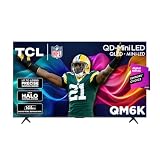
- TCL QM6K QD-MINI LED TV SERIES - AFFORDABLE PREMIUM PERFORMANCE FOR SPORTS, GAMING & STREAMING. Experience superior contrast, rich color, and ultra-smooth motion with TCL’s QD-Mini LED technology. Designed to outperform traditional QLED and OLED TVs, the QM6K is the best TV for every moment—whether you're streaming, gaming, or watching the big game.
- QD-MINI LED. IT’S MINI LED PLUS QLED COLOR - BREATHTAKING BRIGHTNESS AND COLOR IN ANY LIGHT. Combines ultra-precise Mini LEDs with Quantum Dot technology for incredible brightness, bold contrast, and over a billion vibrant colors.
- TCL HALO CONTROL SYSTEM - BETTER BLACKS. SHARPER DETAIL. NO BLOOMING. Advanced local dimming eliminates haloing, enhances shadow detail, and improves picture accuracy—so dark scenes look deeper, and bright scenes stay crisp.
- DOLBY VISION, HDR10+, HDR10 & HLG - STUNNING HDR IN EVERY FORMAT. Enjoy 4K content the way it was meant to be seen. Dynamic HDR support delivers exceptional color, contrast, and detail across all major formats.
- 144HZ NATIVE REFRESH RATE + MOTION RATE 480 - SMOOTH, FAST ACTION—PERFECT FOR LIVE SPORTS. Watch fast-paced action with incredible clarity and minimal motion blur—making this one of the best TVs for sports.
Troubleshooting common problems
Netflix is not in 4K despite a 120Hz TV
- The plan may not include Ultra HD.
- Playback quality may be restricted.
- Internet speed may be insufficient.
- The app or device may not be certified for Netflix 4K.
- An HDMI port or cable chain may lack HDCP 2.2 compatibility.
- A console may not be configured for 4K.
- An AV receiver, splitter, capture device or adapter may interrupt the HDCP/HDR chain.
- A PC browser or GPU path may have DRM or hardware-decoding limitations.
Use Netflix’s device requirements for Roku, PlayStation and Xbox to check the relevant chain.
Playback stutters at 120Hz
- Test the TV’s built-in Netflix app.
- Restart the TV and streaming device.
- Temporarily set the device output to 60Hz.
- On Windows, try Netflix’s recommended 120Hz-or-lower setting.
- Remove adapters, splitters, capture hardware and older AV receivers.
- Verify the HDMI port and cable.
- Update the app, operating system, firmware and GPU drivers.
- Test another title.
- If only one program is affected, report it through Netflix’s title-problem process.
General playback recovery guidance is also available at Netflix’s video troubleshooting page.
The TV reports 120Hz but motion is not smoother
The source may be 24fps or 30fps, the TV may be repeating rather than interpolating frames, motion smoothing may be disabled, the player may be outputting 60Hz, or a cinema/filmmaker mode may be active. None of those conditions indicates a faulty 120Hz panel or a hidden Netflix 120fps setting.
Should you buy a 120Hz TV for Netflix?
| Use case | Verdict |
|---|---|
| Netflix only on an already good 4K HDR TV | Usually not a decisive upgrade; Netflix does not double its frame rate on a 120Hz panel. |
| Netflix plus PlayStation 5, Xbox Series or PC gaming | Often worthwhile because 4K/120 gaming is a separate display feature. |
| Netflix plus sports | Potentially useful for 50/60fps cadence and optional motion processing, subject to artifact preference. |
| Film-focused home theater | Useful for even 24fps-to-120Hz cadence, without adding native frames. |
| Unreliable built-in Netflix app | Try a certified streaming player before replacing a competent TV. |
When comparing sets, look for a genuinely 120Hz panel, 4K resolution, the HDR formats you use, a Netflix-certified platform, suitable HDMI inputs and good 24fps handling. Do not justify the purchase solely with an HDMI 2.1 label.
What’s actually slowing this PC down?
Pick the symptom - the matching free tool is one click away.
Bottom line
Netflix works with many 120Hz-capable displays, but its public consumer documentation does not describe a normal 120fps streaming option. A 120Hz TV can improve cadence handling, support gaming and apply motion processing; it does not turn ordinary Netflix video into native 120fps content.
Quick Recap
Product prices and availability are accurate as of the date/time indicated and are subject to change. Any price and availability information displayed on Amazon at the time of purchase will apply.