Some links on this page are affiliate links: if you buy through them we may earn a commission, at no extra cost to you.
If “better” means closer to the source, quieter and more consistent, CD wins. If it means warmer, more tactile or simply more enjoyable to you, cassette can win on preference. Those are different judgments—and comparisons between formats are often really comparisons between different masterings, equipment and tape condition.
A cassette’s analog signal is not automatically more faithful because it is continuous. CD’s digital signal is not automatically harsh because it is sampled. The useful question is what each complete playback chain does to the music, and what kind of listening experience you want.
What “better” means
People use better to mean several things. Fidelity is how closely playback matches the source master. Pleasantness is whether you enjoy the sound. Warmth is a subjective impression often associated with softened treble, mild compression or harmonic coloration. And authenticity might mean hearing a period recording on the format and equipment associated with its era.
A format can be less accurate yet more appealing. Nostalgia, the feel of loading a tape, its artwork and side-by-side sequencing are also real parts of the experience; they simply are not measurements of fidelity.
#1 Best Overall
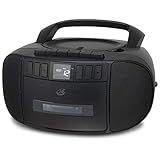
- CD & CASSETTE PLAYER: Enjoy your favorite CDs and cassette tapes in one compact boombox with built-in stereo speakers.
- RECORD TO CASSETTE: Record directly to cassette from the CD player or AM/FM radio and automatically stop the tape when it reaches the end.
- AM/FM RADIO: Tune in to your favorite local AM and FM stations with easy analog tuning and a telescoping antenna for FM reception.
- PRIVATE LISTENING: Connect your headphones through the built-in headphone jack when you want to listen without disturbing others.
- PROGRAMMABLE CD PLAYER: Customize your listening with programmable CD tracks, repeat options and an easy-to-read LCD display with white backlight.
The short technical comparison
| Trait | CD | Compact cassette |
|---|---|---|
| How it stores audio | 16-bit, 44.1 kHz PCM samples; a player converts them to an analog output | A magnetic pattern on moving tape, read by a playback head |
| Noise and dynamic range | Very low noise in a competent player; theoretical 16-bit dynamic-range estimates are roughly 96–98 dB, depending on convention | Audible tape hiss and substantially less usable dynamic range; performance varies with tape, deck and noise reduction |
| Frequency response | Designed for approximately 20 Hz–20 kHz audio | Varies with tape type, deck, alignment, recording level and condition |
| Speed stability | No tape-transport wow and flutter during normal playback | Mechanical speed variation can cause pitch wavering |
| Wear and maintenance | Optical playback avoids contact wear, though discs can be scratched, contaminated or otherwise damaged | Tape and transport are vulnerable to wear, damage and aging; decks may need service |
These are format-level tendencies, not a promise that every CD sounds good or every cassette sounds poor. A damaged disc, a bad master or a faulty player can undermine CD’s advantages; a carefully recorded tape played on a well-maintained deck can sound remarkably good.
What a CD does—and does not—do
Standard CD audio uses pulse-code modulation at 44,100 samples per second, with 16 bits per sample. At that sampling rate, the Nyquist frequency is 22.05 kHz; practical reconstruction filters preserve the intended audible band below the upper limit, roughly 20 kHz. The player’s digital-to-analog converter and output circuitry reconstruct an analog signal for your amplifier. You do not hear individual bits or a literal staircase.
Sixteen-bit audio has a theoretical dynamic range commonly described as about 96–98 dB, depending on the calculation convention. That is not the same as a guaranteed measured range for every player or recording. In ordinary competent playback, however, CD offers a low noise floor, stable pitch and predictable response without tape hiss or cumulative tape-to-tape generation loss. Error correction lets a player recover many read errors; severe disc damage can still cause interpolation, muting, skipping or other artifacts.
Rank #2

- VERSATILE MUSIC EXPERIENCE: Enjoy a stylish CD Cassette Player combo with 3W dual speakers for crisp, stereo sound. Play your favorite CDs and MP3/WMA files with ease, and customize your listening with song programming for CD and USB modes.
- BLUETOOTH + AUX: Not just a CD player, but a multi-functional music powerhouse. With Bluetooth 5.1, connect to your devices for seamless wireless streaming. Prefer a wired connection? Use the auxiliary input for direct playback from your phone. You can also plug in a USB drive to play your favorite tracks or audiobooks. The handy remote control lets you operate the cd player boombox from up to 20 feet away.
- CASSETTE PLAYER & AM/FM RADIO: Enjoy classic sounds with the built-in cassette tape deck, complete with recording functionality. Switch to AM/FM radio to catch your favorite talk shows, news, or sports broadcasts. Extend the antenna for enhanced reception and use the LCD screen for easy tuning. This radio cd player combo for home ensures you're never short of entertainment options.
- FLEXIBLE POWER OPTIONS: Power up your boombox CD player effortlessly with the included AC cable for indoor use, or switch to 6 C-size batteries for portable convenience during outdoor activities. A portable cassette player with a built-in handle, making it easy to take on the go. The earphone jack allows for a personalized listening experience anytime, anywhere.
- WORRY-FREE SUPPORT: This classic boombox with cd and cassette player makes a thoughtful gift for family and friends of all ages. With our 5-year coverage, and 24/7 customer support, you can purchase with confidence knowing we are committed to your satisfaction.
“Digital” does not mean “harsh.” A CD can sound fatiguing because of its mastering—aggressive compression, clipping or tonal choices—or because of a playback chain issue. Early or inexpensive players could also differ in their filters and analog output stages. Those are real caveats, but they do not show that sampling itself makes CD inaccurate. In a controlled AES study, Meyer and Moran reported that listeners in their blind tests did not detect a CD-standard 16-bit/44.1 kHz loop at normal-to-loud levels, with audibility reported only at very elevated levels. That study addresses a digital bottleneck, not a direct cassette-versus-CD contest. Research on high-resolution audio is not entirely uniform, and does not establish cassette as the more accurate format.
What happens on cassette
During recording, the audio signal is converted into a magnetic pattern on tape. The tape passes the head at about 4.76–4.8 cm per second. On playback, the head generates a small electrical signal, which is equalized and amplified; if noise reduction was used on the recording, compatible decoding is needed to restore the intended balance.
That compact, slow-moving tape has practical limits:
Rank #3
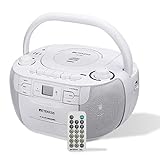
- Durable cd cassette player combo; plug in wall radio can be used anywhere in the home with power; cd cassette player am/fm radio powered by 6*D batteries; can be replaced at any time; no need to worry about power outage emergency; can no longer be used after the battery runs out during outdoor activities or travel; in long-term use; no need to replace the entire cd cassette player due to battery loss
- Versatile cd and cassette player combo; Retekess tr621 combines various playback options such as AM FM radio; cd; tape; TF card and USB; allowing you to switch freely between different music; perfect for those who cherish the nostalgia of tapes while enjoying modern audio options
- User-friendly design; portable cd player design is convenient; intuitive control; no composite buttons; large buttons can be easily used by the elderly and children; small remote control can switch music; control volume; perfect for putting in pocket when doing housework at home
- Cassette tape player offers a personalized programming and recording experience; you can program the order of cd music according to your preferences; You can also set different repeat play modes to enjoy your music; Using the recording function; you can diy your own tape box; making the experience rich and interesting
- Good sound experience; with its stereo function; boombox can provide beautiful and immersive sound when playing different types of music; at festivals; you can use cd cassette player plays pleasant atmosphere songs and can also show its powerful volume at various parties; It is also a good gift choice
- Hiss: the magnetic medium and electronics add broadband noise, most noticeable in quiet passages.
- Limited headroom: record too hot and the tape saturates and distorts; record too quietly and hiss becomes more prominent.
- Treble compromises: high frequencies are harder to record and reproduce at cassette speed, especially on ordinary tape or inexpensive transports.
- Wow and flutter: slow and fast speed fluctuations can make sustained vocals, piano and strings waver.
- Azimuth and alignment: a misaligned head can reduce treble and blur stereo precision.
- Dropouts and print-through: damage or defects can cause local signal loss; magnetic leakage between tape layers can create faint pre-echo or post-echo.
- Wear and copying: belts, pinch rollers, heads and other deck parts age. Copying tape to tape adds another generation of noise and loss.
Published specifications illustrate the gap but are not universal limits. Sony lists signal-to-noise ratios of 55 dB for Type I, 57 dB for Type II and 58 dB for Type IV on representative decks; one model’s listed frequency response reaches about 16, 17 and 19 kHz respectively under its stated conditions. TEAC specifies 30 Hz–15 kHz for Chrome tape and 30 Hz–13 kHz for Normal tape on the W-1200, plus 0.25% weighted RMS wow and flutter. Such figures depend on test conditions and equipment, so they should not be treated as a single performance ceiling for every cassette setup.
Recommended Free Tools
Tape type and Dolby settings matter
Type I (Normal/ferric) is widely compatible and common, but generally offers less treble performance and recording headroom than better formulations. Type II (Chrome/high-bias) can provide improved high-frequency performance and headroom. Type IV (Metal) can perform very well, but is scarce or costly and many modern decks do not record it. Type III (Ferrichrome) is a historical niche rather than a normal choice today.
Tape type alone does not determine the result. Tape condition, deck calibration, bias and equalization, recording level, head azimuth, transport speed and the quality of the original source all matter. A Type II cassette recorded on a poorly aligned deck can disappoint; a well-made Type I recording on a good deck can be enjoyable.
Rank #4

- Sleek Design for Boombox CD Player : You can enjoy your favorite collection of CDs or personally recorded CD-R and CD-RW discs with MP3 format on this CD player. Equipped with 3W dual speakers, it generates good sound for you to enjoy a smooth and stereo audio experience at home, kitchen, bedroom or outdoor. No matter uses this CD player boombox for entertaiment or study, it always a nice tool for you. Also, it supports programming songs under CD and USB modes.
- Fantastic Boombox Music Player : This CD palyer is also a boombox player that can play music by other 3 ways. With Bluetooth 5.1 version, it can connect your Bluetooth devices in less than 1 second or just use the auxiliary cord to connect your phone/computer to enjoy wired music. Besides, you even can plug in a USB drive loaded with your favorite songs or audiobooks to play. A remote control enables you to control this CD boombox from the distance up to 20 feet, no need to get close to use. (Do not support Bluetooth transmit)
- Cassette Player+AM/FM Radio : In addition to the traditional CD player, this boombox CD player adds with tape and radio functions. The Built-in cassette tape deck with recording function can meet those who have the habit of collecting tapes. At leisure,turn to the AM/FM mode that you can listen talk show,NFL,NPR,news on this cd boombox player.Pull out the antenna to enhance the reception and a LCD screen enables you to tune more visually and conveniently.A nice combo on this CD cassette player.
- Two Ways to Power : You can directly plug the AC cable in the wall to charge this CD player while you are indoor or in the kitchen; When you go out side or meet power outage, just insert 6*C size batteries into this cd boombox, then you can continue to enjoy your happy time. For more humanized design, a handle on this CD player boombox makes it excellent to take on the go and an earphone jack allows you to connect your earphones to it for a more personalized listening experience anytime.
- Ideal Gift + Worry Free : We devote to offer great CD player boombox to you and your love ones! As the appearance is classic, and the operation is simple without many composite button, it is an ideal gift for your parents, grandparents, kids, uncles, aunts and friends. Your voice drives us to be the best. We guarantee a 12-month warranty, 30-day money back and 24/7 customer service to make it no risk for you to purchase this CD and cassette player.
Dolby B, C and S are noise-reduction systems, not sound-quality grades. They reduce hiss by encoding selected high-frequency content during recording and applying complementary de-emphasis on playback. Use the corresponding playback setting: decoding a non-Dolby recording can make it dull, while playing a Dolby-encoded tape without decoding can sound too bright. Poor tracking, calibration or aging electronics can also cause tonal imbalance or pumping.
Independent reader supportYour contribution helps us test, update, and keep practical guides available for everyone.Why cassette can sound warmer
“Warmth” is not one measurable property. It can arise from tape saturation on peaks, mild harmonic distortion, compression-like behavior near the tape’s limits, softened high frequencies, crosstalk, or coloration in the playback head and amplifier. A little hiss or imperfect alignment may also change the impression. Some listeners like these effects; others hear lost detail, noise or instability.
PC Slower Than It Used to Be?
A free scan shows the junk files, broken settings and background clutter dragging Windows down - then fixes them in one click.Free scan · Windows 10 & 11Crashes, No Sound, or Screen Glitches?
Random freezes, missing sound and display glitches usually trace back to one bad driver. Find and replace yours safely.Free scan · under a minuteLevel matching matters too. Even a small loudness difference can make one source seem fuller or more exciting. Nostalgia and the ritual of handling a cassette can enhance enjoyment without being flaws in a listening experience. They just cannot establish that the cassette contains more accurate information.
Best Value
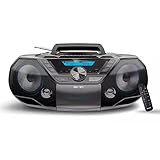
- ENHANCED STEREO SOUND: Our radio CD Player Boombox combo has dual stereo speakers housed in an optimized design and driven by the built-in bass reflex technology delivers a deep bass experience from a compact loudspeaker box system deliver an enjoyable listening experience.
- EASY TO USE: The simplistic, stylish design of this CD Player Boombox fits right in with your trendy home. With large control buttons and backlit LCD display, this easy-to-use compact CD player is a perfect choice of cd players for home, in the shop, or on the go.
- FM RADIO: The built-in FM tuner with digital tuning and 30 station presents makes it easy to listen to and save your favourite news, talk or music radio stations. The FM antenna has been upgraded for better reception.
- BLUETOOTH WIRELESS: Pair your phone/tablet or other Bluetooth devices to this portable Boombox CD Player with Bluetooth to wirelessly stream your favourite music and podcasts, with stable connection and extended wireless range enjoy this cd player portable with speakers anywhere.
- USB PLAYER: Our boom box Conveniently play MP3 or WMA music files recorded on your USB flash drives, with a maximum supported capacity upgraded to 128 GB (FAT32 format only, exFAT/NTFS not supported).
Why a CD can lose a comparison
The most important confound is often mastering. The cassette and CD may come from different mixes, source tapes or mastering decisions. A cassette from a dynamic, sympathetic master can be more pleasant than a heavily compressed, clipped CD. Conversely, a carefully mastered CD can sound more open and natural than a cheaply duplicated or worn cassette.
Commercial pre-recorded cassettes are not equivalent to a careful home recording. Some were duplicated at high speed, while a home recording on good Type II or Type IV tape, made on a calibrated deck, may perform better. And a modern cassette reissue may have been made from a digital master; the format label does not reveal the production chain. The same caution applies to CDs: a CD can be sourced from a digital remaster rather than an original analog master. Do not assume a release is all-analog unless its label documents that chain.
Other causes of an unfair comparison include a worn or misadjusted deck, incorrect Dolby decoding, the wrong tape setting, a scratched CD, a faulty analog output, or mismatched playback volumes. A portable cassette player may also be unable to show what a high-quality deck can do.
The Tool Desk
Outbyte PC Repair FREERepair Windows errors before they cause bigger problemsFix Now →Outbyte Driver Updater FREEScan for outdated or missing drivers - takes under a minuteDriver Scan →How to compare them fairly
- Choose the same album and, if possible, the same mastering. If the versions differ, you are comparing releases as well as formats.
- Match volume closely. A louder source often seems better even when it is not more faithful.
- Use a serviced cassette deck. Check transport speed, head alignment and tape condition; confirm the right tape type and Dolby setting.
- Listen to revealing passages. Quiet sections expose hiss; cymbals and ambience reveal treble changes; sustained notes expose pitch wavering; loud bass and transients can reveal distortion or saturation.
- Blind the comparison if you want to test preference. Switching without knowing which source is playing reduces expectation effects. It does not make ritual or nostalgia invalid; it separates those pleasures from a claim about sound accuracy.
Which should you choose?
| Your priority | Better default | Reason |
|---|---|---|
| Maximum fidelity and quiet listening | CD or lossless digital | Lower noise, stable speed and more predictable response |
| Warmth, coloration or making mixtapes | Cassette, if you enjoy its character | Tape can add a distinctive presentation and physical ritual |
| Collecting a particular release | Whichever version you value, after checking condition | Edition, artwork and availability may matter more than format |
| Repeated daily listening with minimal maintenance | CD or lossless digital | Less mechanical upkeep and no tape contact during playback |
| Preserving old recordings | A careful digital transfer, or a specialist transfer service | Playback quality and file preservation matter more than format loyalty |
| Period-authentic listening | Cassette | The format, hardware and handling are part of the experience |
For digitizing an irreplaceable cassette, a maintained deck and audio interface—or a specialist service that can explain its playback and transfer process—are more important than buying a generic “cassette-to-digital” gadget. Preserve an uncompressed WAV or lossless FLAC transfer, keep the original untouched, and make any cleaned-up listening copy separately. Digital transfer cannot restore information already lost to hiss, wear or poor alignment.
CD’s advantage is not that it is emotionally superior, nor that every CD release sounds wonderful. It is that the format is generally more accurate, quieter and more stable when the source and playback chain are competent. Cassette’s appeal is real, but it is an appeal to a particular sound and experience—not evidence that analog inherently preserves more musical information.
Quick Recap
Sources
- Society of Broadcast Engineers: Compact Disc audio fundamentals
- Audio Engineering Society: High-resolution audio and CD reference context
- Meyer and Moran, AES: CD-standard A/DA/A loop audibility study
- Sony TC-WE305 specifications; Sony TC-WE475 specifications
- TEAC W-1200 specifications
Product prices and availability are accurate as of the date/time indicated and are subject to change. Any price and availability information displayed on Amazon at the time of purchase will apply.

