Ralph Ellison’s “On Bird, Bird-Watching, and Jazz” is a 1962 cultural-critical essay about Charlie “Bird” Parker, bebop, and artistic identity: Ellison praises Parker’s extraordinary melodic invention while questioning the loneliness, self-destruction, and public mythology that American audiences attached to the jazz innovator.
Ellison’s subject is therefore larger than Parker’s biography. The essay asks how a musician becomes an individual, how audiences turn artists into symbols, and whether artistic freedom can survive when innovation is detached from tradition and communal life.
Key takeaways
- Ralph Ellison’s “On Bird, Bird-Watching, and Jazz” was first published in 1962 and later reprinted on pages 65–76 of Living with Music: Ralph Ellison’s Jazz Writings.
- “Bird” is Charlie Parker, the Kansas-born improviser whom the Library of Congress identifies as a major innovator of the bebop era.
- Ellison praises Parker’s melodic invention while criticizing the loneliness, self-pity, and destructive public mythology he hears surrounding Parker’s music.
- Ellison treats “Bird” as an achieved public identity shaped by musicians, audiences, critics, and cultural expectations—not simply as a nickname with a settled origin.
- The essay contrasts Parker’s rejection of the conventional entertainer’s role with Louis Armstrong’s theatrical performance persona without reducing Armstrong to a merely commercial musician.
- Ellison’s larger concern is how jazz musicians find individual freedom through discipline, tradition, ritual, and communal memory.
What is Ralph Ellison’s “On Bird, Bird-Watching, and Jazz” about?
“On Bird, Bird-Watching, and Jazz” is not a straightforward Charlie Parker biography. Ellison uses Parker to examine artistic identity, bebop, entertainment, racial and cultural expectations, and the danger of turning an artist’s suffering into an appealing public legend.
Ellison’s argument is deliberately double-edged. He recognizes Parker as a musician of extraordinary imagination, but he refuses to treat speed, rebellion, isolation, or self-destruction as proof of artistic authenticity. Parker’s music matters because of its invention; the “Bird” myth matters because it shows how American culture consumes and reshapes difficult artists.
#1 Best Overall

- 【Vintage Record Player】Bluetooth Input & AUX Audio input & RCA line-out & Headphone jack. 2 Built in stereo speakers,with Bluetooth wireless technology,elegantly listen to the music from your smart phone.Use Aux cable input to directly play the music. Or enjoy your time with headphone. For better or louder sound, connect external speaker via RCA cable.
- 【Belt Drive Vinyl Turntable】Easy to use, simple setup and operation. Great ideal for vinyl lovers. Three-speed Turntable (33, 45, 78 RPM) plays all of your 7" 10" 12" vinyl records.TIPS:When placing a 12-inch vinyl record on the turntable, gently tilt it toward the tonearm to ensure proper playback.
- 【Record Player Bluetooth】 Built-in Bluetooth receiver & 2 stereo speakers,,you can listen to your favorite music from your Bluetooth compatible device like smartphone with ease. Just Bluetooth in connect and play!
- 【Portable Record Player with Built in Speaker】It creates a warm atmosphere when family gatherings. When you are alone, it can help you relax. Even if you don't use it, it can be one of the home's premium decorations. As a gift, it also allows the recipient to feel your heart.
- 【Retro Vinyl Record Player】There is a removable cover on the top to protect vinyl and turntable plat. You can shut the cover shields and keep the dust out. And the beautiful textured exterior are a perfect fit for any environment.
The essay was first published in 1962. It was later included in Living with Music: Ralph Ellison’s Jazz Writings, a 2001 collection edited by Robert G. O’Meally. The Smithsonian Libraries and Archives record for Living with Music lists the collection’s jazz essays and its physical length of 290 pages; the essay occupies pages 65–76 according to the bibliographic record from the Jazzinstitut Darmstadt.
Who was Bird in Ralph Ellison’s essay?
Bird was Charlie “Bird” Parker, also known as “Yardbird,” the alto saxophonist whose improvisation helped change the course of jazz. The Library of Congress identifies Parker as a major improviser and musical innovator of the bop era. Parker was born in Kansas City, Kansas, on August 29, 1920, and died in New York on March 12, 1955.
Ellison is interested in what the name does, not only in where the nickname supposedly came from. “Bird” becomes a public identity produced through performance and reception. Other musicians, listeners, critics, and the entertainment industry all participate in making Parker legible as a particular kind of artist: fast, liberated, dangerous, elusive, and outside ordinary social rules.
That identity is therefore “achieved” rather than simply inherited. Parker’s music helped create the identity, but the identity also began to organize how audiences heard the music. The public could become more interested in the outlaw image than in the disciplined musical knowledge beneath the image.
What’s actually slowing this PC down?
Pick the symptom - the matching free tool is one click away.
What did Ellison admire about Charlie Parker’s music?
Ellison admired Parker’s capacity to invent melodies within demanding harmonic structures. Ellison calls Parker “a most inventive melodist” and, using a bird-watcher’s language, “a true songster.” The description is praise for musical intelligence, not just a colorful extension of Parker’s nickname; the reproduced essay passage is available in the published excerpt of Ellison’s essay.
Parker’s bebop was innovative partly because it did not mean abandoning everything that came before. A useful historical example is “Ko-Ko,” which the Library of Congress National Recording Preservation Board describes as a new “head” melody built over the chord progression of Ray Noble’s “Cherokee”. The example shows how bebop musicians could create intricate new melodic language over an existing harmonic framework.
That distinction is central to Ellison’s wider view of jazz. Improvisational freedom is not the same as musical or cultural rootlessness. A musician develops an individual voice through apprenticeship, technical command, inherited forms, shared memory, and interaction with other musicians. Innovation becomes more powerful—not less—when it remains connected to a living tradition.
Rank #2

- VINTAGE LOOKING&GREAT IDEA OPTIONS - As a music player combined age and modern sense, A vintage and fashion style record player is a great idea for your loving family and friends at all festivals. No matter to awake a good time in memory, start an elementary musical education, or just prepare a birthday surprise
- THREE SPEED THREE SIZES OPTIONS - Balanced tonearm with lifting arm control, support adjusting 3 listening speeds(33-1/3, 45 and 78 RPM) and playing 3 sizes(7'', 10'' and 12'') of records, let you enjoy your entire record collection
- WIRELESS INPUT PAIRING - Not only can play vinyl records to experience the retro-style music and atmosphere, but you can also play all your favorite music at any time via a Wireless connection, playing music from mobile phones or other audio devices
- BELT-DRIVEN ANTI-VIBRATION SYSTEM - The turntable base is equipped with a spring and belt-driven design to provide shock absorption and improve sound quality. An easily removable dust cover protects your vinyl records from damage
- BUILT-IN SPEAKER AND VERSATILE - Dynamic full range stereo speaker provide sound for daily leisure listening. Don't worry if you don't have extra speakers. Or your can connect to external powered speakers via RCA output to get better sound. AUX and BT playback is also a way to play music. All-in-one turntable - Easy to set up and use, suitable for beginners
Why is Ellison critical of Parker’s public myth?
Ellison’s criticism is aimed at the romanticization of Parker’s isolation and destructive reputation, not at Parker’s talent. A contemporary discussion of Ellison’s language reproduces this judgment: “For all its velocity, brilliance and imagination there is in [Charlie Parker’s music] a great deal of loneliness, self-depreciation and self-pity.” The quotation is Ellison’s interpretation, not a neutral consensus about Parker’s musicianship; the passage appears in Salon’s review of the Ellison material.
Quick wins for a faster PC:
Repair Windows errors before they cause bigger problemsFix Now →Fix the driver behind crashes, sound loss and screen glitchesFind Drivers →Clear out junk files and repair common Windows errorsFree Scan →Ellison sees a cultural trap in the myth. A largely white, sensation-seeking audience could treat Parker’s disorder as entertainment, converting private pain into a public spectacle. The audience might reject conventional respectability while still consuming the artist through the entertainment economy.
In this reading, Parker’s attempt to escape one imposed role— the smiling, accessible entertainer—can produce another role: the alienated genius whose chaos is part of the attraction. The “Bird” persona offers apparent freedom, but it can also imprison the artist inside expectations of danger, suffering, and permanent rebellion.
How does Ellison compare Charlie Parker and Louis Armstrong?
Ellison contrasts Parker’s rejection of the conventional entertainer’s role with Louis Armstrong’s theatrical and joking performance style. The contrast does not mean “Parker was authentic and Armstrong was commercial.” Ellison’s point is that Armstrong’s clowning was a performed role, while Parker and later bebop musicians sought status by refusing the inherited entertainer persona.
| Question | Charlie Parker in Ellison’s discussion | Louis Armstrong in the contrast |
|---|---|---|
| What public role is at issue? | Parker resists the expected role of the accessible, theatrical entertainer. | Armstrong openly performs a comic and theatrical entertainer role. |
| What does the role conceal? | Parker’s rebellion can conceal discipline, musical tradition, and communal formation. | Armstrong’s clowning can obscure the seriousness and mastery behind the performance. |
| What is the cultural paradox? | Rejecting entertainment does not remove Parker from the entertainment economy; his private disorder becomes part of the spectacle. | Performing entertainment does not prove that Armstrong lacks artistic depth or independence. |
| What does Ellison warn against? | Romanticizing isolation and self-destruction as the price of innovation. | Assuming visible theatricality is evidence of artistic shallowness. |
Armstrong therefore functions as more than Parker’s opposite. The comparison asks readers to notice that every public performance involves choices about identity, audience, dignity, and cultural expectation. A mask can be theatrical, rebellious, genial, or tragic; none of those surfaces by itself explains the music.
How does the essay connect jazz with identity and community?
Ellison connects jazz identity to a musician’s relationship with tradition and community. In Ellison’s wider jazz criticism, improvisation is freedom achieved through discipline: the player finds an individual voice by mastering a shared language rather than by pretending to have no history.
This framework explains why the essay praises Parker and questions the mythology around him at the same time. Parker’s melodic invention demonstrates extraordinary individual power. The surrounding legend, however, risks treating the individual as detached from apprenticeship, ritual, African American musical history, and the musicians who make improvisation possible.
Rank #3

- Exquisite Appearance, Built from wood and metal materials with a unique sense of layering, The streamlined corner design is truly atmospheric and stylish
- All in 1, This turntable spins at both 33 and 45 RPM speeds, the turntable’s speaker can play other devices’ music wirelessly or using the Aux-in port, and the built-in amplifier allows connection to your own externally powered speakers
- Magnet type Cartridge and Adjustable Counterweight, Essentials for any serious classic turntable, These work to balance each channel and produce rich and warm audio, releasing authentic sound so you can find freedom from noise and distortion
- Wireless Streaming, Pair and play music from all your favorite devices like iPhone and Android smartphones, tablets, PCs, usb mp3 players through the turntable’s speakers using Bluetooth connection
- Audio-Technica Stylus, The diamond-tipped Audio-Technica stylus cartridge is designed to produce rich sound and outstanding clarity, tracking your record’s grooves with precision for accurate, high-definition audio
Ellison’s concern is not that jazz must remain unchanged. Bebop itself represents transformation. The concern is whether transformation remains connected to cultural memory. Innovation can extend a tradition, while the commercial myth of the isolated genius can erase the tradition that made innovation possible.
Is “On Bird, Bird-Watching, and Jazz” a biography of Charlie Parker?
No. Ralph Ellison’s “On Bird, Bird-Watching, and Jazz” is a cultural-critical essay, not a comprehensive biography of Charlie Parker. The essay uses Parker’s music, nickname, public conduct, and reception to investigate artistic identity, entertainment, racialized cultural expectations, and the relationship between innovation and tradition.
Readers looking for Parker’s dates and place in bebop history can use the Library of Congress biography and recording-history material. Readers looking for Ellison’s interpretation should read the essay as an argument about what Parker came to signify in postwar American culture.
What should you listen to after reading Ellison on Bird?
Start with Charlie Parker’s recorded music, especially “Ko-Ko,” then listen for the relationship between melodic invention, harmonic structure, speed, and ensemble interaction. The Library of Congress account of “Ko-Ko” provides a useful entry point because it explains how Parker’s new melody works over “Cherokee.”
Listening should supplement Ellison’s interpretation rather than “prove” it. A recording presents sound; Ellison interprets the cultural meanings audiences attach to that sound. Pay attention to the difference between what Parker plays—the phrasing, rhythmic pressure, melodic design, and interaction—and what listeners may project onto Parker as “Bird.”
If you want a practical listening path, listen to Charlie Parker alongside recordings by Louis Armstrong and compare the public performance roles Ellison discusses. Availability of particular Parker recordings or collections depends on the listener’s country, service, and current catalog, so a current catalog check is necessary before recommending a specific platform or edition.
Do these 3 things before closing this tab:
1Clear out junk files and repair common Windows errors2Fix the driver behind crashes, sound loss and screen glitches3Repair Windows errors before they cause bigger problemsWhere can you read Ellison’s essay on Bird?
The most useful book-length source is Living with Music: Ralph Ellison’s Jazz Writings, edited by Robert G. O’Meally and published in 2001. The collection places “On Bird, Bird-Watching, and Jazz” alongside Ellison’s writing about Charlie Christian, Jimmy Rushing, Duke Ellington, Mahalia Jackson, the blues, and other subjects. The Smithsonian library catalog record confirms the collection’s title, editor, contents, and 2001 publication information.
Rank #4
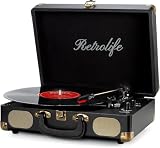
- 【Retrolife INDIVIDUAL SUITCASE RECORD PLAYER】A satisfying combo of modern and vintage elements. Black classic PU leather outlook with retro bronze metal screws and nets, you can take it everywhere with its solid handle. Be ready to create your own music memories
- 【FOUR AVAILABLE CONNECTION CHOICES】Music streaming digital audio via turntable built-in Bluetooth speakers. Hook up external speakers through RCA output or Aux-in line for non-Bluetooth devices like MP3. You can use your headphones to get private listening. Just seize the day with music
- 【THREE-SPEED & THREE-SIZES TURNTABLE】Support 3-Size of 7/10/12″records and 3-Speed of 33/45/78 RMP playing speeds. Belt-driven system matches technical Anti-Resonance design to achieve better sound quality to you
- 【NO EXTRA EQUIPMENT REQUIRED】Set up easily and get started in minutes. Ideal for beginners and vinyl enthusiasts to get your fun time. Suitable for your bedroom/living room/office thanks to the perfect size and premium sound quality
- 【USEFUL KNOBS INCLUDED】An Auto-stop switch that stops spinning once the record playing at the end of the record. Quick mode switch(Bluetooth/Aux-in/Phono) for your simple use. Great to use it when you need relaxation, party and gathering etc
Continue reading
Living with Music is the book containing Ellison’s essay on Bird. It is a collection of Ellison’s jazz criticism, not a standalone Charlie Parker biography, so it is the better choice for readers who want to place the Parker essay beside Ellison’s writing on other musicians and forms.
Because the essay appears within a collection, editions, pagination, and availability may vary by region and format. Library catalogs are the safest way to identify a local print or digital copy; current retail inventory and pricing require separate verification.
Frequently Asked Questions
Is “On Bird, Bird-Watching, and Jazz” a Charlie Parker biography?
No. Ralph Ellison’s “On Bird, Bird-Watching, and Jazz” is a cultural-critical interpretation of Charlie Parker, bebop, artistic identity, entertainment, and public mythology rather than a complete account of Parker’s life.
Windows Errors? Fix Them Before They Spread
Repair common Windows errors and clear accumulated junk for a smoother, more stable PC - no reinstall needed.Free scan · no reinstallOutdated Drivers Are Slowing You Down
One free scan finds every outdated or missing driver and matches the right update for your exact hardware.Free scan · exact hardware matchWho was Bird in Ralph Ellison’s essay?
“Bird” is Charlie Parker, the major bebop improviser and musical innovator. Ellison treats “Bird” as an achieved public identity shaped by Parker’s music and by the expectations of musicians, audiences, critics, and the entertainment industry.
What book contains Ellison’s essay on Charlie Parker?
The essay appears in Living with Music: Ralph Ellison’s Jazz Writings, a 2001 collection edited by Robert G. O’Meally. The essay was first published in 1962 and occupies pages 65–76 in the collection’s cited edition.
What did Ralph Ellison think of Charlie Parker?
Ellison praises Parker’s melodic inventiveness but criticizes the loneliness, self-pity, and destructive public mythology associated with Parker’s music. Ellison’s criticism targets the romanticization of chaos, not Parker’s musical talent.
The Bottom Line
Ralph Ellison’s “On Bird, Bird-Watching, and Jazz” praises Charlie Parker’s extraordinary invention while challenging the cultural myth that turns isolation and self-destruction into artistic virtue. Ellison’s Parker is both a brilliant improviser and a public construction: “Bird” represents freedom, but also the danger of severing individual identity from tradition, community, and historical memory.
Quick Recap
Product prices and availability are accurate as of the date/time indicated and are subject to change. Any price and availability information displayed on Amazon at the time of purchase will apply.