Recommended Free Tools
There is no single worldwide dragon species. The European fire-breathing beast, the Chinese rain-bringing lóng, the Indian nāga, the Egyptian chaos-serpent Apep, and the Mesoamerican Feathered Serpent belong to different religious and artistic traditions.
In this article, types means recurring cultural forms and named dragon traditions—not a universal zoological classification. Some are winged monsters, some are sacred water beings, and some are enormous serpents that modern writers group with dragons because of their scale, power, or symbolic role.
Quick answer: the twelve most useful dragon traditions to know are the European fire-breathing dragon, wyvern, lindworm, Chinese lóng, Japanese ryū or tatsu, Indian nāga, Mesopotamian mušḫuššu, Tiamat, Egyptian Apep, Norse Jörmungandr, Quetzalcoatl, and Yamata-no-Orochi.
They should not all be imagined as variations of the modern fantasy dragon. A Western dragon is often an enemy to be defeated; an East Asian dragon may be a powerful controller of rain; a nāga may guard sacred water; and Quetzalcoatl is more accurately called a Feathered Serpent than an Aztec dragon. The word dragon is a useful comparative label, but each tradition needs to be understood on its own terms.
#1 Best Overall

- 【Collectible Figurines】It shows a silvery dragon,spread the wings,perched atop an rocky,which designed with faux sparkling crystal that make it looks like real crystal, full of wealthy but dangerous. The powerful dragon protects its crystal cavern comes with an automatic changing LED light through several different colors
- 【High quality】Dragon light statue with LED measures approx 6.1W x 3.35"D x 7.5"H, Weights about 2 lbs. Use 2 LR44 Battery (included). Pull out the plastic sheet from the battery shell on the bottom before use
- 【Dragon Themed Gifts】It is a admirable creative giving on Halloween, Birthdays, Souvenirs, New year, Valentine's Day, Thanksgiving, Christmas & Housewarming, Theme Party. Awesomely art collection for a friend or family member that loves dragons
- 【Statues for Home Decor】This Modern Gothic Dragon figurine is a indoor and outdoor table decor to display in your home, shelf, office, mantel,desk, library, yard, adds a ghostly and horror feel to any setting. Turn off the lights and see the full light-up scene
- 【Perfect Service】HMUSNWOL dragon statues are professionally tested before they are shipped out from the factory.It arrive in a beautiful gift box and wrapped in foam to protect the sculpture, We are dedicated to provide customers with high quality products through constantly improvement.If you have any problems,please send us an email and we will give you a satisfactory answer as soon as possible
Dragon types at a glance
| Tradition | Typical form | Common associations | How firmly it fits the word dragon |
|---|---|---|---|
| European fire-breathing dragon | Large scaled beast, often winged and four-legged | Sin, danger, treasure, heroic defeat | Directly fits the familiar Western image |
| Wyvern | Two legs, wings, long tail | Heraldry and medieval or later art | A European visual convention |
| Lindworm | Long, snake-like body with few or no legs | Northern and central European folklore | A variable regional form |
| Chinese lóng | Serpentine, clawed, four-legged creature | Rain, water, imperial power, good fortune | A distinct East Asian dragon tradition |
| Japanese ryū or tatsu | Serpentine, horned, whiskered, clawed | Water, rainfall, religious and artistic power | A Japanese dragon tradition related to East Asian forms |
| Indian nāga | Serpent or serpent-human being | Water, fertility, guardianship, sacred power | A broad class of serpent beings |
| Mušḫuššu | Composite snake-dragon | Babylonian art and symbolic power | An ancient Near Eastern dragon-like creature |
| Tiamat | Primordial sea and chaos being; later often dragon-like | Salt water, creation, chaos | A dragon interpretation, not a fixed ancient appearance |
| Apep or Apophis | Gigantic serpent | Chaos and opposition to the sun god Ra | More precisely an Egyptian chaos-serpent |
| Jörmungandr | World-encircling sea serpent | Poison, ocean, Thor, Ragnarök | A dragon analogue rather than a winged dragon |
| Quetzalcoatl | Feathered serpent | Cosmic movement, divinity, culture | Better called a Feathered Serpent |
| Yamata-no-Orochi | Eight-headed, eight-tailed serpent | Storms, water, Susanoo, Kusanagi | A serpent frequently rendered as dragon-like |
1. The European fire-breathing dragon
The classic European dragon is usually portrayed as a large reptilian or serpentine monster with scales, claws, wings, and—especially in its modern popular form—the ability to breathe fire. It is the image most people picture when they hear the word dragon: a dangerous creature guarding a hoard, terrorizing a community, or waiting for a saint or hero to defeat it.
Medieval evidence is more varied than that modern image suggests. Discussions of medieval bestiaries by the Metropolitan Museum of Art describe the dragon as a powerful serpent whose strength lies in its tail and its ability to constrict. The British Museum summarizes the later familiar European image as a winged, fire-breathing beast. In other words, fire is central to the popular Western dragon, but it should not be projected backward onto every medieval description or outward onto dragon traditions from other cultures.
Christian medieval symbolism often made the dragon an embodiment of the Devil, sin, or disorder. Stories in which a saint or knight overcomes a dragon therefore worked as more than monster adventures: they dramatized the triumph of religious or moral order over a threatening force. The same tradition also helped establish the dragon as a symbol of danger and power in European art.
Key distinction: this is a cultural image, not evidence that medieval Europeans believed in a standardized biological species. Its appearance changed across texts, manuscripts, sculpture, heraldry, and later fiction.
2. The wyvern
A wyvern is a recognizable European dragon form with two legs, wings, and a long serpentine tail. By contrast, the four-legged Western dragon is often drawn with separate forelegs and wings. That difference makes the wyvern easy to identify in heraldry and medieval or later artistic designs.
The distinction should not be treated as an ancient worldwide rule. A medieval bestiary object discussed by the Metropolitan Museum of Art describes a two-footed dragon as a wyvern, showing that the word reflects a particular visual convention. The categories were not necessarily used with complete consistency across every period or region, and modern fantasy art has often turned the difference into a more rigid taxonomy than historical sources support.
Wyverns are therefore best understood as a European artistic and heraldic type, not as a separate animal species that all medieval writers carefully distinguished from dragons. Their two-legged anatomy is the defining shortcut, while their symbolism depends on the particular image or story.
3. The lindworm
The lindworm is a serpentine dragon tradition associated especially with northern and central European folklore and visual culture. It is generally imagined with a long, snake-like body and fewer limbs than the standard winged, four-legged dragon. Some representations give it legs; others make it nearly or entirely legless.
Quick wins for a faster PC:
Clear out junk files and repair common Windows errorsFree Scan →Scan for outdated or missing drivers - takes under a minuteDriver Scan →Unlike the wyvern distinction, which is often presented as a simple anatomy lesson, lindworm has carried different meanings in different regional traditions and later retellings. Modern fantasy classifications sometimes use it as a precise label for a legless or semi-legged dragon, but historical usage was less uniform.
The safest explanation is to call the lindworm a regional serpentine dragon form. Its elongated body connects it visually with giant snakes and other dragon-like beings, while its European folklore setting separates it from the East Asian water dragon or the ancient Egyptian chaos-serpent.
Rank #2

- A Touch of Magic for Your Shelf: This statue captures a feisty golden hatchling in a deep slumber. With its tail curled and wings tucked in, it brings a peaceful yet mystical vibe to your library. It represents the quiet power of a dragon waiting to grow—a perfect emotional symbol for any fantasy fan
- Designed for Book Stacks: Looking for the perfect bookshelf decor? As shown in the photos, this dragon’s curled posture allows it to rest naturally on top of horizontal book stacks. It acts as a stunning centerpiece for your "Romantasy" collection or a prop for aesthetic BookTok photos
- Premium Antique Finish: Crafted with a brushed antique gold/bronze look, this isn't a shiny, cheap plastic toy. The hand-painted finish highlights every scale and claw, giving it the texture of a discovered artifact. It blends beautifully with leather-bound books and wooden shelves
- The Ultimate Gift for Fantasy Lovers: Whether they are writers, D&D players, or Romantasy readers, they will love this "Golden One." Each dragon is packed in a custom-fit polyfoam mold inside a sturdy box, ensuring its delicate wings arrive safely. It’s a gift that feels like part of their favorite story
- Compact & Surface-Safe: Sized at 4.7"L x 2.4"W x 3.9"H, it fits easily on narrow shelves, nightstands, or crowded desks. The base features 4 soft protective pads, so you can place it directly on your precious book covers or furniture without worrying about scratches
4. The Chinese lóng
The Chinese lóng, commonly translated as dragon, is typically a long, serpentine, clawed creature associated with rain, water, cosmic power, imperial authority, achievement, and good fortune. It may have a serpentine body, four legs, horns, whiskers, and other animal-like features rather than the compact, winged anatomy of a European dragon.
In this tradition, the dragon is often not a monster whose defeat restores social order. It can be an auspicious and authoritative power connected with the natural world. Control over rain and water made the dragon especially important in an agricultural society, while its association with imperial authority placed it prominently in courtly art.
British Museum material describes Chinese dragons as snake-like, four-legged beings symbolizing imperial power, achievement, and good fortune. Metropolitan Museum collections document dragon imagery on imperial robes, rank badges, lacquer, ceramics, and other objects connected with court culture. These contexts matter: a dragon embroidered on an imperial garment is not simply a decorative version of a European dungeon monster. It communicates rank, cosmic legitimacy, and favorable power.
Key distinction: the Chinese dragon is often a ruler of elemental forces and a symbol of auspicious authority, not primarily an embodiment of evil.
5. The Japanese ryū or tatsu
Japanese dragons, commonly called ryū or tatsu, are closely related to wider East Asian dragon traditions but developed distinctive Japanese religious and artistic contexts. They are generally serpentine water beings, often depicted with horns, whiskers, and clawed feet. The British Museum describes them as deities associated with water and rainfall.
Japanese dragon imagery can therefore represent an elemental or sacred force rather than a creature that exists mainly to be slain. Water, storms, rivers, seas, and rainfall provide the setting for many dragon associations. Artistic representations may emphasize the creature’s movement through clouds or waves, reinforcing its connection with weather and the natural world.
What’s actually slowing this PC down?
Pick the symptom - the matching free tool is one click away.
Japanese mythology also contains hostile serpent-monsters that should not automatically be treated as the same thing as a benevolent water dragon. The most important example is Yamata-no-Orochi, discussed below. Later art can render that being in the form of an orthodox dragon, but its role and story are distinct from the broader Japanese water-dragon tradition.
Key distinction: ryū or tatsu refers to a Japanese dragon tradition, while Yamata-no-Orochi is a specific eight-headed serpent whose dragon-like appearance is partly an artistic interpretation.
6. The Indian nāga
Nāgas are serpent or serpent-dragon beings in South Asian religious traditions. The term is best understood as a broad class rather than the name of one individual dragon. Depending on the text and tradition, a nāga may be connected with water, subterranean realms, fertility, guardianship, royalty, danger, or sacred and spiritual power.
Nāgas can be represented as snakes, multi-headed serpents, serpent-human figures, or beings that combine human and reptilian characteristics. Their presence around water and underground realms links them with hidden power and fertility, while their role as guardians gives them a protective dimension. They are not reducible to either a purely benevolent spirit or a purely evil monster.
The Tool Desk
Outbyte PC Repair FREERepair Windows errors before they cause bigger problemsFix Now →Outbyte Driver Updater FREEScan for outdated or missing drivers - takes under a minuteDriver Scan →Rank #3

- Just The Right Size: Our desk figurines measure 6"H to make sure they are not too big yet easily noticeable making them ideal for decorating your tabletops, desks, shelves, counters, and more to add more personality and charm to your decor
- Elevate Your Decor: We combine quality craftsmanship with unique designs to bring you figurines that will help you add a touch of your own personality to your decor while being a breeze to coordinate with the rest of your decorations
- Quality That Matters: The figurines are made with close attention to even the smallest details using quality polyresin material which coupled with our unique and eye catching design provides just the right fit for any room in your home or office
- Expand Your Collection: Our meticulously crafted collectibles make a charming addition to your figure collection or can simply be used as bedroom, bathroom, kitchen, or living room decorations to brighten up the look of your space and impress guests
- PERFECT GIFTS FOR ALL — This Dragon Statue Sculpture Craft is a perfect gift for any occasion such as birthday, Christmas, Mother's Day or Father's Day, Easter, Thanksgiving, weddings, Valentine's Day, New Year's, graduation, etc.
The tradition also has an important history of religious influence. British Museum exhibition material notes that Buddhist Dragon Kings derive from earlier Indian serpent deities. This helps explain why dragon imagery in later Buddhist and East Asian contexts can carry ideas inherited from serpent guardians and water beings rather than from the European fire-breathing monster.
Key distinction: translating nāga as dragon can be useful for comparison, but serpent deity or serpent being is often more precise.
7. The Mesopotamian mušḫuššu
The mušḫuššu, often translated or described as a snake-dragon, is a composite creature associated especially with ancient Babylonian visual culture. Rather than looking like a naturalistic oversized lizard, it combines reptilian, feline, and other animal features into a symbolic body.
That composite design is significant. Ancient Near Eastern monster imagery often communicated power through the combination of characteristics drawn from several animals. The mušḫuššu is therefore not simply an early version of a European fire-breather. Its identity comes from its place in Mesopotamian art, its unusual anatomy, and the symbolic authority invested in it.
British Museum collections include Mesopotamian dragon and serpent-dragon imagery, while scholarship on the Ishtar Gate and related Babylonian traditions identifies the mušḫuššu as a major ancient Near Eastern dragon-like form. It is a useful reminder that “dragon” can describe a composite guardian or emblem just as readily as a flying monster.
Key distinction: the mušḫuššu is an ancient composite symbol, not a standardized fire-breathing reptile.
8. Tiamat
Tiamat is a primordial goddess associated with salt water and chaos in the Babylonian creation epic Enuma Elish. Modern retellings frequently call her a dragon or sea dragon because she is a vast, threatening force of primordial waters who opposes the younger gods. That label is understandable, but it needs a historical qualification.
The surviving evidence does not establish one standardized ancient dragon appearance for Tiamat. The British Museum identifies a Neo-Assyrian seal as possibly depicting Tiamat, explicitly marking the identification as uncertain. Recent scholarly summaries likewise caution that no definitive ancient iconography of Tiamat as a dragon survives.
Consequently, Tiamat belongs on a list of dragon traditions as an important dragon interpretation, not as an unquestioned ancient portrait of a creature everyone recognized as a dragon. She is more securely understood through her role as a primordial salt-water power and embodiment of chaos.
Key distinction: calling Tiamat a dragon is a later comparative and artistic convention grounded in her sea-monster and chaos role; it is not the same as saying that ancient Babylonian sources preserve one universally agreed dragon design.
Rank #4
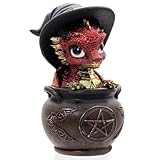
- 【Artisan Craftsmanship】 Every dragon figurine is carefully sculpted by experienced artisans. From its expressive face to the finely curved wings, each detail is hand-finished to create a unique, high-quality collectible that brings warmth and charm to any setting.
- 【Whimsical Fantasy Dragon Design】 This adorable mini dragon wears a tiny witch hat and peeks from a mystical cauldron with Celtic symbols and a pentagram—perfect for lovers of fantasy décor and witchy charm.
- 【A Thoughtful and Meaningful Gift】 Perfect for gifts for birthdays, anniversaries, Christmas, graduations or any other special moments in life. It’s a heartfelt gift for lovers, friends, coworkers, or anyone who you cherish in life that could use a little extra encouragement.
- 【Perfect Size for Bookshelf and Desktop Decor】 At just 4.7 inches tall, this dragon figurine fits perfectly on bookshelves, office desks, nightstands, or any small space that could use a touch of magic. It brings personality and calm to your favorite corners.
- 【Collectible Quality That Lasts】 Crafted from high-quality resin, this figurine is made to be cherished. Durable, detailed, and emotionally meaningful—it’s more than décor, it’s a piece of art you’ll want to keep for years to come.
9. The Egyptian Apep or Apophis
Apep, also called Apophis, is the great serpent who threatens the solar god Ra during Ra’s nightly journey through the Egyptian underworld. Apep represents chaos and the forces opposed to cosmic order. The struggle is not simply a battle between two animals: it is a recurring confrontation between the forces that endanger the ordered cosmos and the power that sustains it.
Modern comparative mythology often groups Apep with dragons because he is gigantic, supernatural, serpentine, and a cosmic adversary. Yet chaos-serpent is the more precise description. Ancient Egyptians did not need to use the same category as medieval European writers for the comparison to be meaningful.
Free tools Windows power users keep installed
One-click scans. No signup required.
Apep shows why a list of dragon types should include some beings that are not literally called dragons in their original cultural setting. The comparison helps readers see a shared narrative function—an enormous serpent threatening cosmic order—while the qualification preserves the distinct Egyptian religious context.
10. The Norse Jörmungandr
Jörmungandr, the Midgard Serpent, is a gigantic serpent in Norse mythology. According to the surviving mythic tradition, Odin casts it into the sea, where it grows until it encircles Midgard, the human world. Its immense size gives it a world-enclosing role rather than the anatomy of a winged European dragon.
Jörmungandr is a principal adversary of Thor and belongs especially to the Ragnarök cycle. At the end of the mythic sequence, Thor kills the serpent but is himself overcome by its poison, so the final encounter is fatal to both. The serpent’s oceanic setting, poison, enormous scale, and apocalyptic significance make it one of mythology’s clearest dragon analogues.
It is still more accurate to call Jörmungandr a world-encircling serpent than to picture it as a fire-breathing dragon. Its power comes from cosmic scale and poisonous opposition, not wings, claws, or flames.
Do these 3 things before closing this tab:
1Repair Windows errors before they cause bigger problems2Fix the driver behind crashes, sound loss and screen glitches3Clear out junk files and repair common Windows errors11. Quetzalcoatl, the Feathered Serpent
Quetzalcoatl is the Nahuatl Feathered Serpent, a major Mesoamerican deity and cultural figure. The name combines quetzal, associated with brilliant bird plumage, and coatl, meaning serpent. The resulting image joins an earthly snake body with celestial feathers.
This combination is not a minor decorative variation. It expresses movement between different cosmic levels: the serpent represents the earthbound or terrestrial dimension, while the feathers connect the being with the sky. Related Feathered Serpent traditions appear across Mesoamerica, although the names, stories, and local meanings are not automatically identical.
Quetzalcoatl is sometimes casually called an Aztec dragon for the benefit of modern audiences, but that translation loses the distinctive symbolism. Feathered Serpent is more accurate and preserves the religious meaning of the form. Quetzalcoatl is a deity and cultural figure, not simply a monster with wings.
Key distinction: the feathers do not turn a conventional snake into a European dragon; they create a specifically Mesoamerican union of serpent and bird imagery.
Crashes, No Sound, or Screen Glitches?
Random freezes, missing sound and display glitches usually trace back to one bad driver. Find and replace yours safely.Free scan · under a minuteWindows Errors? Fix Them Before They Spread
Repair common Windows errors and clear accumulated junk for a smoother, more stable PC - no reinstall needed.Free scan · no reinstallBest Value

- [ SCROLL DOWN TO SEE OUR PRODUCT PAGE FOR MORE SELECTION ] Immerse yourself in the world of exquisite home decor as we present our meticulously curated figurine collection. Every piece is a testament to superior craftsmanship and original design, empowering you to redefine your living spaces. With these unique creations, your home becomes a canvas for self-expression effortlessly. Moreover, their adaptability seamlessly blends with your existing decor, ensuring a harmonious and visually appealing atmosphere that speaks volumes about your refined taste.
- [ SCROLL DOWN TO SEE OUR PRODUCT PAGE FOR MORE SELECTION ] Our collection of home decor collectible figurines exemplifies the pursuit of perfection, leaving no detail unattended. Crafted from premium polyresin material, these pieces showcase a dedication to quality that resonates in their smallest intricacies. This devotion to excellence, coupled with our captivating and exclusive designs, guarantees that each figurine becomes an exquisite addition to any room, effortlessly complementing your surroundings. From the meticulous features to the overall visual allure, our figurines encapsulate a blend of quality and style that elevates your decor to unparalleled heights.
- [ SEARCH ICE ARMOR STATUE/FURNITURE/WIND CHIME TO SEE OUR FULL CATALOG ] Discover the allure of our meticulously sculpted figurine collectibles, destined to grace your cherished collection with newfound charm. Alternatively, these captivating pieces effortlessly transform bedrooms, bathrooms, kitchens, and living rooms into captivating realms, infusing your space with an enchanting touch. Prepare to leave a lasting impression on your guests with these luminous pieces that radiate brightness and character, making an indelible mark on your environment.
- [ DETAILED CRAFTMANSHIP WITH EXTRA PROTECTION ON EACH PACKAGE ] Behold the epitome of carefully crafted artistry in our Statue Sculpture Craft, an impeccable gift choice for any occasion. Whether it's a birthday, Christmas, Mother's Day, Father's Day, Easter, Thanksgiving, wedding, Valentine's Day, New Year's, or a graduation, this creation holds universal appeal. It resonates with statue aficionados, nature lovers, couples, parents, and more, offering a thoughtful embodiment of craftsmanship. Its timeless charm and adaptability bring joy and appreciation to your loved ones' hearts, making any special day truly unforgettable.
- 5.5"H [ SCROLL DOWN TO SEE OUR PRODUCT PAGE FOR MORE SELECTION ] Perfectly Proportioned: Our thoughtfully designed figurines stand at a delightful perfect size , ensuring they strike the ideal balance between being noticeable and not overpowering. Their compact size makes them perfect for embellishing tabletops, desks, shelves, counters, and various other spaces , infusing your decor with an extra touch of personality and undeniable charm.
12. Yamata-no-Orochi
Yamata-no-Orochi is an eight-headed, eight-tailed serpent from Japanese mythology. The storm deity Susanoo defeats it, and the encounter leads to the discovery of the sword Kusanagi, one of Japan’s imperial regalia. The story is recorded in the Kojiki and Nihon shoki.
Fundamentally, Yamata-no-Orochi is a gigantic serpent rather than a standard Japanese dragon. However, later Japanese art can render it as an orthodox dragon emerging from stormy water. The British Museum’s account of a nineteenth-century painting makes this interpretive choice especially clear: the artist depicts the mythic serpent in a dragon-like form.
This is an important distinction for reading mythological art. An artist’s dragon-shaped depiction does not necessarily prove that the earliest version of the story described a dragon in the modern sense. Yamata-no-Orochi belongs on this list because it is a powerful serpent tradition that has been represented through dragon imagery, not because it fits a universal dragon anatomy.
Why dragons look so different across cultures
The recurring dragon image is flexible because it combines several powerful symbols:
- Serpents: long bodies, hidden movement, danger, renewal, and the ability to inhabit earth or water.
- Birds and wings: access to the sky, storms, transcendence, and movement between worlds.
- Water: rain, fertility, rivers, oceans, hidden wealth, and destructive floods.
- Composite anatomy: the combination of powerful animals into one symbolic being, as with the mušḫuššu.
- Cosmic opposition: a monster or serpent that represents chaos, darkness, or threats to the ordered universe.
- Authority: imperial power, sacred guardianship, royal status, or control over natural forces.
These themes overlap, but overlap does not prove that every dragon story came from one original myth or one remembered animal. Similar images can arise because snakes, storms, water, predators, and the unknown are powerful subjects in many societies. Cultural contact and artistic exchange also matter in particular historical cases, but they should be demonstrated rather than assumed.
Dragon, serpent, or dragon-like being?
A careful comparison uses the original tradition’s own terms before applying the English word dragon. The following distinctions prevent the most common misunderstandings:
- The European dragon is the closest match for the familiar winged, fire-breathing monster, but even European sources vary.
- A wyvern and lindworm are useful European labels for recurring visual or folkloric forms, not universally standardized medieval species.
- The Chinese lóng and Japanese ryū or tatsu are genuine dragon traditions, but their links with water, rain, authority, and auspicious power often matter more than fire-breathing.
- A nāga is a broad family of serpent beings, not one individual dragon.
- The mušḫuššu is a composite Mesopotamian snake-dragon represented in art.
- Tiamat is a primordial salt-water and chaos being whose dragon appearance is not securely standardized in ancient evidence.
- Apep, Jörmungandr, and Yamata-no-Orochi are enormous serpents that modern readers may compare with dragons, but their original identities are more specific.
- Quetzalcoatl is best translated and explained as the Feathered Serpent, not simply as an Aztec dragon.
How to recognize the major traditions
- Look first at the body. Wings and four legs suggest the familiar European form; two legs and wings suggest a wyvern; a long, nearly legless body suggests a lindworm or giant serpent.
- Look at the element. Rain, rivers, clouds, and oceans point toward Chinese or Japanese dragon traditions, while salt water and primordial chaos point toward Tiamat.
- Look at the religious role. A sacred guardian may be a nāga; an imperial emblem may be a Chinese dragon; an enemy of cosmic order may be Apep.
- Check whether the being is a named figure or a broad class. Tiamat, Jörmungandr, Quetzalcoatl, and Yamata-no-Orochi are named beings. Nāgas are a broad category, while wyvern and lindworm describe recurring European forms.
- Separate original text from later art. Yamata-no-Orochi’s dragon-like depiction and Tiamat’s familiar dragon form demonstrate why an image from a later period cannot automatically be treated as the earliest description.
Sources and historical framing
This comparison draws on material from the Metropolitan Museum of Art and the British Museum, including discussions of medieval bestiaries, European dragon imagery, Chinese and Japanese dragons, Buddhist Dragon Kings, Mesopotamian serpent-dragons, Egyptian and Near Eastern serpent traditions, Mesoamerican Feathered Serpent imagery, and Japanese representations of Yamata-no-Orochi. The evidence is presented with qualifications where a modern dragon label does not exactly match the original cultural category.
Frequently Asked Questions
Are all dragons from different cultures related to one original myth?
No single worldwide dragon ancestor has been established by the evidence summarized here. Different societies developed their own serpent, monster, deity, water, storm, and chaos traditions. Cultural contact may explain particular similarities, but it should not be assumed for every dragon image.
Which type of dragon breathes fire?
Fire-breathing is especially central to the familiar European dragon in later popular imagery. It is not a universal feature of dragons. Chinese and Japanese dragons are commonly associated with water and rain, while figures such as Apep, Jörmungandr, and Yamata-no-Orochi are fundamentally serpentine beings.
Is Tiamat really a dragon?
Tiamat is a primordial Babylonian goddess associated with salt water and chaos. Later representations and retellings often depict her as a dragon or sea serpent, but no single standardized ancient dragon appearance is securely established. Calling her a dragon is best treated as a comparative or later interpretive convention.
Is Quetzalcoatl an Aztec dragon?
Quetzalcoatl is more accurately called the Nahuatl Feathered Serpent. The name combines bird plumage associated with the quetzal and the word for serpent. Calling the figure simply a dragon obscures the distinctive Mesoamerican religious symbolism.
What is the difference between a dragon and a wyvern?
In the common European artistic distinction, a wyvern has two legs, wings, and a long tail, while a conventional Western dragon has four legs as well as wings. The distinction is useful for describing later art and heraldry, but it was not a universally fixed biological classification in medieval Europe.
The Bottom Line
The biggest mistake is assuming that every dragon should look like the European fantasy archetype. A Chinese lóng may govern rain, a Japanese ryū may inhabit water, a nāga may guard sacred realms, Tiamat may embody primordial chaos, and Quetzalcoatl may unite serpent and bird symbolism. Dragon works best as a comparative umbrella term—as long as each tradition is explained in its own cultural and historical context.
Quick Recap
Product prices and availability are accurate as of the date/time indicated and are subject to change. Any price and availability information displayed on Amazon at the time of purchase will apply.