Windows Errors? Fix Them Before They Spread
Repair common Windows errors and clear accumulated junk for a smoother, more stable PC - no reinstall needed.Free scan · no reinstallOutdated Drivers Are Slowing You Down
One free scan finds every outdated or missing driver and matches the right update for your exact hardware.Free scan · exact hardware matchWitchboard (2025) reworks the spirit-board premise of Kevin Tenney’s 1986 horror film, but Chuck Russell chose expansion over close imitation. That choice raises a useful question—not whether the new film obeys some official remake rule, but whether its new mythology and plot preserve what made the original worth revisiting.
What is Witchboard (2025) about?
The 2025 film follows a young woman who uncovers an ancient spirit board. After she encounters it, people around her begin dying, leaving her friends to face the curse. The film’s official FAQ places the story in New Orleans and describes the board as awakening dark forces that pull a young couple into possession, deception, and supernatural terror. Chuck Russell directed and co-wrote the film with Greg McKay.
![Universal Classic Monsters 6-Movie Collection (Dracula / Frankenstein / The Bride of Frankenstein / The Wolf Man / The Invisible Man / The Mummy) [DVD]](https://m.media-amazon.com/images/I/51uo3RNHn-L._SL160_.jpg)
![Boris Karloff & Bela Lugosi 4-Movie Horror Collection [DVD]](https://m.media-amazon.com/images/I/51M7T3p2p7L._SL160_.jpg)
![The Classic Sci-Fi Ultimate Collection: Volume 1 (Tarantula / The Mole People / The Incredible Shrinking Man / The Monolith Monsters / Monster on the Campus) [DVD]](https://m.media-amazon.com/images/I/51Et9wCMyNL._SL160_.jpg)
Madison Iseman, Aaron Dominguez, Melanie Jarnson, Charlie Tahan, Antonia Desplat, and Jamie Campbell Bower are among the cast. Bloody Disgusting reported an R rating and a Paramount digital release beginning September 16, 2025; that dated release report does not establish where the film can be watched now.
How closely does the remake follow the 1986 film?
The 2025 Witchboard is best understood as a reimagining or loose remake, not a scene-for-scene reproduction. Both films take their identity from a spirit board and the supernatural danger attached to it, but the newer film expands the premise into its own story and mythology. The available descriptions establish the shared artifact and broad horror setup; they do not provide a scene-by-scene account that would support a definitive plot comparison.
#1 Best Overall
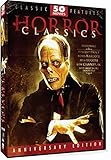
- An instant library of 50 horrorics assembled on 12 DVD's.
That distinction matters when judging the remake. The relevant questions are what the board is and how it works in each film, where the threat comes from, which relationships or plot elements survive, and whether the new material deepens the central idea or distracts from it. Those are useful comparison tests, not a claim that remakes must follow one formula.
What “the most important remake rule” really means here
There is no documented industry rule that a remake must preserve a particular plot, character, or tone. The more defensible standard is an argument about creative purpose: a new version should offer a reason to exist while retaining enough of the original’s defining appeal for the connection to matter. A remake can change nearly everything and still meet that standard if its additions make the core premise more compelling; fidelity alone does not guarantee success.
Russell’s own description makes clear that he was not aiming for strict fidelity. In a July 28, 2025 interview with ComicBook.com, the director and co-writer said: “There was a love triangle. There’s a couple of things we emulated, but I was very loose in reimagining the film. I wanted to explode the concepts.” He also said: “I didn’t know what he’d think, because there’s no point in a remake, in my mind, unless you’re going to bring something special to it.” Russell said the original resonated with him and that Kevin Tenney, the 1986 film’s filmmaker, loved the result. These comments explain Russell’s intent and his account of Tenney’s response; they do not, by themselves, show that the changes work onscreen.
Do the changes work?
The critical responses cited here are mixed, not a consensus verdict. RogerEbert.com’s review calls the film a “sorta-remake” and describes it as shaky and uneven. Bloody Disgusting’s September 16, 2025 release article quotes Joe Lipsett’s review: “Witchboard is messy and uneven, scattered in both narrative and performance, but fun enough to lightly recommend.” That is Lipsett’s assessment as quoted by the publication, not a summary of all critical opinion.
Together, those reactions point to the tension at the heart of a loose reimagining: ambition can make familiar material feel newly alive, but extra mythology and plot can also leave a horror story scattered. Whether that tension is a worthwhile trade depends on what a viewer values—recognition of the 1986 film’s approach, or a substantially different take on its cursed-board premise.
Independent reader supportYour contribution helps us test, update, and keep practical guides available for everyone.How to compare the two films
For a useful double feature, look beyond whether the same basic object appears in both. A spirit-board game or Ouija-style board is a recognizable prop; the comparison becomes more revealing when you ask what each film makes that object mean.
- The board’s rules: What does it allow, and what limits or consequences shape its use?
- The supernatural threat: Does the danger arise from the board itself, from the force associated with it, or from the people drawn into its orbit?
- Relationships and plot: Which connections or story beats are retained, and which have been replaced?
- Tone and pacing: Does the new film sustain dread, or do its additions interrupt the momentum?
- Purpose of the changes: Do new ideas sharpen the central curse, or make it harder to follow?
This approach avoids treating fidelity as a scorecard. It also keeps the comparison grounded in the films’ storytelling rather than in the assumption that every remake should either copy its source or reject it completely.
Quick Recap
Product prices and availability are accurate as of the date/time indicated and are subject to change. Any price and availability information displayed on Amazon at the time of purchase will apply.
Do these 3 things before closing this tab:
1Fix the driver behind crashes, sound loss and screen glitches2Clear out junk files and repair common Windows errors3Scan for outdated or missing drivers - takes under a minute