What’s actually slowing this PC down?
Pick the symptom - the matching free tool is one click away.
Translating Pather Panchali means more than finding English words for Bengali ones. The novel’s rural speech, customs, social relationships and landscape belong to a particular place and time—and even Bengali readers may find parts of that world less familiar as it changes. In her translator’s note, Rimi explains how she balances contextual meaning with fidelity to the novel’s local texture.
Why is Pather Panchali difficult to translate?
Bibhutibhushan Bandyopadhyay’s novel, first published as a book in Bengali in 1929, follows a family in a rural community. Its children encounter woods, orchards, stories and the distant railway; their world also includes poverty and family debt. The challenge is not simply that the book is old or that Bengali differs from English. Customs and everyday meanings that once felt familiar can become harder to recognize as the agrarian landscape and ways of life change.
| # | Preview | Product | Price | |
|---|---|---|---|---|
| 1 |

|
Pather Panchali | $20.54 | Buy on Amazon |
| 2 |

|
Pather Panchali (English and Bengali Edition) | $15.96 | Buy on Amazon |
| 3 |
|
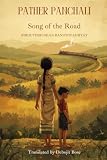
Pather Panchali: Song of the Road | $15.17 | Buy on Amazon |
| 4 |

|
Pather Panchali ( Bengali Edition ) | $12.99 | Buy on Amazon |
| 5 |

|
Pather Panchali (Bengali Edition) | $13.96 | Buy on Amazon |
Rimi points to women’s woodland picnics, seasonal harvest observances and village practices tied to a landscape increasingly transformed by townships and cement construction. She presents these changes as part of the translator’s task: a cultural detail may need a small bridge for a reader who does not know the practice, even when it would have needed no explanation for an earlier audience.
Speech poses another problem. The novel’s rural turns of phrase and dialect patterns convey region and social position. As Rimi observes, “No received standard anywhere allows for class/caste and location-based variations in speech.” Standard English can smooth out those distinctions; forcing every variation into a conspicuous dialect can create a different distortion. Translation therefore involves decisions about what texture to preserve and how.
Quick wins for a faster PC:
Fix the driver behind crashes, sound loss and screen glitchesFind Drivers →Clear out junk files and repair common Windows errorsFree Scan →#1 Best Overall
When does context matter more than literal wording?
Rimi’s examples show why a word-for-word rendering can be less faithful to a scene than a contextual equivalent. She writes, “A literal translation of a word is not always the accurate contextual translation of a situation.”
- “Mawron!” literally means “death,” but Rimi says it can function in everyday speech as anything from exasperation to playful encouragement. Translating the word literally in every instance could give an English reader the wrong emotional signal.
- “Amar shona manik” evokes “my gold and gemstones” literally. Rimi’s smoother contextual rendering, “My precious boy,” carries the affectionate address without making the line sound like a list of valuables.
These choices do not mean Bengali is “untranslatable.” They show that the translator has to interpret what a phrase does in context—its tone, relationship and place in the conversation—not just what its component words denote.
Rank #2
What cultural details should be explained—and what should stay local?
Rimi describes adding “cultural bridges” where a reader might otherwise miss a custom or social relation. But explanation has a cost: too much can interrupt a scene or make a local world feel like an object lesson. Her approach is selective, clarifying details when understanding depends on them while leaving other material to work through the story itself.
Names raise a related choice. Rimi renders Nishchindipur as “the Abode of Contentment,” because she considers the name’s meaning significant. Other names remain untranslated when their etymology would not materially help the reader. The scholarly discussion of earlier versions also notes that translators have had to weigh how to handle the title: “Panchali” has no direct English equivalent, and “Song of the Road” was used as a subtitle.
Free tools Windows power users keep installed
One-click scans. No signup required.
Rank #3
There is no single rule that resolves every case. A name’s meaning may be central in one passage and incidental in another; a retained place name can preserve the map of the novel without burdening every sentence with explanation.
Is the novel only a sombre story?
No. Rimi describes Pather Panchali as a vibrant ballad of everyday life, with sensory detail, adventure and determination as well as hardship. The publisher’s synopsis likewise foregrounds the children’s world of woods, orchards, stories and the distant railroad alongside poverty and debt. A reader who knows the story chiefly through its film reputation or expects an unrelieved account of suffering may miss that breadth.
The novel and Satyajit Ray’s 1955 film are distinct works, and the film’s reception should not be treated as a substitute for reading the book. The translation question is about how the novel’s language and world travel into English, not a verdict on the adaptation.
Which English translation of Pather Panchali should you read?
There is no evidence here to declare one version the best for every reader. A useful comparison begins with what each edition contains, then asks how it handles language and context. Penguin Random House India lists Rimi’s English translation in its Penguin Modern Classics catalogue; the publisher describes the translation as seeking to preserve as much of the original’s “music and suggestiveness” as possible.
Best Value
| English edition or history | What is established | What to consider |
|---|---|---|
| Rimi, Penguin Modern Classics | Listed by Penguin Random House India as a new English translation; the catalogue offers paperback, hardback and ebook buying options. | Useful for readers interested in a recent translation whose translator explains choices around idiom, cultural context, speech and names. |
| Clark–Mukherji, 1968 | The 2020 scholarly article describes it as the best-known and widely circulated English version. The article reports longstanding criticism that it is incomplete, including the omission of the third part, “Akrur Sambad.” | Treat the completeness criticism as the article’s account, not an uncontested verdict. The article interprets the film’s 1955 ending as a possible influence on where the translation stops; that is its critical reading, not an established motive. |
| Kshitish Roy and Margaret Chatterjee, 1976 | The 2020 scholarly article identifies this English version as officially declared an abridged version. | Its abridged status matters if you want to compare a complete text with an explicitly shortened one. |
For a close comparison, check five things: whether the full novel or an abridgment is presented; how idioms are rendered; whether customs and social relations are explained; how rural and socially varied speech appears in English; and whether names are translated, retained or glossed. The 2020 article also makes a broader point: translations respond to their receiving audiences. That is a useful lens for comparison, but it does not by itself establish any individual translator’s intentions.
The novel’s first book publication was in 1929, according to that article; it dates the Clark–Mukherji version to 1968 and the Roy–Chatterjee version to 1976. These dates mark a translation history, not a ranking. To choose an edition, decide whether you value completeness, a particular handling of voice, or the opportunity to compare translation choices—and check the edition’s contents rather than relying on its title alone.
Independent reader supportYour contribution helps us test, update, and keep practical guides available for everyone.Does the novel hold up for a reader now?
Rimi says she has been asked whether the translation is “worth my time” by readers who perceive the plot as dreary. Her answer, reflected in her account of the novel, is that hardship is only part of its experience: the children’s curiosity, the sensory detail of village life and their determination also shape the book. A contemporary reader does not need to know every custom in advance; the translator’s choices help make the story legible without turning its unfamiliar world into a generic one.
Rimi also acknowledges the limits of the work: “Every translator has some regrets, for it is impossible to completely recreate an entire culture, place, and time in a different language.” That is not a claim that the effort fails. It is a recognition that translation is a series of informed choices, and that a new version can make different parts of a classic newly visible.
The Tool Desk
Outbyte PC Repair FREEClear out junk files and repair common Windows errorsFree Scan →Outbyte Driver Updater FREEScan for outdated or missing drivers - takes under a minuteDriver Scan →Quick Recap
Sources and further reading
- Rimi’s translator’s note, adapted by Scroll.
- Penguin Random House India catalogue page for Pather Panchali.
- “Fifty Years of the Song of the Road: A ‘Good’ Translation or a ‘Successful’ One?” (2020).
- Penguin Random House India excerpt from Pather Panchali.
Product prices and availability are accurate as of the date/time indicated and are subject to change. Any price and availability information displayed on Amazon at the time of purchase will apply.




