Django Unchained is a Spaghetti Western in lineage and style, but not a remake of the 1966 Django. Quentin Tarantino drew on Sergio Corbucci and the wider Italian Western tradition to make a different kind of story: a stylized revenge adventure set in the antebellum South, where Django’s fight to rescue his wife collides with the history of slavery. Its awards and strong reception help explain its staying power; its long runtime and controversial treatment of violence keep the “masterpiece” verdict open to debate.
What makes Django Unchained a Spaghetti Western?
The label describes a real creative lineage, not just the film’s look. The Spaghetti Western is generally associated with Westerns made by Italian directors in the 1960s and 1970s. Tarantino has said that his inspiration was the genre broadly, and Corbucci’s films in particular. In a BAFTA interview, he put it this way: “Well it wasn’t just Django per se, that movie, it was the spaghetti Western genre in the big picture, but Sergio Corbucci’s films in the miniature.”
| # | Preview | Product | Price | |
|---|---|---|---|---|
| 1 |
![Django Unchained [Blu-ray]](https://m.media-amazon.com/images/I/51thu3O-TFL._SL160_.jpg)
|
Django Unchained [Blu-ray] | $8.99 | Buy on Amazon |
| 2 |
![Django Unchained - Limited Edition Steelbook [Blu-ray]](https://m.media-amazon.com/images/I/41us8ucOX+L._SL160_.jpg)
|
Django Unchained - Limited Edition Steelbook [Blu-ray] | $199.99 | Buy on Amazon |
| 3 |
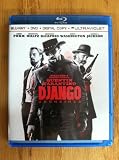
|
DJANGO UNCHAINED Combo Set BLU-RAY+DVD+DIGITAL COPY+ULTRAVIOLET (Quentin Tarantino) | $12.47 | Buy on Amazon |
| 4 |

|
Django Unchained Steelbook | $39.99 | Buy on Amazon |
The connection is visible in the film’s name and casting as well as its influences. Django takes his name from the protagonist of Corbucci’s 1966 film, and Franco Nero, who played that original Django, appears in a cameo. The American Film Institute’s account of the film also notes Tarantino’s study of Corbucci and his use of reissued Spaghetti Western soundtracks while developing the script.
That makes Django Unchained an homage and reinvention, not a continuation of the original film’s story. The 2012 movie follows Django, played by Jamie Foxx, and bounty hunter Dr. King Schultz, played by Christoph Waltz, as they travel through the South and set out to rescue Django’s wife, Broomhilda. The setting, historical subject and specific character journey are its own.
#1 Best Overall
- Django is a freed slave, who, under the tutelage of a German bounty hunter, becomes a bad-ass bounty hunter himself. After taking down some bad guys for profit, they track down Django's slave wife and liberate her from an evil plantation owner.
How does the film transform the Western?
A Western hero with a personal stake
Django is not simply a hired gun moving from one frontier encounter to another. His journey has a defined purpose: to reunite with Broomhilda. The bounty-hunting partnership with Schultz gives the story its road-movie momentum, while Django’s growing agency turns the familiar Western progression toward confrontation into a rescue mission.
Genre adventure against a specific history
Tarantino said he wanted both to tell a Western story and to confront America’s antebellum South. In an NPR Fresh Air interview, he described wanting to show “America at that time” with an “unblinking look,” while also making the story “a genre movie, as an exciting adventure.” Those aims explain the film’s distinctive tension: it uses the forward drive and catharsis of a revenge Western to address a historical reality that cannot be reduced to a fictional villain or a single act of vengeance.
A soundtrack that signals the lineage
The music is part of the film’s argument about genre. Its soundtrack draws on Ennio Morricone alongside contemporary tracks, including music by Rick Ross, Anthony Hamilton and John Legend. The contrast links the film to older Western conventions while making its sound unmistakably modern; it is not simply an attempt to reproduce a 1960s score.
Is Django Unchained historically accurate?
It is best understood as a stylized revenge fantasy set against slavery, not as a documentary or a substitute for histories and first-person slave narratives. Tarantino’s stated desire to confront the period describes his intention; it does not establish historical fidelity. The film shapes its subject through heightened performances, comic-book stylization and extreme violence in service of a dramatic arc.
Recommended Free Tools
That approach creates a genuine disagreement about what the film accomplishes. Its revenge structure gives Django agency in a genre where a Black protagonist’s centrality is itself a consequential choice. At the same time, the stylization and spectacle can strike viewers as turning historical suffering into entertainment or using it chiefly as fuel for a fantasy of payback. Acknowledging both responses is more useful than treating the director’s purpose as the final word on the film’s ethics.
The Guardian reported Tarantino’s view that he wanted to break the “history-under-glass” quality he associated with screen portrayals of slave narratives. That statement helps explain the film’s confrontational style, but it should be read as an artistic rationale rather than evidence that the result is historically comprehensive.
Why call it a modern masterpiece—and what complicates that claim?
“Masterpiece” is a judgment, not an award category or settled fact. The case for the label rests on the film’s forceful synthesis: a recognizable Italian Western inheritance, a distinct American setting, a revenge plot centered on Django, and a soundtrack that makes the old genre feel newly assembled. Its institutional recognition is substantial. The AFI records Django Unchained as an AFI Movie of the Year and lists two Academy Award wins, alongside two Golden Globe wins:
| Recognition | Wins recorded by AFI | Other recognition recorded by AFI |
|---|---|---|
| Academy Awards, 2013 | Original Screenplay; Supporting Actor (Christoph Waltz) | Nominations for Best Picture, Cinematography and Sound Editing |
| Golden Globe Awards, 2013 | Supporting Actor (Christoph Waltz); Screenplay | Not stated in the AFI summary |
Reception indicators are favorable but do not amount to unanimity. At access on October 7, 2026, Rotten Tomatoes showed an 87% Tomatometer from 295 reviews and a 92% Popcornmeter from more than 250,000 ratings. Those figures are a dated snapshot and can change; the site’s critic consensus calls the film “Bold, bloody, and stylistically daring.” The AFI’s review history also records objections to the film’s 2-hour-45-minute runtime and uneven pacing, alongside praise for its provocation and entertainment value.
The Tool Desk
Outbyte PC Repair FREERepair Windows errors before they cause bigger problemsFix Now →Outbyte Driver Updater FREEFix the driver behind crashes, sound loss and screen glitchesFind Drivers →The length is part of the trade-off: the film has room for extended buildup and shifts in tone, but not every viewer will find that momentum sustained. Its willingness to fuse historical trauma with genre pleasure is similarly a source of both its distinctiveness and its criticism. That friction is central to assessing the film, rather than an incidental controversy around it.
Rank #4
- Brand New in box. The product ships with all relevant accessories
How does it compare with the original Django?
The 1966 film matters as an influence, not as the plot being retold. The clearest comparison is between the original’s place in the Spaghetti Western tradition and Tarantino’s later use of that tradition to tell a new story about slavery, liberation and revenge in the United States.
| Point of comparison | Django (1966) | Django Unchained (2012) |
|---|---|---|
| Relationship | Corbucci film whose protagonist supplies the later film’s name | Separate story; homage to the earlier film and broader genre |
| Setting and subject | Spaghetti Western; the supplied AFI account identifies it as the original film but does not detail its setting here | Antebellum American South, with slavery central to the story |
| Connection on screen | Franco Nero played the original Django | Nero appears in a cameo |
The comparison is most revealing when it asks what Tarantino carries forward—genre iconography, musical cues and the outlaw-hero tradition—and what he changes: the historical setting, Django’s personal objective and the film’s direct engagement with slavery.
Is the film still worth revisiting?
For viewers interested in how a director can borrow from a genre without simply reproducing it, Django Unchained remains a particularly clear case. Its strongest claim to lasting importance is not a measurable cultural-impact statistic, but the way its formal choices keep raising questions about who gets to occupy the Western’s heroic role and what happens when the genre’s pleasures are placed beside the realities of slavery. Viewers seeking historical instruction should pair it with reliable histories and first-person accounts; viewers seeking a formally ambitious, divisive Western will find the debate part of the experience.
Crashes, No Sound, or Screen Glitches?
Random freezes, missing sound and display glitches usually trace back to one bad driver. Find and replace yours safely.Free scan · under a minuteWindows Errors? Fix Them Before They Spread
Repair common Windows errors and clear accumulated junk for a smoother, more stable PC - no reinstall needed.Free scan · no reinstallRotten Tomatoes listed subscription viewing on AMC+ and rental or purchase through Fandango at access on October 7, 2026. These options are territory-specific and may change.
Quick Recap
Product prices and availability are accurate as of the date/time indicated and are subject to change. Any price and availability information displayed on Amazon at the time of purchase will apply.




