John Waters’s Pink Flamingos (1972) was censored in the United Kingdom and described as once banned in Australia—but the available records do not support saying it was banned worldwide. In the UK, the film moved from informal screenings and unclassified video to formal age classification with cuts. Decades later, it entered the US National Film Registry.
What is Pink Flamingos?
John Waters’s 1972 film centers on Divine, a notorious criminal living with her family outside Baltimore who claims the tabloid title “Filthiest Person Alive.” A couple challenges her for the distinction. The film’s deliberately provocative comedy and affront to social respectability help explain why it became a censorship flashpoint, though that context is not evidence of a universal ban. The Criterion Collection’s film page describes its premise and lists the film as a 1972 US production.


What happened to the film in the UK?
The British Board of Film Classification (BBFC) records a sequence of distinct events, not one continuous formal ban. Waters’s film was made in 1972 but was not submitted to the BBFC until 1989. During the intervening years, it was shown occasionally at members-only cinema clubs, and an unclassified VHS release circulated in the early 1980s. In the mid-1980s, one tape was seized, leading to a conviction under section 3 of the Obscene Publications Act.
The BBFC also notes that Pink Flamingos was never placed on the Director of Public Prosecutions’ list of potentially obscene “video nasties.” The tape seizure and prosecution should not be mistaken for that separate designation. The BBFC’s case study provides its account of the film’s UK history.
#1 Best Overall
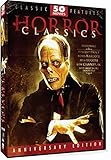
- An instant library of 50 horrorics assembled on 12 DVD's.
The 1990 video decision
When the film was submitted for video classification in December 1989, BBFC examiners disagreed about whether it should be rejected, cut, or passed uncut. The board’s 1990 decision classified it 18 and required 3 minutes 4 seconds of cuts across five scenes. The BBFC identifies the material as involving animal cruelty, sexual violence, explicit sexual activity, and obscenity.
The 1997 cinema re-release
For a 1997 cinema re-release, the BBFC waived its earlier cut to the “singing anus” scene but retained cuts to four other scenes. The film was passed 18 with 2 minutes 42 seconds removed. These were specific UK decisions for different formats and dates, rather than an enduring blanket prohibition.
Was it banned outside the UK?
The National Film and Sound Archive of Australia describes Pink Flamingos as “Once banned in Australia” in its 2017 program entry. That record supports a historical Australian ban, but it does not give the dates or full decision history. The program lists the film as a 1972 US production directed by Waters, with a running time of 94 minutes and an R18+ rating. The NFSA program entry is the basis for those details.
The headline claim that the film was banned in Canada and parts of Europe is not established by the cited records. The BBFC documents the UK’s censorship and classification history, and the NFSA supports a historical Australian ban; neither proves a worldwide ban. Without country-specific records, broader claims about Canada or unspecified European countries should be treated as unverified.
How did a censored film enter the US National Film Registry?
In 2021, Pink Flamingos was added to the National Film Registry. Its inclusion is a different kind of institutional recognition from a classification decision: it places the film among works selected for preservation as part of US film heritage. The Library of Congress National Film Preservation Board records the selection.
Independent reader supportYour contribution helps us test, update, and keep practical guides available for everyone.What is available in Criterion’s edition?
Criterion lists a director-approved Blu-ray featuring a new 4K digital restoration supervised and approved by Waters. The restoration resolution describes the source and restoration work; the listed physical edition is Blu-ray, not 4K UHD. Its listed features include an uncompressed monaural soundtrack, Steve Yeager’s 1998 feature-length documentary Divine Trash, two Waters commentaries, a conversation with Jim Jarmusch, a Baltimore-location tour led by Waters, deleted scenes, alternate takes, and a trailer. Criterion’s product page lists the edition and features; it does not establish current stock, price, or region compatibility.
Quick Recap
Best Value
Rank #4
Product prices and availability are accurate as of the date/time indicated and are subject to change. Any price and availability information displayed on Amazon at the time of purchase will apply.




