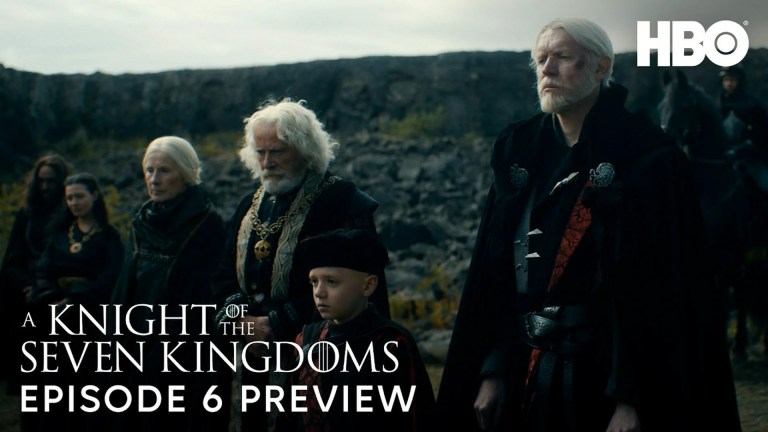
The A Knight of the Seven Kingdoms full-frontal scene was staged with a production prosthetic, not Danny Webb’s actual anatomy. The moment appears in Season 1, Episode 2, “Hard Salt Beef,” and prosthetics designer Waldo Mason said the 10-inch prop included tubing for Ser Arlan’s comic public-urination scene.
The sequence is a flashback involving Ser Arlan of Pennytree, Dunk’s late hedge-knight master. Its purpose is less about plot than character: showrunner Ira Parker wanted to give an overlooked man who had protected Dunk one memorable, exaggerated “special thing.”


Key takeaways
- The full-frontal scene appears in Season 1, Episode 2, “Hard Salt Beef,” as a flashback involving Ser Arlan of Pennytree.
- Danny Webb’s visible anatomy was a production prosthetic, not the actor’s actual body.
- Prosthetics designer Waldo Mason described the prosthetic as 10 inches long and said it included tubing for the urination action.
- Showrunner Ira Parker said the gag was meant to give the overlooked Ser Arlan one memorable “special thing.”
- The scene’s emotional context comes from Arlan’s importance to Dunk, while the exact full-frontal staging is a television adaptation choice rather than a documented feature of the source novellas.
Was the full-frontal scene in A Knight of the Seven Kingdoms real?
No. The conspicuous anatomy was a production prosthetic, not Danny Webb’s actual body, and the reported design included tubing to make Ser Arlan’s public urination possible. The clearest production account comes from prosthetics designer Waldo Mason, whose comments resolved the question more reliably than the showrunner’s earlier joke that he could not remember whether a prosthetic had been used.
Mason described the prop as a 10-inch prosthetic and wrote that he was “Very proud to have forged Ser Arlan Pennytree’s formidable weapon for the opening moments of this episode!” Entertainment reporting on Mason’s behind-the-scenes statement identifies the object as a production-made prosthetic with tubing for the scene’s practical effect; it was not presented as a CGI creation. The prosthetics-design report provides the production evidence behind that explanation.
#1 Best Overall
| Reader question | Answer |
|---|---|
| Was that real? | No. The visible anatomy was a prosthetic. |
| Was Danny Webb wearing a prosthetic? | Yes. Prosthetics designer Waldo Mason said the production made a 10-inch prosthetic for the sequence. |
| Was the scene CGI? | The available production account identifies a practical prosthetic with tubing, not CGI. |
| What episode contains the scene? | Season 1, Episode 2, “Hard Salt Beef.” |
What episode has the full-frontal scene?
The scene is in Season 1, Episode 2, “Hard Salt Beef.” The Warner Bros. Discovery Pressroom episode page identifies “Hard Salt Beef” as Episode 2 and credits Aziza Barnes and Ira Parker as the television writers, with Owen Harris directing.
Minor Episode 2 spoilers: The episode opens with a flashback involving the late Ser Arlan of Pennytree, played by Danny Webb. Arlan emerges naked from a brothel and urinates in public, creating the startling image that prompted viewers to ask whether the anatomy was real. The sequence is brief, but its exaggerated physical comedy makes it unusually memorable.
Who is Ser Arlan of Pennytree?
Ser Arlan of Pennytree is Dunk’s late hedge-knight master and the person who looked after him before Dunk became entangled in the larger world of knighthood. The flashback is not simply an unrelated nude gag: the scene is built around the memory of a man who mattered deeply to Dunk but received little public recognition after his death.
Rank #2
![Riddick: The Complete Collection [Blu-ray]](https://m.media-amazon.com/images/I/51ITY6eDlLL._SL160_.jpg)
- Shrink-wrapped
Ira Parker, the showrunner and co-creator, explained the emotional starting point in an interview: “I felt bad for Ser Arlan at some point.” Parker continued, “He was the only person who’s ever looked out for Dunk and really stuck with Dunk.” Those comments frame the scene as a comic memorial for a character who died on a muddy road, was buried without ceremony, and was barely remembered by the knights and lords he had served. Parker’s explanation of Ser Arlan’s “1 special thing” gives the sequence its broader context.
Why did the show put the scene in Episode 2?
The scene gives Ser Arlan one outsized, unforgettable characteristic: he is earthy, physically unselfconscious, and larger than life. Parker said, “I felt the need to give him his one special thing, to channel a little Boogie Nights, I suppose.” The joke therefore works in two directions: it gets an immediate laugh, while also making Arlan feel like a vivid person rather than a disposable figure from Dunk’s backstory.
The choice also suits the social scale of the story. A Knight of the Seven Kingdoms follows road-level characters—an inexperienced hedge knight and his young companion—rather than centering every moment on kings, castles, and grand political events. Arlan’s public, undignified spectacle reflects the show’s interest in the earthy lives beneath Westeros’s formal pageantry.
The scene should not be treated as a hidden plot clue or as evidence that the anatomy reveals something important about Arlan’s history. The production explanation is simpler: the writers and performers created a deliberately exaggerated comic detail to honor an overlooked character.
Is the scene from the Dunk and Egg books?
The scene’s emotional logic is connected to Dunk’s relationship with Arlan, but the exact full-frontal television staging should not be presented as a confirmed scene from the books. The available material supports describing the moment as an adaptation choice, not as a literal recreation of a documented book passage.
Crashes, No Sound, or Screen Glitches?
Random freezes, missing sound and display glitches usually trace back to one bad driver. Find and replace yours safely.Free scan · under a minuteWindows Errors? Fix Them Before They Spread
Repair common Windows errors and clear accumulated junk for a smoother, more stable PC - no reinstall needed.Free scan · no reinstallReaders who want the literary context can start with George R. R. Martin’s A Knight of the Seven Kingdoms, which collects the first three official Dunk and Egg prequel novellas. Martin’s official bibliography lists the volume as a Bantam Books collection, and the author’s book page places the stories nearly a century before A Game of Thrones. The illustrated Bantam edition is described by Penguin Random House as containing more than 160 illustrations by Gary Gianni.
| Format | What it provides | What it does not establish |
|---|---|---|
| The television episode | The specific flashback, comic staging, Danny Webb’s performance, and the practical prosthetic used for the gag. | It does not turn the prosthetic into a plot fact about Ser Arlan. |
| George R. R. Martin’s book collection | The source novellas and the wider literary context for Dunk and Egg. | The available research does not confirm that the exact full-frontal staging appears in the books. |
| The illustrated Bantam edition | The same source collection in a physical illustrated format, with more than 160 Gary Gianni illustrations according to the publisher’s library-marketing description. | It is source material, not a behind-the-scenes production record or a prop replica. |
What is confirmed about how the scene was made?
The confirmed production detail is limited but decisive: Waldo Mason identified a 10-inch prosthetic and said tubing was incorporated to support the urination action. That evidence answers the central question without requiring speculation about camera tricks, digital effects, or the actor’s body.
Rank #4

- The Help (Three-Disc Combo: Blu-ray/DVD + Digital Copy)
The available reporting does not document the exact camera setup, fitting schedule, or performer-consent procedures. Those details should not be invented. The showrunner’s initial uncertainty is also important: Ira Parker did not provide the final confirmation in the first reported discussion. Mason’s later production-design statement is the evidence that resolves the prosthetic question. The earlier report on whether the scene was real and the later prosthetics report should therefore be read together, with the latter carrying the specific design confirmation.
Independent reader supportYour contribution helps us test, update, and keep practical guides available for everyone.What is the simplest explanation for the viral moment?
The scene is a deliberately staged comic flashback, not an accidental glimpse, an unplanned act of nudity, or a revelation about Danny Webb’s actual anatomy. The production used a 10-inch prosthetic with tubing, while Ira Parker’s creative rationale was to give Dunk’s forgotten former master a memorable final flourish. The result is crude, affectionate, and intentionally impossible to overlook.
Frequently Asked Questions
Was Danny Webb wearing a prosthetic in A Knight of the Seven Kingdoms?
No. The visible anatomy was a production prosthetic, not Danny Webb’s actual body. Prosthetics designer Waldo Mason described a 10-inch prosthetic with tubing for the urination action.
Best Value
What episode has the full-frontal scene in A Knight of the Seven Kingdoms?
The scene appears in Season 1, Episode 2, “Hard Salt Beef.” The episode opens with a flashback involving Ser Arlan of Pennytree, Dunk’s late hedge-knight master.
Is the full-frontal scene in the Dunk and Egg books?
The exact full-frontal staging should not be described as a confirmed scene from the Dunk and Egg books. The scene’s emotional context comes from Dunk’s relationship with Arlan, but the television production appears to have created the gag as an adaptation choice.
The Bottom Line
The A Knight of the Seven Kingdoms full-frontal scene was not real anatomy and was not reported as CGI: it used a 10-inch production prosthetic with tubing, according to prosthetics designer Waldo Mason. The gag appears in Season 1, Episode 2, “Hard Salt Beef,” as a comic memorial to Ser Arlan and his importance to Dunk.
Recommended Free Tools
Quick Recap
Product prices and availability are accurate as of the date/time indicated and are subject to change. Any price and availability information displayed on Amazon at the time of purchase will apply.