Free tools Windows power users keep installed
One-click scans. No signup required.
The harmonium became closely associated with Indian music through a combination of practical adaptation and wide musical use—not simply because a European instrument was imported unchanged. Missionaries and European households helped establish early footholds, while Indian makers developed a portable, hand-pumped version that worked well for accompanying singers. Its convenience came with a musical trade-off: a keyboard’s fixed pitches cannot reproduce every slide and subtle inflection found in Indian melodic traditions.
Where the harmonium came from
The harmonium took shape in nineteenth-century Europe, building on earlier expressive free-reed organ designs. The free-reed principle itself has a broader history that includes Southeast Asian development; European makers developed the instrument form known as the harmonium.
The Paris Philharmonie collection traces the instrument to the expressive organ associated with Gabriel-Joseph Grenié and says Alexandre-François Debain registered the harmonium name in 1842. Other accounts give 1840 for the relevant patent or naming milestone, so “early 1840s” is the safest concise date. Philharmonie de Paris: “Harmonium portatif”
How it reached India
There is no firmly established single arrival date or route. A historical dissertation on the harmonium in North Indian music identifies 1868 as the first known mention in Indian literature, while cautioning that the surviving record is too incomplete to provide a full chronology. Claims that the fully developed harmonium was present in India in the eighteenth century do not fit its early-1840s European development.
Do these 3 things before closing this tab:
1Clear out junk files and repair common Windows errors2Scan for outdated or missing drivers - takes under a minute3Repair Windows errors before they cause bigger problems#1 Best Overall
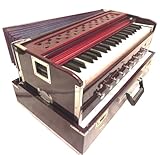
- Portable Design: This 9-stop harmonium features a folding design for easy transport and storage.
- Robust Construction: Crafted with a rosewood-colored body and brass accents for durability.
- Versatile Tones: Equipped with a 3 1/2 octave keyboard and coupler for producing rich, resonant tones.
- Included Accessories: Comes with a carrying bag and tuned to the standard A440 pitch.
- Authentic Instrument: An Indian musical instrument ideal for classical and devotional music performances.
Two early contexts are documented, and they need not be treated as competing explanations. The Philharmonie describes portable harmoniums being introduced through nineteenth-century evangelical missions. The dissertation also records their use at missionary stations without church organs, where portability and robustness mattered, as well as imports for domestic music-making in European households, especially in Calcutta. These accounts establish plausible footholds, not a single proven point of entry.
Why the Indian hand-pumped version suited singers
The European foot-pumped harmonium and the portable Indian-style instrument differ in ways that shaped how people used them:
Rank #2

- CONCERT QUALITY SOUND: Features 3 reeds for a rich, full-bodied tone that meets professional performance standards.
- 9 SCALE CHANGER: Easily shift between 9 scales with the built-in scale changer, offering versatile tuning options for any musical style.
- EXTENDED RANGE: Spans 3.75 octaves, providing a wide tonal range ideal for both classical and contemporary Indian music.
- DURABLE FIBER BOX CONSTRUCTION: Built with a sturdy fiber box body in a rich mahogany color finish, combining durability with elegant aesthetics.
- PORTABLE DESIGN: Lightweight and compact build makes this harmonium easy to transport to concerts, rehearsals, and performances.
| Feature | European foot-pumped form | Indian portable hand-pumped form |
|---|---|---|
| Air supply | Foot-operated bellows | Rear bellows pumped by hand |
| Playing posture | Generally played at a keyboard position rather than seated on the floor | Compact form suited to floor-based performance |
| One-player accompaniment | Footwork supplies air while the hands can play | One hand can pump while the other plays the melody |
| Practical effect | Designed around a larger, foot-operated organ format | Portable airflow and melody-playing made it convenient for accompanying a vocalist |
When a player presses a key, air from the bellows passes through the corresponding tuned free reed. On a portable hand-pumped harmonium, the player can keep the airflow going with one hand while playing notes with the other. That arrangement makes it possible for one musician to sustain a melodic accompaniment without needing a separate person to operate the instrument.
The harmonium typically shadows and supports a singer, and can also provide introductions and interludes. It therefore filled a practical role in vocal performance: a player could follow a melody while maintaining sound beneath it. A drone or supporting tones may also be used, depending on the instrument and playing style. Grinnell College Libraries: “Harmonium”
Windows Errors? Fix Them Before They Spread
Repair common Windows errors and clear accumulated junk for a smoother, more stable PC - no reinstall needed.Free scan · no reinstallCrashes, No Sound, or Screen Glitches?
Random freezes, missing sound and display glitches usually trace back to one bad driver. Find and replace yours safely.Free scan · under a minuteRank #3

- BUILT FOR TRAVEL: Weighs about 11 lbs and is sized to fit in airplane overhead bins; a padded bag is included
- 27 KEY, 2 OCTAVE KEYBOARD: Two octaves starting at F (not C), enough range for kirtan, bhajans, mantra chanting and accompanying your own singing
- TRIPLE-FOLD BELLOWS: Folding bellows give a steady supply of air for smooth, sustained notes
- SIMPLE BY DESIGN: No stops, drones or coupler, so there is nothing to set up; open it and play
- CHECKED IN BERKELEY: Every harmonium is checked by our staff in Berkeley, CA for tuning and playability before it ships
Indian makers adapted the instrument
Local adoption involved redesign and manufacture, not just a change of repertoire. The Philharmonie records an 1887 model called the Dwarkin-Flute, made by Dwarikanath Ghosh and adapted for the Indian market. It also notes that demand led Indian makers to manufacture harmoniums.
Contemporary craft documentation from D’source, a National Institute of Design resource, describes harmonium-making in Ahmednagar, Maharashtra, and identifies compact, coupler and scale-changer types. These modern variants show that the instrument continued to develop; they should not be mistaken for a complete account of its historical forms. D’source / National Institute of Design: “Making of Harmonium – Ahmednagar, Maharashtra”
Rank #4

- Color: Random color
- BINA 23B Deluxe, Harmonium, 2 1/2 Octaves, 32 Keys, Small, Portable, Compact, Special Reeds, Safri, Natural Color, Bag, Kirtan, Musical Instrument Indian (PDI- DAA)
How it became strongly associated with Indian music
Its combination of portability, a sustained sound and straightforward melody-playing made the harmonium useful across a broad range of vocal settings. Grinnell’s collection documents its use in Hindu, Islamic, Sikh and Christian devotional music, light classical music and classical concert settings. D’source also names folk music, ghazal, kathak, thumri, khayal, qawwali and Sufi traditions.
That reach explains why the harmonium can feel synonymous with Indian music: it became a familiar accompaniment across many genres and communities. The phrase describes a strong cultural association, not a claim that every Indian musical tradition uses the instrument.
Best Value

- Well-Tuned, A440, 42 Keys, 3 1/2 Octaves,
- A440 Pitch - Checked At Dispatch
- Multi-Fold Bellows For Easy Pumping & Consistent Sustain Bright Nickeled Brass Knobs
- Harmonium Dimensions: Close: 23" X 14" X 8 Inches Approx. (+/- 1 Inch) Open: 23" X 14" X 11 Inches Approx. (+/- 1 Inch) Weight 9.5 - 10 Kg Approx.
- The harmoniums are packed to perfection to remove any loss/damage of the instrument.
Why musicians and cultural authorities criticized it
The same keyboard that made the harmonium convenient also limited what it could do. Its keys produce discrete, fixed pitches, while many Indian melodic styles rely on continuous slides and nuanced movement between pitches. A player can approximate some melodic gestures, but the keyboard does not reproduce every subtle inflection. Grinnell’s collection describes this mismatch as one reason critics considered the instrument unsuitable for Hindustani classical music.
The debate was also about cultural identity. In a 2011 article, scholar Matt Rahaim situates the harmonium controversy within efforts by British and Indian scholars, composers and administrators to define a national musical sound as distinct from the West. He also notes a different role for the instrument in music education, where its fixed pitches could serve a project of standardization. Matt Rahaim, “That Ban(e) of Indian Music: Hearing Politics in The Harmonium,” The Journal of Asian Studies
The All-India Radio ban—and the disputed end date
All-India Radio banned the harmonium in 1940. The reported end date differs between sources: Rahaim’s Cambridge abstract gives 1971, while Grinnell’s collection gives 1980. Without confirmation from primary archival records, a definitive end year should not be asserted. Both sources agree that the harmonium remained popular and continued to be used outside radio during the ban.
Quick Recap
Product prices and availability are accurate as of the date/time indicated and are subject to change. Any price and availability information displayed on Amazon at the time of purchase will apply.




