For all the apocalyptic spectacle of Stranger Things’ finale, the show ultimately narrows its focus to a single, quieter question: what becomes of Eleven after everything she’s endured? The last episode is less interested in tying a neat bow on Hawkins than it is in positioning its central hero at a crossroads, emotionally and thematically. The Duffer Brothers have been clear that Eleven’s final moments are meant to be read not as an ending, but as a state of becoming.
By the time the dust settles, Eleven has faced Vecna directly, pushed her powers to their breaking point, and confronted the emotional cost of being the show’s designated savior. What happens next can feel intentionally ambiguous on first watch, but the Duffers’ explanations help sharpen the intent behind those final images. Taken together, they clarify where Eleven stands, what she’s lost, and why her arc stops exactly where it does.


The Final Confrontation Leaves Eleven Changed, Not Defeated
In the finale’s climax, Eleven manages to overpower Vecna, but the victory is incomplete. He survives, Hawkins is left fractured by the Upside Down bleeding into the real world, and the threat is very much unresolved. Crucially, Eleven emerges from the fight alive but visibly drained, both physically and emotionally.
The Duffers have explained that this outcome was deliberate. Eleven isn’t meant to “win” in a traditional sense, because Stranger Things has never framed her powers as a clean solution. Instead, the battle marks the limit of what raw ability can achieve without emotional grounding and support.
What’s actually slowing this PC down?
Pick the symptom - the matching free tool is one click away.
#1 Best Overall

- Season 1 Complete Collection – Includes all episodes from the first season
- Blu-ray and DVD Combo – Multiple viewing formats for convenience
- Collector’s Edition Packaging – Retro VHS-style box designed for display
- Bonus Collectibles Included – Features poster and themed puzzle
- Great for Fans & Collectors – Perfect gift for sci-fi and TV series enthusiasts
Her Powers Aren’t Gone, But They’re No Longer the Point
One of the most debated elements of the finale is Eleven’s apparent struggle to access her powers afterward. The show leaves this understated, but the implication is clear: something has shifted. According to the Duffers, this isn’t about stripping Eleven of her abilities as punishment or shock value, but about re-centering her identity.
For much of the series, Eleven has been defined by what she can do. The finale subtly pushes back against that framing, suggesting that her journey forward will hinge less on supernatural strength and more on emotional resilience, choice, and self-definition.
Ending in Uncertainty Is the Emotional Truth of Growing Up
The final image of Eleven standing with the group, quietly sensing that Vecna is still out there, underscores the show’s coming-of-age themes. She’s no longer a lab experiment or a runaway child, but she also isn’t a fully formed hero with all the answers. The Duffers have described this moment as intentionally unresolved, mirroring the uncertainty of adolescence itself.
Where we leave Eleven, then, is in a space between trauma and agency. She’s survived, she’s changed, and she’s aware that the fight isn’t over, but for the first time, her future isn’t solely defined by what others need her to be.
Do these 3 things before closing this tab:
1Scan for outdated or missing drivers - takes under a minute2Repair Windows errors before they cause bigger problems3Fix the driver behind crashes, sound loss and screen glitchesIs Eleven Alive, Changed, or Transformed? Separating On-Screen Facts From Fan Theories
In the immediate aftermath of the finale, one question eclipsed all others: what exactly happened to Eleven? The ambiguity of her final moments invited a wave of theories, ranging from heroic sacrifice to supernatural transformation. But when you separate what the show actually presents from what viewers inferred, the answer becomes far more grounded and intentional.
The On-Screen Reality: Eleven Is Alive
First and most importantly, the finale leaves no concrete evidence that Eleven dies. She is conscious after the battle, reunites with the group, and remains physically present in Hawkins as the Upside Down continues to encroach. The Duffers have been clear that this was not meant to be a death scene or a fake-out designed to shock.
What the show emphasizes instead is exhaustion and emotional depletion. Eleven survives, but the cost of pushing herself to that extreme is written all over her, reinforcing that survival and victory are not the same thing.
No Ascension, No Replacement, No Becoming Vecna
One popular theory suggests that Eleven somehow “transcended” humanity or became spiritually bound to the Upside Down. Others feared she was on a path to becoming the very thing she fought, mirroring Vecna’s origin. The finale itself offers no support for either idea.
According to the Duffers, Eleven’s arc is not about evolving into a higher being or crossing some irreversible threshold. Her power remains rooted in her humanity, not in domination or corruption, and the show deliberately avoids framing her as a mythic entity beyond the people she loves.
The Real Transformation Is Internal
Where the change does occur is internal and thematic rather than physical or cosmic. Eleven ends the series more self-aware than ever before, carrying the weight of what she couldn’t prevent as much as what she managed to stop. The fractures in Hawkins mirror her own understanding that some damage can’t be undone with force alone.
This is the transformation the Duffers have pointed to repeatedly: Eleven learning that her worth is not measured by outcomes or power levels. She hasn’t ascended or fallen, but she has crossed a line from reactive survival into conscious choice.
Why the Show Leaves Room for Interpretation
The finale intentionally resists spelling out every implication of Eleven’s state. That openness has fueled speculation, but it also aligns with the show’s broader coming-of-age perspective. Adolescence, like Eleven’s journey, is defined by thresholds you don’t always recognize as you cross them.
By grounding her fate in lived emotion rather than spectacle, Stranger Things reframes the question from “What did Eleven become?” to “Who does she choose to be next?” The uncertainty isn’t a puzzle to solve so much as a reflection of growth still in progress.
The Duffer Brothers’ Explanation: What They Say Actually Happened to Eleven
When asked directly about Eleven’s fate, the Duffer Brothers have consistently pushed back against supernatural interpretations that frame the ending as a transformation or disappearance. In their view, the finale is not about removing Eleven from the world or redefining her as something other than human. It is about what happens when someone who has spent her entire life being used finally stops measuring herself by how much damage she can absorb or inflict.
The Duffers emphasize that Eleven survives the final confrontation as herself, changed but not erased. What the audience sees in the closing moments is not a being drained of power or elevated beyond humanity, but a young person who has reached emotional exhaustion after years of trauma, sacrifice, and impossible responsibility.
Eleven Is Not “Gone,” Just Finally Allowed to Stop Fighting
One of the most persistent misconceptions after the finale is that Eleven’s quiet, withdrawn state signals that something has been taken from her permanently. According to the Duffers, that reading misses the point. Her stillness is not emptiness, but release.
Free tools Windows power users keep installed
One-click scans. No signup required.
Rank #2

- Printed in the U.S.A. with Eco-Friendly Inks
- Stranger Things
- Fifth Sun
For the first time since escaping Hawkins Lab, Eleven is not in immediate survival mode. The finale places her in a rare position where she is no longer required to prove her value through action, and the show deliberately lingers on that discomfort. After a lifetime of crisis, peace doesn’t feel triumphant; it feels unfamiliar.
Her Powers Are Secondary to Her Choice
The Duffers have also clarified that the finale is not meant to function as a definitive statement on whether Eleven’s abilities are diminished, evolving, or unchanged. That ambiguity is intentional, but it is not the emotional focus of the scene. What matters is that Eleven no longer defines herself by what she can do.
Throughout the series, power has been something done to her, extracted, weaponized, and feared. The ending reframes that relationship by shifting attention away from spectacle and toward agency. Eleven’s growth is not about mastering her abilities, but about choosing a life where those abilities are no longer the sole reason she exists.
A Survivor, Not a Symbol
In interviews reflecting on the series as a whole, the Duffers have stressed that Eleven was never meant to become a symbol or myth by the end of the story. She is not a martyr, a savior frozen in time, or a cosmic balance-keeper. She is a survivor who carries scars that do not conveniently fade when the threat is gone.
Recommended Free Tools
That distinction matters because it grounds Stranger Things in its core theme of coming of age through damage, not destiny. Eleven doesn’t “win” in a way that erases her pain, and she doesn’t lose herself to it either. She simply keeps going, with more awareness of who she is beyond what the world demands from her.
Why the Ending Is Meant to Feel Quiet, Not Conclusive
The Duffers have described the finale’s emotional restraint as deliberate, even risky. Instead of a clear-cut victory or a dramatic farewell, they chose an ending that mirrors real growth: unresolved, reflective, and slightly uneasy. That quietness is the point.
Eleven’s story ends not with a declaration of what she has become, but with the understanding that she finally gets to decide. In the Duffers’ eyes, that choice, more than any display of power, is the true resolution of her arc.
Why Eleven’s Ending Is Emotional, Not Just Mythological: Identity, Trauma, and Growing Up
For a character so often framed through supernatural spectacle, Eleven’s final moments are strikingly human. The Duffers have emphasized that while the mythology of Stranger Things matters, it was never meant to overpower the emotional truth of her journey. The finale strips away the language of prophecy and power and replaces it with something far more intimate: a young person standing at the edge of adulthood, unsure, but finally self-directed.
This is why her ending resonates less like a legend being sealed and more like a life quietly continuing. Eleven’s fate is not about what she becomes in the cosmic sense, but about who she allows herself to be when the noise fades.
Trauma Doesn’t End When the Threat Does
One of the most important clarifications from the Duffer Brothers is that Eleven’s story was never designed to resolve her trauma neatly. The destruction of Vecna and the closing of the Upside Down do not function as emotional erasers. Instead, the finale acknowledges that survival carries its own weight.
Eleven has spent her entire life being shaped by trauma, from the lab to the battlefield. By allowing her to exist in a space that is neither triumphant nor broken, the ending affirms something deeply grounded: healing is not a finish line, and growing up does not mean being “fixed.”
Identity Beyond Usefulness
Throughout Stranger Things, Eleven is repeatedly valued for her usefulness. Her powers make her essential, but they also make her conditional. The finale subtly dismantles that framework by presenting an Eleven who is no longer defined by how she serves the fight.
Crashes, No Sound, or Screen Glitches?
Random freezes, missing sound and display glitches usually trace back to one bad driver. Find and replace yours safely.Free scan · under a minuteWindows Errors? Fix Them Before They Spread
Repair common Windows errors and clear accumulated junk for a smoother, more stable PC - no reinstall needed.Free scan · no reinstallThe Duffers have noted that this shift was crucial to her arc. For the first time, Eleven is allowed to exist without an immediate purpose imposed on her by others. That freedom, fragile and uncertain, is the emotional breakthrough the series has been building toward.
Growing Up Means Living With Ambiguity
Stranger Things has always been a coming-of-age story disguised as genre television, and Eleven’s ending fully embraces that idea. Adolescence does not end with clarity; it ends with questions. The finale reflects this by resisting a clean answer about who Eleven will become or what her future holds.
According to the Duffers, that ambiguity is not a narrative dodge but a thematic statement. Growing up means accepting that identity is ongoing, shaped by choice rather than destiny. Eleven’s story closes at the moment she finally understands that, which is why her ending feels emotional instead of mythological.
Power vs. Personhood: What the Finale Says About Eleven Beyond Her Abilities
From its earliest episodes, Stranger Things positioned Eleven’s powers as both her greatest asset and her deepest burden. The finale deliberately reframes that equation, not by stripping her abilities away, but by refusing to let them be the defining answer to her story. What ultimately happens to Eleven is less about what she can still do, and more about what she is finally allowed to choose.
Rank #3
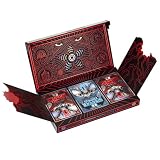
- WELCOME TO THE UPSIDE DOWN – Bring Hawkins energy to every shuffle with a Stranger Things playing card box set made for poker nights, blackjack, solitaire, magic practice, cardistry, party games, display, and gifting. A bold choice for fans who want cards with real story and atmosphere.
- THREE DECK COLLECTOR SET – This box set includes three themed playing card decks, including the blue holographic foil Upside Down Special Edition. It gives fans more than a single deck, making it stronger for display, collecting, gift baskets, game night, and fan collections.
- VHS-STYLE DISPLAY BOX – Housed in a nostalgic VHS-style box with red and holographic silver foil details and embossed accents, this set feels pulled straight from the world of Hawkins. It stands out on a shelf, desk, collector case, coffee table, or game room display.
- STRANGER THINGS ARTWORK – Featuring characters, moments, and supernatural atmosphere from the Stranger Things universe, this set brings more personality than ordinary playing cards. Great for fans of Hawkins, the Upside Down, Eleven, Demogorgon stories, and retro sci-fi horror.
- READY FOR PLAY, MAGIC & GIFTS – Use the decks for poker, rummy, blackjack, solitaire, beginner magic tricks, card flourishes, cardistry practice, family game night, travel entertainment, party games, collector shelves, birthdays, holidays, stocking stuffers, and fan gifts.
The Duffer Brothers have emphasized that this distinction was central to the ending. After years of narratives that treated power as destiny, the finale pauses to ask a quieter, more human question: who is Eleven when she is not being asked to save the world?
The Show Rejects the “Power Equals Purpose” Myth
Genre storytelling often equates strength with meaning. If a character has extraordinary abilities, the implication is that they exist to use them. Stranger Things spends its final moments actively dismantling that idea.
In the aftermath of Vecna’s defeat, Eleven is not framed as a weapon awaiting the next war. Instead, she occupies a liminal space where her powers are present but no longer central to her identity. According to the Duffers, this was a conscious rejection of the notion that her value should be measured by effectiveness or sacrifice.
Why the Finale Refuses a Definitive Answer About Her Powers
One of the most debated elements of the ending is its refusal to clearly define the future of Eleven’s abilities. Are they diminished? Stabilized? Simply irrelevant for now? The ambiguity is intentional.
Quick wins for a faster PC:
Fix the driver behind crashes, sound loss and screen glitchesFind Drivers →Repair Windows errors before they cause bigger problemsFix Now →Scan for outdated or missing drivers - takes under a minuteDriver Scan →The creators have explained that locking her into a clear power-based outcome would have undercut the point of her arc. By leaving that question open, the finale shifts focus away from mechanics and toward meaning. What matters is not the status of her abilities, but that her life is no longer organized around them.
Choosing Selfhood Over Obligation
For the first time in the series, Eleven’s choices are not reactive. She is no longer responding to danger, commands, or expectations placed on her by authority figures. The finale positions her as someone who can exist without immediately being needed.
This is where the theme of personhood crystallizes. The Duffers have described Eleven’s ending as a reclamation, not of power, but of agency. She is finally a person who happens to have abilities, rather than an ability shaped into a person.
A Coming-of-Age Story That Ends With Humanity, Not Heroics
By stepping back from spectacle, the finale affirms what Stranger Things has been building toward since season one. Growing up is not about mastering power; it is about understanding oneself beyond it. Eleven’s journey ends not with a grand display of strength, but with a quieter assertion of identity.
The Tool Desk
Outbyte Driver Updater FREEScan for outdated or missing drivers - takes under a minuteDriver Scan →Outbyte PC Repair FREERepair Windows errors before they cause bigger problemsFix Now →In that sense, her fate is the most grounded outcome the show could offer. The battle is over, but the life remains. And for the first time, that life belongs fully to her.
How Eleven’s Fate Connects to the Show’s Endgame and the War With the Upside Down
Eleven’s ending only fully clicks when viewed against the scale of what Stranger Things ultimately set out to resolve. The war with the Upside Down was never just a physical conflict; it was a story about trauma, control, and the cost of survival. Her fate reflects the idea that defeating Vecna was as much about breaking cycles of exploitation as it was about closing interdimensional gates.
Rather than positioning Eleven as the final lock on the Upside Down, the finale reframes her as proof that the conflict has moved beyond needing a singular savior. The world no longer depends on her suffering to stay intact. That shift is the real victory.
The End of the Weapon Narrative
From the moment Eleven escaped Hawkins Lab, the show grappled with whether power could exist without abuse. The Upside Down war repeatedly forced her back into the role of weapon, even when the intentions were benevolent. By the finale, the Duffers intentionally dismantle that framework.
Vecna’s defeat does not hinge on Eleven annihilating him through sheer force. Instead, it emerges from collective resistance, emotional confrontation, and the consequences of his own fractured ideology. Eleven stepping out of the spotlight signals the end of a narrative where one traumatized child must bear the weight of the world.
Why the Upside Down Doesn’t Need Eleven Anymore
The finale suggests that the Upside Down is no longer sustained by a single psychic imbalance. Its collapse is tied to exposure, understanding, and communal action rather than raw power. In that sense, Eleven’s reduced centrality is a sign of progress, not loss.
The Duffers have framed this as a maturation of the story’s mythology. Early seasons required Eleven to bridge worlds because no one else could. By the end, the characters — and the town itself — are capable of facing the aftermath together. Eleven’s fate confirms that the war has shifted from survival to healing.
A Victory Defined by Survival, Not Sacrifice
Stranger Things consistently flirted with the idea that Eleven’s story would end in martyrdom. The finale rejects that expectation outright. Her survival without obligation is the clearest thematic statement the show makes about growing up.
What’s actually slowing this PC down?
Pick the symptom - the matching free tool is one click away.
Rank #4
The war demanded courage, but it does not demand her life, her identity, or her future. In sparing Eleven from a destiny of eternal guardianship, the Duffers reinforce that coming of age is not about giving everything away. It is about learning when the fight is finally over — and allowing yourself to live beyond it.
Independent reader supportYour contribution helps us test, update, and keep practical guides available for everyone.Symbolism and Visual Clues You Might Have Missed in Eleven’s Final Scenes
While the finale’s plot resolution is relatively clear, the Duffer Brothers pack Eleven’s final moments with quiet visual storytelling that reframes her entire journey. These choices aren’t about teasing future threats or hidden twists. They’re about signaling closure, autonomy, and a redefinition of who Eleven is allowed to be when the fighting stops.
The Return to Stillness
One of the most striking elements of Eleven’s last scenes is how physically still she is. Gone are the nosebleeds, the aggressive close-ups, and the frantic camera movement that once accompanied her use of power. The framing lingers instead, often holding her in wider shots that place her within the group rather than isolating her as a force of nature.
This visual calm mirrors the Duffers’ intent to show that Eleven no longer exists in a constant state of activation. For the first time, she is not being watched, measured, or braced for impact. Stillness becomes a symbol of safety rather than vulnerability.
Free tools Windows power users keep installed
One-click scans. No signup required.
Costuming as Identity, Not Armor
Eleven’s wardrobe in the finale subtly completes a long-running visual arc. She is no longer dressed like a lab subject, a soldier, or even a symbolic superhero figure. Her clothing blends in, signaling choice rather than assignment.
The Duffers have often used costume to reflect control, from the hospital gowns to the pink dress meant to disguise her. Here, normalcy is not camouflage. It is self-expression, underscoring that Eleven’s identity is no longer defined by how useful she is in a crisis.
The Absence of Powers as a Visual Choice
Notably, the finale avoids any dramatic demonstration of Eleven’s abilities. There is no final test, no moment where she proves she still has it. The camera never asks her to perform.
This absence is deliberate. By refusing to visually confirm her powers one way or the other, the show aligns with the Duffers’ stance that her worth is no longer tied to spectacle. What matters is not what she can do, but that she is free from needing to prove it.
Light, Space, and the End of Confinement
Eleven’s final scenes are bathed in natural light, a stark contrast to the shadowed basements, tanks, and voids that defined her earlier years. Doors remain open. Windows are visible. The frame breathes.
These environmental details reinforce the thematic endpoint of her arc. Eleven’s story began in confinement and secrecy. It ends in openness, not because the danger was small, but because she finally is no longer contained by it.
A Quiet Goodbye to the Supernatural
Perhaps the most telling clue is what the finale does not linger on. There is no ominous Upside Down echo in Eleven’s final beat, no visual reminder that she remains tethered to that world. The supernatural fades into the background as her humanity comes forward.
The Duffers use this restraint to make a clear statement. Eleven’s relationship with the Upside Down is no longer her defining feature. Her final scenes don’t close the door on possibility, but they firmly close the chapter on obligation, allowing her story to end not with power, but with peace.
Quick wins for a faster PC:
Clear out junk files and repair common Windows errorsFree Scan →Fix the driver behind crashes, sound loss and screen glitchesFind Drivers →What Eleven’s Ending Means for the Future of Hawkins — and for Her Final Chapter
Eleven’s quiet ending doesn’t just resolve her personal journey; it subtly reframes what victory looks like for Hawkins itself. The town survives not because its greatest weapon is still armed, but because the cycle that demanded children sacrifice their innocence has finally been broken.
By stepping away from spectacle, the finale suggests Hawkins’ future is no longer dependent on supernatural intervention. The Duffer Brothers have long framed the town as a pressure cooker for trauma, secrets, and repression. Letting Eleven exit that role signals that Hawkins’ healing, like hers, must now come from community rather than combat.
Hawkins Without a Living Weapon
For seasons, Hawkins relied on Eleven as its last line of defense, even when it pretended otherwise. Her presence allowed adults to avoid responsibility and systems to remain broken. The finale removes that crutch.
The Duffers’ intent here is thematic, not logistical. By ending Eleven’s story without reactivating her powers, the show implies that survival shouldn’t require another child to be weaponized. Hawkins’ future, uncertain as it is, must be faced without exploiting the vulnerable.
Best Value
Coming of Age Without a Final Test
Traditional genre storytelling often demands a final trial, a last sacrifice that cements adulthood. Stranger Things deliberately refuses that structure for Eleven. She doesn’t graduate through pain; she simply arrives.
This choice aligns with the Duffers’ broader coming-of-age philosophy. Growing up, in their view, isn’t about proving strength under pressure. It’s about choosing who you are when no one is demanding anything from you.
Identity Chosen, Not Assigned
Eleven’s ending clarifies something the series has been building toward since its earliest episodes: her identity was always imposed. A number. A tool. A solution. The finale removes all of that scaffolding.
What remains is not ambiguity, but autonomy. Whether her powers return someday is deliberately beside the point. The Duffer Brothers frame her future as open because, for the first time, it belongs to her.
PC Slower Than It Used to Be?
A free scan shows the junk files, broken settings and background clutter dragging Windows down - then fixes them in one click.Free scan · Windows 10 & 11Crashes, No Sound, or Screen Glitches?
Random freezes, missing sound and display glitches usually trace back to one bad driver. Find and replace yours safely.Free scan · under a minuteThematic Closure, Not Narrative Erasure
Importantly, the finale doesn’t pretend the trauma never happened. Eleven’s past isn’t rewritten or redeemed through triumph. It’s acknowledged and then allowed to rest.
That distinction gives her arc its emotional weight. Stranger Things ends Eleven’s story not by erasing what she endured, but by refusing to let it dictate her future. In doing so, the show closes its most important chapter with intention rather than escalation, trusting that peace, earned quietly, is still an ending worth believing in.
The Bigger Picture: Why the Duffer Brothers Chose This Ending for Their Central Hero
For the Duffer Brothers, Eleven’s finale was never about shock value or spectacle. It was about closing the loop on a story that began with a child defined entirely by what she could do for others. Ending her journey without a final, power-fueled victory reframes Stranger Things as a coming-of-age story first, and a genre epic second.
Breaking the Cycle of Sacrifice
Across the series, Eleven is repeatedly asked to give more than anyone else, often at great personal cost. Each victory comes with an expectation that she will keep sacrificing, keep bleeding, keep saving a town that rarely protects her in return. The finale intentionally interrupts that pattern.
By choosing restraint over escalation, the Duffers reject the idea that heroism must always be transactional. Eleven is not required to suffer one last time to justify her existence or her place in the world. That refusal is the ending’s most radical move.
A Rejection of the “Chosen One” Trap
Stranger Things has always flirted with the chosen one mythology, only to slowly dismantle it. Eleven may have been uniquely powerful, but the show increasingly questioned whether that uniqueness was a gift or a burden imposed by others. The finale resolves that tension by stepping away from destiny altogether.
The Duffer Brothers have explained that they didn’t want Eleven’s life to feel pre-written by trauma or prophecy. By leaving her future undefined, they allow her to exist outside narrative obligation. She is no longer the story’s answer; she is simply a person allowed to continue living.
Letting the World Grow Up Too
Just as importantly, the ending shifts responsibility away from Eleven and back onto the world around her. Hawkins can no longer depend on a single child to absorb its darkness. Adults, institutions, and communities must now confront the consequences of what they ignored.
The Tool Desk
Outbyte PC Repair FREEClear out junk files and repair common Windows errorsFree Scan →Outbyte Driver Updater FREEFix the driver behind crashes, sound loss and screen glitchesFind Drivers →This mirrors the show’s broader thematic evolution. Growing up, Stranger Things suggests, isn’t only about individual maturity. It’s about collective accountability, and the willingness to stop outsourcing survival to the most vulnerable.
An Ending Rooted in Humanity, Not Power
In the end, the Duffers chose an ending that honors Eleven’s humanity over her abilities. Her story doesn’t conclude with a grand display of strength, but with something far rarer in genre storytelling: rest. Peace. The possibility of a life not shaped by emergency.
That choice crystallizes what Stranger Things was ultimately trying to say. Monsters can be defeated, but cycles must be broken. By letting Eleven walk forward without a mandate to save the world again, the series delivers its quiet final statement: growing up isn’t about what you can endure, but about what you no longer have to.
Quick Recap
Product prices and availability are accurate as of the date/time indicated and are subject to change. Any price and availability information displayed on Amazon at the time of purchase will apply.
Recommended Free Tools




