Justin.tv officially shut down on August 5, 2014. The website, mobile apps, and APIs disappeared, but live video did not. The company closed its original broad livestreaming platform so it could focus on Twitch, the gaming service that had started inside Justin.tv and become its dominant product.
Justin.tv officially shut down on August 5, 2014. Its website, mobile apps, and APIs went offline, ending one of the internet’s most influential early live-video experiments. The company did not abandon live broadcasting, however. It retired the broad Justin.tv brand to concentrate its engineering, money, and community around Twitch—the gaming-focused service that had begun as one category inside Justin.tv and had become the company’s dominant product.
The shutdown was therefore less a failure of live video than the final stage of a strategic pivot. Justin.tv helped make user-generated livestreaming possible at scale. Twitch discovered that gaming was the category with the strongest combination of repeat viewing, chat, creators, and community—and inherited the business.
From a 24-hour personal broadcast to a public platform
Justin.tv began with an intentionally strange idea. In late 2006, founders including Emmett Shear and Justin Kan worked on a continuous reality-video project centered on Kan. On March 19, 2007, Kan began broadcasting his life around the clock, wearing a camera connected to a computer so that viewers could watch his daily activities online.
Do these 3 things before closing this tab:
1Repair Windows errors before they cause bigger problems2Fix the driver behind crashes, sound loss and screen glitches3Clear out junk files and repair common Windows errors#1 Best Overall
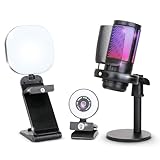
- ALL-IN-ONE STREAMING & GAMING SETUP — Everything you need to go live in one box: a 1080P HD webcam, RGB USB microphone, and adjustable LED light. Skip piecing together streaming accessories one at a time — plug in and start streaming in minutes.
- CRYSTAL-CLEAR 1080P VIDEO — A high-resolution CMOS sensor captures true 24-bit color up to 1920×1080 at 30FPS, with automatic brightness and color compensation so you look sharp on Twitch, YouTube, Zoom, or Teams without manual tweaking.
- STUDIO-QUALITY AUDIO, BACKED BY A 30 DAY WARRANTY — A 14mm capacitive microphone with cardioid pickup, built-in pop filter, gain control knob, and shock mount delivers clear, echo-free sound (>70dB signal-to-noise). Real-time headphone monitoring lets you hear exactly what your audience hears — and it's backed by a full 30 DAY
- PROFESSIONAL LIGHTING, 5 MODES & 5 BRIGHTNESS LEVELS — A CRI 90+ LED panel spans 3000–7200K, from warm to cool white, with 5 brightness levels and a memory function that saves your favorite setting. Rotates 180° and hooks onto your monitor for the perfect angle every time.
- WORKS RIGHT OUT OF THE BOX—Compatible with Windows, Mac, Android, and iOS for streaming, video calls, and content creation. Note: PS5/Xbox streaming requires a capture card (sold separately) to connect this kit to your console.
This original “lifecasting” experiment was not yet the broad livestreaming platform that Justin.tv would become. The company soon opened the service to other broadcasters. Instead of one founder serving as the subject of a permanent online reality show, ordinary users could create channels and transmit their own live video.
That change was the important breakthrough. Justin.tv was not the first website to show video, and it did not invent every form of live broadcasting. Its significance was helping normalize the idea that people outside traditional television could broadcast live to an internet audience.
Justin.tv covered much more than gaming
Before Twitch became the company’s central identity, Justin.tv was a general-purpose live-video site. Its categories included gaming, but also many other kinds of broadcasts. The platform’s breadth was both its appeal and its difficulty: it had to support a wide range of content, audiences, moderation problems, technical demands, and business models.
Gaming gradually stood out. It generated viewers who returned frequently, broadcasters who streamed for long periods, active text-chat communities, and a strong relationship between creators and their audiences. Those characteristics made gaming especially well suited to a dedicated live-video service.
The Tool Desk
Outbyte Driver Updater FREEScan for outdated or missing drivers - takes under a minuteDriver Scan →Outbyte PC Repair FREEClear out junk files and repair common Windows errorsFree Scan →How Twitch grew out of Justin.tv
Gaming first existed as one section of Justin.tv. As the category became increasingly important, the company created a dedicated destination for it. Twitch launched on June 6, 2011, as a gaming-focused evolution of the Justin.tv business—not as an unrelated company that appeared from nowhere.
The separation allowed Twitch to build a clearer product around gamers, game broadcasts, chat, esports, and creator communities. It also gave the company a more focused identity than the original all-purpose platform could offer.
By early 2014, Twitch had eclipsed the rest of the business. In announcing its corporate reorganization, Twitch reported more than 45 million monthly viewers, more than one million monthly broadcasters, and roughly 13 billion minutes watched each month. These were company-reported figures from that period, not current Twitch audience statistics.
Rank #2

- Compatible with Nintendo Switch 2’s new GameChat mode
- Auto-Light Balance: RightLight boosts brightness by up to 50%, reducing shadows so you look your best—compared to previous-generation Logitech webcams (1)
- Privacy with a Slide: The integrated webcam cover makes it easy to get total, reliable privacy when you're not on a video call
- Built-In Mic: The built-in microphone lets others hear you clearly during video calls
- Easy Plug-And-Play: The Brio 101 works with most video calling platforms, including Microsoft Teams, Zoom and Google Meet—no hassle; it just works
The corporate shift came before the shutdown
On February 10, 2014, the company announced that Twitch Interactive, Inc. would replace Justin.tv, Inc. as its corporate umbrella. Justin.tv remained available at that point as a mature product, but the change made the strategic direction unmistakable: Twitch was now the primary brand and the center of the company’s future.
Quick wins for a faster PC:
Repair Windows errors before they cause bigger problemsFix Now →Scan for outdated or missing drivers - takes under a minuteDriver Scan →The company’s August shutdown announcement gave the practical reason for closing Justin.tv. Continuing to operate the older service was incompatible with concentrating resources on Twitch. Running a large live-video platform required expensive infrastructure, storage, engineering, operations, moderation, and support. Maintaining two related destinations no longer made sense when one had clearly become the stronger product.
Justin.tv’s closure was consequently a product and brand consolidation decision. The company did not stop investing in live video; it stopped investing in the Justin.tv identity.
What happened on August 5, 2014?
The shutdown was immediate. After August 5, the Justin.tv website, mobile applications, and APIs were no longer in service. Users were directed toward information about moving their accounts or usernames to Twitch, with contemporary reports identifying September 5, 2014, as the deadline for that transition.
That transfer period should not be confused with continued Justin.tv operation. The transition gave users a limited opportunity to preserve an account or username within the Twitch ecosystem; it did not keep the original site running.
Nor did the closure mean that all Justin.tv broadcasts automatically became a permanent public archive. Twitch had already described the enormous storage demands created by recorded broadcasts. In 2013, it said the combined services were ingesting and storing extraordinary volumes of video and explained that recording would become opt-in for new broadcasters. The end of Justin.tv therefore also exposed a problem familiar to internet history: a service can be culturally important without preserving everything it hosted.
Was Justin.tv acquired by Amazon?
No. The dates matter. Justin.tv shut down on August 5, 2014. On August 25—20 days later—Amazon announced an agreement to acquire Twitch for approximately $970 million in cash.
There had been acquisition speculation involving Twitch and other companies, including reports concerning Google and YouTube. Those reports should not be confused with the completed public announcement. Amazon’s announcement described the acquisition of Twitch, the gaming livestreaming business that had grown out of Justin.tv; it did not present Justin.tv as a continuing consumer brand.
The timing made the business logic clear in retrospect. The company had already decided that Twitch, rather than the older general-purpose platform, was the valuable strategic asset. Amazon’s announcement confirmed the market value of that focused live-video business.
What users lost—and what survived
Users lost access to the Justin.tv destination itself, including its applications and APIs. Some account and username information could be moved to Twitch during the short transition window, but the original community, categories, interface, and broad platform identity did not survive as a separate service.
Some historical material was later preserved by third-party archival projects. These efforts are valuable for researchers and former users, but they are partial and independent rather than an official restoration of Justin.tv. There is no basis for treating them as a complete record of the site’s video history.
What’s actually slowing this PC down?
Pick the symptom - the matching free tool is one click away.
The brand’s retirement was reinforced in November 2017, when Twitch said it was releasing nearly 30 million inactive usernames associated with its predecessor, Justin.tv. By then, Justin.tv was plainly a historical predecessor rather than a dormant consumer product waiting to return.
Independent reader supportYour contribution helps us test, update, and keep practical guides available for everyone.Why Justin.tv still matters
Justin.tv’s legacy is easy to misstate. It did not invent all livestreaming, and Twitch was not created independently in 2011. The more accurate story is a sequence of experiments and narrowing choices:
Rank #4

- 4K Ultra HD Video Webcam:See every detail with crystal-clear 4K resolution. Experience incredibly sharp and lifelike video quality that makes you look professional on every call, ensuring you're always seen in the best light.
- Wide 80° Field of View & Full 360° Flexibility:Fit everyone into the frame with the 80° wide-angle lens. Easily adjust your view with 180° tilt and 360° swivel rotation. Mount it securely on your monitor, desk, or tripod for the perfect angle every time.
- True Plug-and-Play Simplicity: No drivers, no fuss. Just connect the webcam to your computer via USB and you're ready to join calls in seconds. It offers seamless compatibility with all major platforms like Zoom, Teams, and Skype.
- Complete Privacy with a Physical Sliding Lens Cover: Worried about privacy? We've got you covered—literally. A built-in sliding lens cover physically blocks the camera when not in use, ensuring your private life stays private.
- Built-in Mic & Automatic Light Correction: Communicate clearly with the built-in noise-reducing microphone. The camera also intelligently adjusts the video brightness to make you look your best, even in poor lighting conditions.
- Late 2006: the founders developed a continuous lifecasting concept centered on Justin Kan.
- March 2007: Kan began broadcasting his life continuously.
- Later in 2007: Justin.tv expanded into a platform where other users could broadcast live video.
- June 2011: the gaming category became Twitch, a dedicated service.
- February 2014: Twitch Interactive replaced Justin.tv, Inc. as the corporate umbrella.
- August 2014: the original Justin.tv service closed.
- August 25, 2014: Amazon announced its agreement to acquire Twitch.
The lesson is not simply that a startup “pivoted.” Justin.tv demonstrated that broad live broadcasting could attract creators and audiences, then revealed through its own usage that one community—gaming—had unusually strong product-market fit. Twitch was the concentrated version of what the wider platform had helped discover.
That is why Justin.tv can be both a vanished website and a surviving institution. The name, apps, APIs, and original destination disappeared, but the technical knowledge, company, audience dynamics, and live-video business continued through Twitch. In that sense, Justin.tv did not exactly die when it shut down. It was absorbed into the more focused service it had helped bring into existence.
PC Slower Than It Used to Be?
A free scan shows the junk files, broken settings and background clutter dragging Windows down - then fixes them in one click.Free scan · Windows 10 & 11Crashes, No Sound, or Screen Glitches?
Random freezes, missing sound and display glitches usually trace back to one bad driver. Find and replace yours safely.Free scan · under a minuteFrequently Asked Questions
When did Justin.tv shut down?
Justin.tv officially shut down on August 5, 2014. Its website, mobile apps, and APIs were taken offline that day.
Was Justin.tv the same company as Twitch?
No. Justin.tv was the broader live-video platform, while Twitch began as its gaming category and later became the company’s primary product. Amazon announced an agreement to acquire Twitch on August 25, 2014, after Justin.tv had already closed.
Why did Justin.tv shut down?
The company said it was shutting Justin.tv down to concentrate its resources on Twitch. This was a product and brand consolidation decision, not an announcement that live video itself had failed.
Could Justin.tv users move to Twitch?
Some users could transfer accounts or usernames to Twitch during a limited transition period, reportedly ending September 5, 2014. The original Justin.tv service and its video archive did not continue as a complete public platform.
The Bottom Line
Bottom line: Justin.tv shut down on August 5, 2014, because Twitch had become the company’s dominant and more promising product. The closure ended the original general-purpose live-video platform, but its technology, business, and historical influence continued through Twitch, which Amazon agreed to acquire later that same month.
Quick Recap
Product prices and availability are accurate as of the date/time indicated and are subject to change. Any price and availability information displayed on Amazon at the time of purchase will apply.




