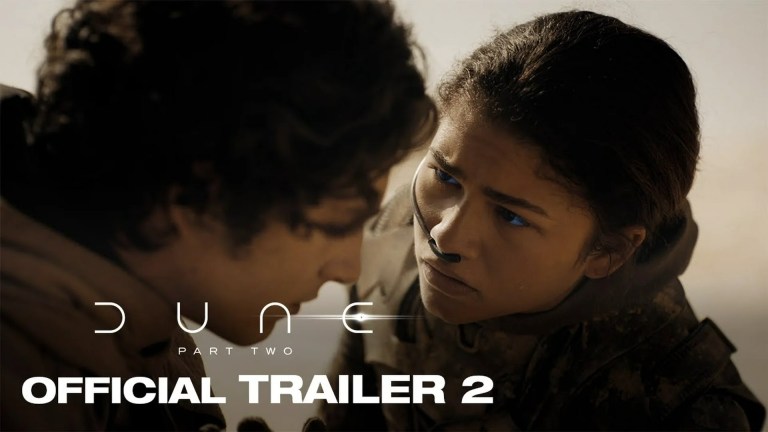
Spoilers for the ending of Dune: Part Two. Paul Atreides is not presented as a straightforward hero. The film makes his revenge and solidarity with the Fremen understandable, then shows the danger of the messianic authority he claims and the wider conflict he unleashes. “Villain” is possible, but too simple if it implies that every choice he makes is purely evil. The film’s sharper point is that a leader can have sympathetic motives and still become dangerous.
Why Paul can look like a hero
Paul begins the film as a survivor of the Harkonnens’ destruction of House Atreides. The official Warner Bros. synopsis describes him joining Chani and the Fremen while pursuing revenge against the conspirators who destroyed his family. He also fights a regime that dominates Arrakis. Those motives make his rise resemble a liberation story, and help explain why some viewers may initially read him as a heroic resistance leader. Warner Bros.’ official synopsis frames that conflict as part of his journey.


![Dune: Part Two [Blu-Ray, Region Free]](https://m.media-amazon.com/images/I/51UuGiFcL6L._SL160_.jpg)
But understanding why Paul fights is not the same as endorsing what he does with victory. The film’s moral tension lies in the distance between his personal grievance and the scale of the power he ultimately accepts.
Why the ending makes his rise dangerous
At the climax, Paul defeats Feyd-Rautha, maneuvers to claim the imperial throne, and calls the Fremen to carry the conflict beyond Arrakis. His victory is therefore not a settled happy ending: it places an expanding war alongside his new authority. TIME’s account of the ending describes how the film’s conclusion follows the novel’s broad climax while changing aspects of character arcs.
#1 Best Overall
Director Denis Villeneuve described the book’s ending as “the beginning of something that is out of control,” a framing that fits the film’s ominous final turn. Vanity Fair’s interview with Villeneuve records the remark. The implication is not that Paul’s earlier resistance was meaningless; it is that his triumph has set forces in motion that cannot be contained by calling him a liberator.
How Chani gives the film distance from Paul
Chani is more than a companion who witnesses Paul’s ascent. Villeneuve said she gives him “a critical distance with Paul” and lets the audience see Paul’s transformation from her perspective. He also described expanding Chani and Jessica into characters with their own agendas rather than leaving them in the background. In his Moviefone interview, Villeneuve explains how those perspectives shape the adaptation.
Rank #2
That choice matters because Paul’s charisma might otherwise make his account of events feel like the film’s only account. Chani’s perspective helps viewers notice the cost of his political and religious transformation instead of treating his growing influence as an uncomplicated sign of destiny.
What Villeneuve says the story is warning about
Villeneuve has said that Frank Herbert intended Paul’s story to be read as a cautionary tale about charismatic figures, not simply as a celebration of a hero. He connected that aim to Dune Messiah, which he described as an epilogue to Paul’s journey. This is Villeneuve’s account of Herbert’s intentions; it should not be mistaken for a direct quotation from Herbert. Moviefone’s interview reports Villeneuve’s explanation, and Polygon’s interview syndicated by GameLud likewise records his stated aim to challenge the perception of Paul as a hero.
The Tool Desk
Outbyte Driver Updater FREEScan for outdated or missing drivers - takes under a minuteDriver Scan →Outbyte PC Repair FREERepair Windows errors before they cause bigger problemsFix Now →Rank #3
![Dune: Part Two [Blu-ray] (2024)](https://m.media-amazon.com/images/I/61mS5bP9KcL._SL160_.jpg)
- Denis Villeneuve returns to direct this second instalment of the adaptation of Frank Herbert's epic sci-fi novel.
The warning is about the risks of investing power in a charismatic leader, even when his cause begins with real suffering and injustice. Paul’s attachment to the Fremen and opposition to the Harkonnens coexist with his decision to claim imperial authority and activate a movement whose violence reaches beyond Arrakis.
Independent reader supportYour contribution helps us test, update, and keep practical guides available for everyone.How the film’s answer differs from a simple label
Dune: Part Two, released in 2024, adapts the latter portion of Frank Herbert’s 1965 novel. The 59 years in the original framing are the elapsed time between the novel’s publication and the film’s release—not a separate measure of a debate. The film follows the novel’s broad climax but makes its own choices about point of view and character. Villeneuve has emphasized that adaptation transforms its source material, calling this version his adaptation, with his sensibility. TIME’s interview with Villeneuve discusses both the novel’s context and his approach to adaptation.
Rank #4
![Dune: Part One & Part Two (Dune 2-Movie Collection, 3-Disc Set) [4K UHD + Blu-ray] [Region Free]](https://m.media-amazon.com/images/I/51ppyZ1p3qL._SL160_.jpg)
- Dune Part One & Part Two 4K Bundle
So, is Paul actually the hero of Dune: Part Two? He has heroic-seeming motives and acts against a brutal enemy, but the film does not ask viewers to treat that as proof he remains a hero after claiming imperial power. Nor does it require the neat conclusion that he is evil in every respect. Its judgment is more unsettling: Paul’s transformation makes him dangerous, and his victory begins rather than ends the crisis.
Quick Recap
Best Value
Product prices and availability are accurate as of the date/time indicated and are subject to change. Any price and availability information displayed on Amazon at the time of purchase will apply.
Quick wins for a faster PC:
Fix the driver behind crashes, sound loss and screen glitchesFind Drivers →Clear out junk files and repair common Windows errorsFree Scan →Scan for outdated or missing drivers - takes under a minuteDriver Scan →