Windows Errors? Fix Them Before They Spread
Repair common Windows errors and clear accumulated junk for a smoother, more stable PC - no reinstall needed.Free scan · no reinstallCrashes, No Sound, or Screen Glitches?
Random freezes, missing sound and display glitches usually trace back to one bad driver. Find and replace yours safely.Free scan · under a minuteTo write gospel music, begin with a clear Christian message and the people who will sing it. Turn that message into a memorable refrain, develop it through focused verses, then shape the melody, groove, harmony, and performance around the setting—whether that is a congregation, choir, quartet, worship team, or soloist. There is no single required gospel chord progression or tempo; participation, expression, and a faithful, singable message matter more than a formula.
1. Choose the message, singers, and setting
Decide what the song needs to do before you choose its sound. It might offer praise, tell a testimony, express lament, encourage listeners, or teach a congregational truth. Write down the intended singers and setting: a soloist with a response group, a choir, a quartet, a worship team, or a whole congregation.

That choice affects nearly everything that follows. A congregation needs words and a refrain it can catch quickly; a soloist can carry a more detailed story and leave space for responses. Gospel is not one uniform sound. The Library of Congress describes its roots in African American spirituals and emphasizes rhythmic religious song and the creative harmony of group singing. Its history also includes distinct traditions and influences, so identify the approach you are drawing on rather than treating one arrangement as universal: Library of Congress: Gospel music and Library of Congress: African American song.
2. Find the central statement—and check its source
If Scripture prompted the song, read the passage in context before turning it into lyrics. Notice who is speaking, to whom, what changes emotionally, and what the text actually claims. Then write the song’s central idea as one plain sentence. This keeps the lyric focused and helps distinguish a faithful paraphrase from a phrase that sounds biblical but adds a claim the passage does not make.
#1 Best Overall
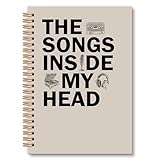
- Notebook Size: Measuring 6x8.2 inches, this notebook comes with a sturdy hardcover and smooth, premium pages. Perfect for everyday use and built to last
- Multifunctional Use: This notebook has a total of 82 sheets and 164 pages, whether it is used for school notes, work records, or as a personal diary, study notes or work journal, it can meet your diverse needs. Its exquisite design enhances the user experience and serves as stylish desk decor
- Decorative Notebook:This notebook features a distinctive design, making it a great addition to your desk decor. Whether it's the unique pattern or simple typography, this notebook isn't just a great writing tool—it's also a reflection of your personal style
- Spiral Bound Notebook:This journal notebook features a spiral design that allows it to open completely 180°flat for easy writing. It also folds seamlessly 360°without creasing. The pages are easy to tear and don't fall apart easily
- Perfect Gift Idea: These notebooks can be used not only for personal use but also as a thoughtful gift. The unique cover design of the notebooks is perfect for those who love to write. A thoughtful gift choice for students, teachers, writers, doctors, nurses, friends and more
The Gospel Coalition’s songwriting guidance puts the principle directly: “Stay Faithful to the Text.” It recommends observing the passage before interpreting it, consulting a commentary or study Bible when useful, and asking a pastor or trusted friends to review the finished song. Matt Papa, a songwriter and worship leader, describes the memorable power of songwriting this way: “A song is a sermon people remember.” Treat that as a reason to be careful and clear, not as a license to overstate what a verse means. The Gospel Coalition’s songwriting guidance.
3. Write a hook people can sing back
Put the central statement into a short line with natural spoken stress and a melody that is easy to remember. That line can become the refrain—the part listeners return to after each verse. Repetition is useful when it gives a group a clear way into the song, not when it merely fills time.
Rank #2

- Includes tips, prompts, and words of wisdom from songwriting masters to inspire your muse.
- Mix of lined pages (lyrics), staffed pages (music), and fret diagrams.
- Room to write 72 songs.
- Acid-free, archival-quality 120 gsm paper takes pen or pencil beautifully.
- Sturdy hardcover binding protects your work.
Try an antecedent-and-consequent shape: a leader sings a thought, and the group answers with a compact response. Make the relationship audible in both words and tune; the musical accents should support the lyric’s natural emphasis. Pilgrim Ministry describes gospel songs as unified word-and-tune compositions, while the Ohio Music Education Association handout discusses the refrain as a defining feature of gospel songs and a way for a group to join in familiar repetitions. Pilgrim Ministry on gospel music and Ohio Music Education Association gospel music handout.
4. Build verses that make the refrain matter
Give each verse a job. It might move from trouble to hope, from personal testimony to praise, or from a question to a response. Focus each verse on one image or turn in the story, and let its closing line lead naturally into the refrain.
The Tool Desk
Outbyte Driver Updater FREEFix the driver behind crashes, sound loss and screen glitchesFind Drivers →Outbyte PC Repair FREERepair Windows errors before they cause bigger problemsFix Now →Rank #3

- 【Perfect Gift for Musicians】: This is a wonderful personalized gift for singers/musicians. It's a great birthday gift, singing gift, and this music leather journal notebook is tailored just for you. It gives you plenty of space to jot down your current thoughts.
Choose concrete details over filler syllables and vague religious clichés. If the refrain declares hope, a verse can show what makes that hope meaningful. If you paraphrase Scripture, preserve its meaning while using your own images and contemporary language where those make the idea clearer. Read the words aloud and check that they are understandable without an explanation.
5. Shape melody, groove, and emotional movement
Start with a melody suited to the singers’ range and experience. Shape its rhythm and contour around the message: a quiet, sustained phrase can support reflection, while a more driving pattern can carry celebration. Gospel history includes strong rhythmic drive and brisk motor rhythms; contemporary composition teaching also treats melody, harmony, rhythm, structure, and lyrics as connected choices. There is no universal tempo that makes a song gospel.
Rank #4
Experiment with syncopated accents, a rising dynamic, or a call-and-response passage, but keep the central hook easy to find and repeat. PBS LearningMedia’s “Exploring Intent-Based Composition through Gospel Music,” published January 9, 2025, is one educational resource for thinking through those musical elements. PBS LearningMedia: Exploring Intent-Based Composition through Gospel Music.
Independent reader supportYour contribution helps us test, update, and keep practical guides available for everyone.6. Arrange harmony for the people who will sing it
Write the lead line first. Once it works on its own, add a response or sustained harmony that supports rather than obscures it. Use the simplest parts that achieve the sound you want; a song does not need every available arranging device.
Best Value

- Perfect Quality: Our notebook is made of high-quality faux leather with hand-stitched binding, ensuring durability and luxury. The soft cover provides a comfortable touch, making it ideal for students and professionals.
- Vintage Design with Embossed Cover: This notebook features a beautiful vintage design with an embossed cover, adding a unique and elegant touch. Available in classic black and brown and gray and pink, there's something for every style.
- Thicker Acid-Free Pages: With 300 Pages of thick acid-free paper, our notebook is 20-50% thicker and smoother than regular paper. It is compatible with most pens and environmentally friendly, protecting your eyesight.
- Functional and Stylish: The unique embossing process creates a raised texture on the cover, enhancing its aesthetic appeal. With dimensions of 5.7 x 8.3 inches, it is perfect for travel, business, or back-to-school use.
- Great Gift Choice: Our notebook is an excellent gift choice for loved ones, friends, family, or colleagues. Available in various classic colors, it combines style and functionality.
The Ohio Music Education Association handout describes common three-part SAT writing and four-part SATB writing in hymn, spiritual, and quartet contexts. It also discusses moving between unison and harmony, expressive vocal colors, inversions, and modulations. These are options, not requirements. A congregation may need a strong unison melody and a response it can learn quickly; a choir or quartet may be able to sustain more independent parts. Ohio Music Education Association gospel music handout.
7. Rehearse, revise, and plan the ending
Sing the song with the actual performers. Listen for unclear diction, awkward breaths, lines that are hard to remember, and words that become difficult at tempo. Revise those before adding extra musical complexity. Decide where a leader may ad-lib, where the group answers, and whether the song needs a repeated closing vamp or a modulation.
In traditional gospel, a written score can serve as a framework rather than a complete performance script. Carnegie Hall’s traditional-gospel timeline describes music that invites performers to interpret the melody and words for themselves. Leave room for that freedom deliberately: give the group a dependable refrain and clear cues, then allow interpretation where it serves the song. Carnegie Hall: Timeline of African American Music.
Match the writing to the gospel approach
Before polishing, check whether the musical choices fit the intended performers and tradition. These are practical contrasts, not fixed genre boundaries:
| Writing choice | What it supports | What to watch |
|---|---|---|
| Congregational refrain and repeated response | Quick participation and a shared focal point | Keep the words, range, and rhythm accessible to first-time singers. |
| Solo-led call-and-response | Personal expression alongside a communal answer | Make the response distinct enough for the group to enter confidently. |
| Choir or quartet harmony | Close vocal blend, sustained parts, and shifts between unison and harmony | Write parts for the ensemble’s actual range and rehearsal capacity. |
| More improvisation or a closing vamp | Interpretive freedom and an extended performance ending | Agree on cues and a way to end together so freedom does not obscure the message. |
Lyric density, tempo, groove, repetition, and improvisation can all vary. Traditional, quartet, choir, contemporary, and regional approaches do not share one mandatory arrangement recipe. Let the message and singing community determine which choices belong in the song.
Quick Recap
Product prices and availability are accurate as of the date/time indicated and are subject to change. Any price and availability information displayed on Amazon at the time of purchase will apply.




