What’s actually slowing this PC down?
Pick the symptom - the matching free tool is one click away.
Gonggi is a Korean dexterity game in which you toss and collect small pieces through increasingly difficult stages. In Squid Game Season 2, the Pentathlon version uses five pieces and ends with a toss-and-catch on the back of the hand. You can practice with small stones or plastic gonggi pieces; the exact stages vary between casual play, competition rules, and the show’s relay challenge.
What you need to play
Gather five small pieces that are easy to pick up and toss. Gonggi can be played with pebbles or colorful plastic tokens, and you can play alone or with friends. A branded set is not essential. Choose pieces that are comfortable to grip and easy to see against the playing surface.
For casual practice, use a clear, level surface. The Korea Gonggi Game Association specifies a 24 cm by 24 cm board for its competitions, but that is a competition requirement, not a general requirement for playing at home.
How a basic round works
Gonggi is built around tossing pieces, collecting them in stages, and catching pieces while they are airborne. A beginner sequence described in a University of Oregon educational handout starts by tossing pieces from the palm, turning the hand over while they are in the air, and catching pieces on the back of the hand. In the first level, the player tosses pieces onto the surface and collects them one at a time.
The Tool Desk
Outbyte PC Repair FREERepair Windows errors before they cause bigger problemsFix Now →Outbyte Driver Updater FREEScan for outdated or missing drivers - takes under a minuteDriver Scan →#1 Best Overall
![[Random] Korean Traditional Play Game Gonggi Jack Stone Pebbles Set (2 Sets)](https://m.media-amazon.com/images/I/412xhADqMeL._SL160_.jpg)
- Classic Korean Game – Enjoy the beloved traditional Korean game, Gonggi, Squid, Play solo or challenge friends for endless fun!
- Prepare the pieces. Hold the pieces in your palm and get ready to toss them.
- Toss and catch. Toss pieces into the air, turn your hand over, and try to catch them on the back of your hand.
- Collect pieces in stages. In the first level described in the handout, toss the pieces onto the surface and pick them up one at a time while continuing the game’s toss-and-catch action.
- Advance through harder catches. Traditional versions add difficulty as play progresses. Stage details differ, so agree on the version you are using before a casual game.
The handout provides only a partial sequence, so it does not establish a complete, universal stage-by-stage rulebook. Different households and competition formats may use different rules.
How the Gonggi challenge works in Squid Game Season 2
Netflix describes gonggi as one of five tasks in the Season 2 six-legged Pentathlon, alongside ddakji, flying stone, spinning top, and jegi. The fictional relay gives each five-person team five minutes to complete its tasks; the next player proceeds after the previous task is finished.
Rank #2

- Timeless Gonggi Game: Discover the joy and challenge of Gonggi, a traditional tossing game perfect for skill-building and strategic play. Suitable for players of adults, it offers endless entertainment and competition.
- Premium Steel Beads for Enhanced Experience: Each Gonggi piece is filled with high-quality steel beads, providing a satisfying weight and sound for a more immersive and durable gameplay experience.
- Boosts Hand-Eye Coordination and Focus: Improve fine motor skills, concentration, and agility as you throw, catch, and flip the stones, making it ideal for developing hand-eye coordination and reflexes.
- Compact and Portable: Easy to carry and store with its lightweight design, perfect for travel, family gatherings, or casual fun at home, parties, or picnics.
- Perfect Gift for Game Lovers: A unique and engaging game set that’s a great gift for anyone interested in traditional Korean culture, offering hours of entertainment for all skill levels.
For the gonggi task, a player throws five pieces in the air in a row and catches them through increasingly complicated stages. After passing those stages, the player throws all five together and catches them on the back of the hand to finish the mini-game. This is the show’s Pentathlon challenge description, not a complete rulebook for every traditional or competitive version.
Casual play and competition rules are not identical
The Korea Gonggi Game Association distinguishes common, amateur, and tour rules. Those categories show that competition play has defined formats, while casual play can follow local or family rules. Its English page links to rule videos rather than spelling out every stage in text.
Recommended Free Tools
Rank #3

- Gonggi Stone catching game (Korean Knucklebones) :Start the game by throwing five gong-gis onto the floor. Pick one gong-gi and throw it into the air. While this gong-gi is in the air, grab one that’s on the floor before catching the one in the air. Repeat this to clear the floor.
- Jebi Kicks (Korean Hacky Sack) : Continuously kick ‘Jebi’ in the air without dropping. Whoever manages the most number of kicks wins.
- Paeng-y (Spinning Tops) : Prepare by winding a rope around the bottom of the top. Then in one swift movement, yank on the free end of the rope to make the top spin.
- Biseokchigi : Knock down the opponents’ Biseok(rocks) in 18 steps. Each step consists of stably resting the biseok on a body part and moving to opponent’s biseok to knock them down.
- DDAKJI : It's involves two playing tiles of different colors. The point of the game is to flip over the other player's tile, by hitting it with your tile from above. As easy as the rules are, it's actually quite a challenging game that takes a lot more skill than you would think - but no worries, I'll give you a tip later to maximize our chances of winning this pastime.
For the association’s described competition rule, a piece that goes out of bounds is out. The association’s 24 cm by 24 cm board specification belongs to that competition context; it should not be treated as mandatory equipment for ordinary home play.
| Version | What the available rules establish | What to agree on or check |
|---|---|---|
| Casual play | Players toss and collect pieces in stages; small stones or plastic tokens can be used. | Agree on the stage sequence, how a dropped piece affects the turn, and what counts as a successful final catch. |
| Squid Game Season 2 Pentathlon | Five pieces are used through increasingly complicated stages, followed by tossing all five and catching them on the back of the hand. | This describes the series’ relay mini-game, not all traditional gonggi rules. |
| Association competition | The association lists common, amateur, and tour rules; its described competition uses a 24 cm by 24 cm board, and pieces going out of bounds are out. | Consult the association’s rules and linked videos for the specific format; the written page does not give every stage detail. |
Why gonggi appears in the series
Gonggi is among the Korean traditional games featured in Squid Game Season 2. Korea.net frames the series as introducing traditional Korean games to global audiences and includes gonggi among the games associated with the season. The show is a fictional contest, however, rather than an authority on the game’s history or every regional version.
Quick Recap
Best Value

- Vibrant Colors & Timeless Design:We designed it in the shape of an octagonal column with bumps on the top and bottom to make it easier to pick up, and used bright and eye-catching colors to make this toy set visually stand out
- Timeless Gonggi Game:Scatter five stones, throw one, then quickly pick up the others and catch the thrown stone,While this gong-gi is in the air, grab one that’s on the floor before catching the one in the air. Repeat this to clear the floor
- Educational Benefits:Great for improving hand-eye coordination, concentration and quick decision-making -concentration, and agility as you throw, catch, and flip the stones, making it ideal for developing hand-eye coordination and reflexes
- Encourages Social Interaction:Fostering interaction among friends or family members. It promotes social skills, healthy competition, and teamwork,perfect for parent-child bonding, classrooms, or office breaks
- Compact and Portable: Lightweight design is easy to carry and store, perfect for travel, family gatherings and other gatherings, enjoy the game anytime, anywhere
Rank #4
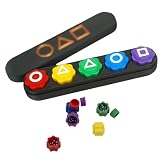
- Develops Motor Skills: Practice hand-eye coordination and precision by flipping and catching marbles in sequential steps. The repetitive motions encourage focus and dexterity improvement over time.
- 2. Pro-Grade Performance Engineering 68g weighted cores (+20% density) with tungsten-steel alloy beads 3D lattice-reinforced ABS shells withstand 15ft drop tests Ultrasonic welding prevents seam separation (industry-leading 238N/cm² bond strength) 100,000+ cycle durability certified by
- 5 Durable Colored Marbles: Includes 5 smooth, lightweight marbles in assorted colors (approx. 1.5cm diameter). Designed for easy handling and lasting play, with chip-resistant finishes.
- Encourages Social Interaction: Compact and portable for play at home, school, or outdoor gatherings. Perfect for 2-4 players to bond over friendly matches or tournaments.
- Versatile Gift Choice: A thoughtful present for families, educators, or fans of cultural games. Ideal for introducing Korean traditions, skill-building activities, or screen-free entertainment.
Sources for the rules and context
- Korea Gonggi Game Association — competition categories, board specification, out-of-bounds rule, and linked rule videos.
- University of Oregon, “Gonggi – Korean Jacks” — equipment and a partial description of basic play.
- Netflix Tudum — the Season 2 Pentathlon and its gonggi challenge.
- Korea.net — cultural context for traditional Korean games featured in the series.
Product prices and availability are accurate as of the date/time indicated and are subject to change. Any price and availability information displayed on Amazon at the time of purchase will apply.




