Free tools Windows power users keep installed
One-click scans. No signup required.
VLC can play playlist items one after another and keep its documented HTTP output from breaking at file boundaries. That does not, by itself, prove a gap-free 4K 60fps broadcast to YouTube: VLC’s documented playlist example outputs local HTTP MPEG-TS, while YouTube’s encoder guidance specifies RTMP or RTMPS ingest. Treat the VLC playlist and YouTube connection as separate pieces until you verify the exact setup you plan to use.
What VLC can—and cannot—promise
VLC’s VLM playlist example queues multiple inputs on one channel. VLM starts the next input when the previous item ends; the example uses sout-keep so the outgoing stream does not break at an item boundary. This is documented sequential playback and output continuity, not a measured guarantee of zero-gap transitions on YouTube.
The example broadcasts as HTTP MPEG-TS, and VLC’s HTTP guide describes that mode as a pull protocol: a receiving client requests the stream from the publishing device. The sample receiver connects to the sender on the same local network. This is not a YouTube ingest recipe. VideoLAN’s VLM playlist example and HTTP streaming guide describe the local method.
Create the documented local playlist broadcast
1. Prepare the media paths
Put the files you want to play in order on the VLC computer. In the example below, replace each path with a path that exists on your system. The sample has three inputs; add or remove setup lines as needed.
What’s actually slowing this PC down?
Pick the symptom - the matching free tool is one click away.
#1 Best Overall

- 【1080P HD High Quality】Capture resolution up to 1080p for video source and it is ideal for all HDMI devices such as PS4, PS3, Xbox One, Xbox 360, Wii U, DVDs, DSLR, Camera, Security Camera and set top box. Note: Video input supports 4K30/60Hz and 1080p120/144Hz. Does not support 4K120Hz/144Hz. Output supports up to 2K30Hz.
- 【Plug and Play】No driver or external power supply required, true PnP. Once plugged in, the device is identified automatically as a webcam. Detect input and adjust output automatically. Won't occupy CPU, optional audio capture. No freeze with correct setting.
- 【Compatible with Multiple Systems】suitable for Windows and Mac OS. High speed USB 3.0 technology and superior low latency technology makes it easier for you to transmit live streaming to Twitch, Youtube, Facebook, Twitter, OBS, Potplayer and VLC.
- 【HDMI LOOP-OUT】Based on the high-speed USB 3.0 technology, it can capture one single channel HD HDMI video signal. There is no delay when you are playing game live.
- 【Support Mic-in for Commentary】Rybozen capture card has microphone input and you can use it to add external commentary when playing a game. Please note: it only accepts 3.5mm TRS standard microphone headset.
2. Save a VLM configuration
Create a text file named playlist.vlm containing the following pattern, adapted from VideoLAN’s example:
new channel1 broadcast enabled
setup channel1 input "path/to/video1.mp4"
setup channel1 input "path/to/video2.mp4"
setup channel1 input "path/to/video3.mp4"
setup channel1 output #std{access=http,mux=ts,dst=:8090/stream,sout-keep,file-caching=1000}
control channel1 play
The repeated input entries are played successively. The output uses HTTP with MPEG-TS muxing; sout-keep is the documented continuity option, and file-caching=1000 is part of the example. This configuration creates a local HTTP stream, not a direct YouTube connection.
Rank #2
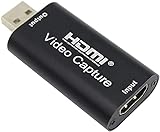
- 【1080P 30FPS Full HD Recording】The HDMI capture card connects to your video source and computer, and captures high-definition video up to 1080p 60fps
- 【HDMI Video Capture】Based on high-speed USB 2.0 technology, you can capture a high-definition HDMI video and HDMI audio signal of a signal channel, sending audio and video signals to computers /pc. The gaming capture card is suitable for devices with HDMI output, such as devices for PS4, for Xbox one, for Wii U and for Switch
- 【Screen Sharing for Meetings】The video capture card is a fast, familiar and economical way to share content in conference rooms and online meetings. Connect to presentations without software, just connect to a laptop or tablet via HDMI to start sharing
- 【Plug and Play】This USB capture card does not need to install a driver, so you can use the built-in functions of the current software to get a seamless experience. Because the video capture device is compatible with most third-party software, it can be plug-and-play for Windows, for Ma OS X, and for Linux. The USB2.0 high-speed transmission port makes it easier for you to have real-time streaming for Twitch, for Youtube, for OBS, for Potplayer and for VLC
- 【Compact & Portable】The capture card is small size & easy to carry, convenient for outdoor and indoor live broadcasting. We provide 30 days no question asked money back and lifetime technical support, if you have any problem, please feel free to contact us
3. Start VLC and check the local stream
- Open a terminal or command prompt in the folder containing
playlist.vlm. - Start VLC with
vlc --vlm-conf=playlist.vlm. If the VLC executable is not on your command path, run it using its installed location. - On a device that can reach the VLC computer, open
http://SENDER_IP:8090/streamin a compatible player, replacingSENDER_IPwith the sender’s local network address. VideoLAN’s example uses an address likehttp://192.168.0.101:8090/stream. - Watch through every item boundary and confirm playback, audio, and ordering. This tests the local HTTP broadcast only.
VLC also documents a graphical local-stream route through Media > Stream, where you choose an output destination such as HTTP and a transcoding profile. That is a GUI alternative for a local stream, not evidence that the GUI supplies a tested YouTube destination. VLC’s stream-output documentation also describes combining transcoding and network output; those examples do not define a YouTube-ready 4K/60 RTMPS configuration. See VideoLAN’s streaming and transcoding guidance.
What YouTube requires for 4K at 60fps
YouTube’s current live encoder guidance recommends RTMP or RTMPS, constant bitrate (CBR), and a two-second keyframe interval; the interval must not exceed four seconds. For 2160p at 60fps, its bitrate recommendations depend on video codec:
Rank #3

- 【1080P 60FPS Video Capture Card】 This HDMI game capture card is based on USB3.0 high speed transmission port, input resolution up to 4K@30HZ, output resolution up to 2K@30Hz or 1920×1080@60Hz. Type c and USB interface can meet most of the devices in daily life. Easily meet the online capture, real-time recording, online meetings, live gaming and other functions, so you have a better visual enjoyment. Note: For capture use only; requires capture software to function and is not intended for direct screen casting to a monitor or TV
- 【Ultra Low Latency Screen Sharing】 HDMI capture card is made of good quality aluminum alloy with strong heat dissipation, allowing you to enjoy ultra low latency while live gaming or video recording or live streaming, avoiding blue screens and lag. This HDMI to USBC capture card supports easy recording of good quality audio or HD video and transferring it to your computer or streaming platform, allowing you to record 60 fps HD video directly on your hard drive and real-time preview
- 【Plug and Play, Easy to Carry】 This HDMI 1080P video capture card does not require any additional drivers or external power supply, just plug and play for fast capture. The capture card is small and lightweight, so you can put it in your bag for emergencies, making it very portable for outdoor live streaming. It's also a great way to share content in game recording, video conference, video recorder and online teaching
- 【Wide Compatibility USB Capture Card】 Easily streams to Facebook, Youtube or Twitch. With the connection, this HDMI to USB C/3.0 video capture devices can be working on several Operating Systems and various software: Windows 7/ 8/ 10, Mac OS or above, Linux, Android, Laptop, Xbox One, PS3/PS4/PS5, Camera, DVDs, Set Top Box, Webcame, DSLR, Switch/Switch 2, TV BOX, HDTV, Potplayer/VLC, ZOOM, OBS Studio etc.
- 【Package Content & Note】 1x HD Audio Capture Card , 1x USB 3.0 to USB C Adapter (A-side 3.0, B-side 2.0), 1x user manual. Please note that you need to restart the OBS Studio software after the audio setup is complete, otherwise it will result in no sound output. When using an adapter, if the device is recognized as USB 2.0, try using the other side with the USB-C port. Simply flip the capture card and reconnect it to be recognized as USB 3.0
| Video codec | Recommended bitrate | Listed minimum |
|---|---|---|
| H.264 | 50 Mbps | 14 Mbps |
| AV1 or H.265/HEVC | 35 Mbps | 10 Mbps |
These are YouTube’s published live ingest recommendations and minimums for 4K/2160p at 60fps, not a guarantee that a connection can sustain them. YouTube lists H.264, H.265 (HEVC), or AV1 video and AAC or MP3 audio. At 4K, low-latency optimization is unavailable and YouTube sets streams to normal latency. Check YouTube’s encoder settings, bitrates, and resolutions for the current guidance.
Independent reader supportYour contribution helps us test, update, and keep practical guides available for everyone.Connect a compatible encoder to YouTube Live
- In YouTube Studio, open Live Control Room and create or select the stream you intend to use.
- Copy the stream URL and stream key shown in the encoder setup. A stream key is a credential—treat it like a password and never put it in a public file, screenshot, or post.
- Enter the URL and key in an encoder that supports YouTube’s RTMP/RTMPS ingest and the required 4K/60 settings. YouTube’s instructions explain its encoder connection workflow; they do not explain how to enter those settings into current VLC while retaining the VLM playlist.
- Before going public, test the complete playlist with representative motion and audio. Confirm resolution, frame rate, codec, bitrate stability, keyframe interval, audio continuity, and YouTube’s stream-health status, especially at each file transition.
See YouTube’s instructions for creating a live stream with an encoder and managing live stream settings. Do not substitute the VLC LAN address, such as http://192.168.0.101:8090/stream, for YouTube’s ingest URL. The documented VLC playlist output and YouTube ingest settings use different protocols in these examples. A compatible encoder or relay between a playlist source and YouTube is a possible workflow, but the cited VLC and YouTube guides do not establish a particular end-to-end configuration.
Rank #4

- Turn Your Camera into a Pro Webcam: Connect your DSLR or mirrorless camera to any computer and go live in stunning quality
- Stunning quality: Stream and record in 1080p60 or even 4K60 for razor-sharp detail (Requires a compatible camera and the latest Cam Link 4K model)
- Connect More Than Just Cameras: Use a camcorder, action cam, or even your iPhone to level up your content
- No Lag, No Delays: Ultra-low latency keeps your video and audio perfectly in sync, just like it should be
- Your iPad, Now a Pro Field Monitor: Preview your shots in real time on an iPad with USB-C
Test for the failures “seamless” can hide
- Playback stops at the end of a file: confirm the next item is listed as another input on the same VLM channel and that
sout-keepis present in the output pipeline. - The LAN stream works but YouTube does not receive it: the local HTTP MPEG-TS example is not YouTube’s documented RTMP/RTMPS ingest. Use an encoder compatible with YouTube’s ingest settings and validate how it receives the playlist.
- YouTube reports unstable stream health: check that the connection can reliably sustain the selected codec’s recommended bitrate, then check the encoder’s CBR setting and keyframe interval against YouTube’s guidance.
- Audio or picture changes at an item boundary: test the actual files in sequence. A playlist can advance without proving that the outgoing audio, frame rate, or encoding remains consistent through each transition.
- Resolution or frame rate is wrong: verify the output encoder and YouTube’s received stream details. The local VLM example does not specify a YouTube-ready 4K/60 transcode profile.
Or let it run in the cloud
If your goal is an always-on YouTube playlist rather than learning the local VLC-to-encoder pipeline, StreamNeo runs uploaded videos from the cloud: upload a recording or build a playlist, add your YouTube stream key, and go live. Nothing has to stay on at home. It streams the uploaded quality up to 4K 60fps at one price per slot, with automatic recovery if YouTube drops the stream. The first day is free with no card. Monthly service is $9.99 per month. Start your free day with StreamNeo.
Quick Recap
Product prices and availability are accurate as of the date/time indicated and are subject to change. Any price and availability information displayed on Amazon at the time of purchase will apply.
Quick wins for a faster PC:
Fix the driver behind crashes, sound loss and screen glitchesFind Drivers →Repair Windows errors before they cause bigger problemsFix Now →Scan for outdated or missing drivers - takes under a minuteDriver Scan →