Resident Evil helped popularize survival horror by making fear part of a playable loop: explore, solve problems, manage scarce resources, fight when necessary, and try to escape. Across the series, Capcom has kept those ingredients in view while changing how close danger feels, how vulnerable the player is, and how much the games lean toward horror or action.
What did Resident Evil do for horror games?
Capcom dates the first Resident Evil to March 22, 1996, and describes it as the debut that established survival horror. Its account of the game emphasizes using weapons and other items to get out of dangerous situations. Capcom managing corporate officer Jun Takeuchi later put the series’ role more carefully: the original “popularized the concept of survival horror for gaming.”
That distinction matters. Horror games existed before Resident Evil; the available evidence does not support saying the series invented game horror or single-handedly created every convention later associated with it. Its documented contribution was to make a recognizable survival-horror approach prominent: danger is not just something to defeat, but pressure that shapes exploration, decisions, and the use of limited resources.
The design also makes fear something the player can act on. Capcom developers have described the satisfaction of overcoming fear as a distinctive kind of catharsis in games. Weapons, puzzles, difficult encounters, and story revelations give the player ways to learn and respond, so surviving a threat can feel earned rather than merely witnessed.
Quick wins for a faster PC:
Fix the driver behind crashes, sound loss and screen glitchesFind Drivers →Clear out junk files and repair common Windows errorsFree Scan →Scan for outdated or missing drivers - takes under a minuteDriver Scan →#1 Best Overall

- Comes in collector-friendly window box packaging with opening front flap.
How does the survival-horror loop work?
When Capcom explained the design of Resident Evil 7 biohazard, director Koshi Nakanishi identified five recurring pillars of the series:
- Fear and horror: threats create pressure instead of serving only as targets.
- Environmental exploration: the player investigates places and discovers what they contain.
- Puzzle solving: progress can depend on interpreting clues or working out how to proceed.
- Resource management: the player must make choices about useful items and supplies.
- Combat: enemies can be confronted, but fighting is one part of survival rather than the whole experience.
The balance among these elements can shift. Exploration and puzzles give the player knowledge; resource decisions and combat put that knowledge under pressure. A series entry can feel markedly different by changing the intensity of the fear, the scale of the threat, or the player’s capacity to fight without abandoning the underlying combination.
How did Resident Evil change over time?
| Entry or approach | What Capcom’s accounts establish | What changes for the player |
|---|---|---|
| Resident Evil (1996) | Capcom describes the debut as establishing survival horror; its account highlights weapons and other items used to escape dangerous situations. | Survival is framed around handling danger and finding a way out, not simply defeating every threat. |
| Resident Evil 7 biohazard | Capcom foregrounded horror and exploration, chose first person for a more direct and visceral perspective, and centered an ordinary new protagonist in a Louisiana plantation setting. | The close perspective and human-scale setting emphasize vulnerability and immediacy. |
| Resident Evil Village | Capcom retained the first-person “Isolated View” and Ethan as protagonist while describing the game as more action-oriented, with more combat options and larger enemy encounters. | The player still experiences danger at close range, but the balance gives more room to action and combat. |
This is not a simple progression from “horror” to “action” and back again. The series changes the relationship between player and danger: how directly the player sees a threat, how capable the protagonist feels, how localized the setting is, and how much opportunity the game gives for combat.
Rank #2

- Figure measures 5 inches
- Color changes to blood splatter when the figure is sprayed with ice water or put in freezer
- Included accessories: Trash bag, pistol, knife, and hacksaw
- Officially licensed
Why did Resident Evil 7 feel like a reset?
In 2016, Capcom said the team wanted players to experience the fear of the 1996 game in a contemporary form. The opening emphasized horror and exploration, while the first-person camera was intended to put players in the character’s position and make events feel more direct. The game was built using Capcom’s RE Engine.
The protagonist and setting reinforced that shift. Capcom contrasted the ordinary new hero with the more capable, heavily equipped figures in some earlier entries. Rather than another broad crisis, Resident Evil 7 brought the threat down to one person and one place: a Louisiana plantation. The result was a more intimate form of vulnerability.
Despite the stylistic break, Capcom said the game was not a reboot and did not discard the mainline story. Its change in perspective and scale was a redesign of how the series delivered its established concerns, not a departure from continuity.
Rank #3
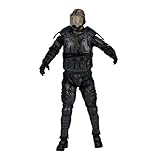
- Figure is approximately 5 inches tall
- Includes up to 20 points of articulation for full range of posing and play
- Includes removable gas mask to expose skull
- Includes The Walking Dead bookmark
- Collect all McFARLANE TOYS AMC THE WALKING DEAD figures!
How did Village recombine horror and action?
Village followed Resident Evil 7, returned to Ethan, and kept the first-person perspective. Capcom described it as more action-oriented, with expanded combat possibilities and larger enemy encounters. That combination matters: the close, isolated viewpoint remained, even as the player had more reason and ability to fight.
Seen together, the two games show the series adjusting its horror-action balance rather than choosing one permanent identity. Resident Evil 7 foregrounded fear and exploration; Village retained the direct perspective but tilted further toward action. The tension between vulnerability and empowerment is part of the series’ evolution.
Recommended Free Tools
Why do remakes matter to the series’ evolution?
Capcom has described fan demand as a reason for reimagining Resident Evil 2 and Resident Evil 3. These revisitations are another route for the franchise to change across generations, alongside new mainline entries. They should not be treated as if every remake served the same creative purpose: Capcom’s comments establish that it reimagined earlier games, but not a single design rationale shared by all of them.
Rank #4

- The Shogun Horror series from Takatoku Toys begins with a bold new take on the legendary slasher killer - Ghost Face!
- Highly articulated figure features a tailored soft goods cloak
- One interchangeable head and two pairs of hands included
- Accessories include standard knife, bloody knife, katana and sheath, kusarigama, and a bisento
- Blending modern horror with feudal-era Japanese details, this bold reimagining of Ghost Face is sure to command attention on any shelf
The franchise has also grown commercially alongside this mix of new releases and revisitations. In a June 12, 2020 release, Capcom said the series had passed 100 million cumulative worldwide shipments; that is a shipment figure, not a count of individual players. The same release reported 7.5 million cumulative units for Resident Evil 7 biohazard at that time. These dated company figures indicate scale, but they do not independently measure the series’ influence on the wider game industry.
Independent reader supportYour contribution helps us test, update, and keep practical guides available for everyone.Which Resident Evil game should you start with?
Capcom USA’s guide dated October 18, 2024 offers Resident Evil 2 (2019) as a staff-recommended starting point for newcomers. The same guide includes a staff opinion naming Resident Evil 7 the scariest entry; that is a personal recommendation, not a formal ranking or universal consensus.
Choose based on the experience you want first:
- For a staff-recommended entry point: try Resident Evil 2 (2019), as suggested in Capcom USA’s 2024 guide.
- For the series’ close, vulnerable horror approach: Resident Evil 7 biohazard is the clearest example discussed here.
- To see that approach shift toward action: play Resident Evil Village after Resident Evil 7; it returns to Ethan and keeps the first-person view.
- If you want virtual reality: Capcom’s 2024 guide lists Resident Evil 4, Resident Evil 7, and Village among entries with VR versions. Check current platform and edition compatibility before choosing one.
There is no single mandatory starting order implied by these recommendations. A newcomer can begin with the 2019 Resident Evil 2 remake, while someone chiefly interested in the series’ modern first-person shift can begin with Resident Evil 7.
The Tool Desk
Outbyte Driver Updater FREEFix the driver behind crashes, sound loss and screen glitchesFind Drivers →Outbyte PC Repair FREEClear out junk files and repair common Windows errorsFree Scan →What the series’ history does—and does not—show
Capcom’s accounts document a series that has repeatedly rebalanced a recognizable set of survival-horror elements. They also document Capcom’s own description of the original’s role in popularizing the genre. They do not, by themselves, establish a complete prehistory of survival horror, provide an independent industry-wide measure of influence, or prove that particular later games adopted their conventions because of Resident Evil.
Within those limits, the series’ lasting design idea is clear: make danger frightening, give the player meaningful ways to respond, and let the balance between those two conditions change. That is how Resident Evil has remained recognizable through shifts in perspective, scale, protagonist, and action emphasis.
Quick Recap
Product prices and availability are accurate as of the date/time indicated and are subject to change. Any price and availability information displayed on Amazon at the time of purchase will apply.