Outdated Drivers Are Slowing You Down
One free scan finds every outdated or missing driver and matches the right update for your exact hardware.Free scan · exact hardware matchWindows Errors? Fix Them Before They Spread
Repair common Windows errors and clear accumulated junk for a smoother, more stable PC - no reinstall needed.Free scan · no reinstallHBO’s IT: Welcome to Derry isn’t a remake or a retread—it’s a calculated expansion of one of horror’s most durable mythologies. Developed by Andy Muschietti, Barbara Muschietti, and Jason Fuchs, the series takes Stephen King’s IT universe beyond the familiar rhythms of the Losers Club and plunges viewers deeper into the cursed soil of Derry, Maine. For fans who’ve long suspected the town itself is the real monster, this is the story that finally puts that idea front and center.
Slated to debut on HBO and Max in 2025, the series is designed as a multi-season prequel that explores Pennywise’s reign of terror long before the events of the 2017 and 2019 films. Bill Skarsgård returns as the shape-shifting entity, anchoring the show’s continuity with the films while allowing the narrative to stretch in darker, stranger directions. The goal isn’t nostalgia—it’s excavation, peeling back decades of buried violence, fear, and collective denial.
What makes Welcome to Derry especially significant is its ambition. Rather than focusing on a single cycle of Pennywise’s appearances, the show positions itself as a historical horror chronicle, using different eras to expose how Derry repeatedly enables its own destruction. In doing so, HBO is betting that King’s most iconic villain can sustain a long-form, prestige horror treatment without losing his bite.
A Prequel That Reframes the IT Timeline
Set primarily in the early 1960s, Welcome to Derry unfolds roughly 27 years before the events of IT: Chapter One, aligning with Pennywise’s infamous cyclical awakenings. Drawing inspiration from the interludes in King’s novel, the series explores earlier outbreaks of violence and disappearance, suggesting that the town’s evil is systemic rather than episodic. This approach allows the show to tell self-contained stories while steadily building a larger, interconnected mythology.
What’s actually slowing this PC down?
Pick the symptom - the matching free tool is one click away.
#1 Best Overall
The cast extends beyond Skarsgård, with Taylour Paige, Jovan Adepo, Chris Chalk, James Remar, and Madeleine Stowe among the ensemble, signaling a character-driven approach rather than a monster-of-the-week format. Andy Muschietti directs multiple episodes, ensuring visual and tonal continuity with the films, while HBO’s involvement elevates the project into the realm of prestige genre television. As an expansion of the IT franchise, Welcome to Derry isn’t just filling in gaps—it’s redefining how far this nightmare can stretch.
Release Date & Production Status: When Welcome to Derry Is Expected to Premiere on HBO/Max
As of now, Welcome to Derry is officially slated to premiere sometime in 2025 on HBO and Max, though an exact release date has not yet been announced. HBO has positioned the series as a marquee genre title, signaling a launch window that gives it room to breathe rather than burying it in a crowded release calendar. Given the network’s track record with prestige horror and event television, expectations are leaning toward a late-year debut.
What’s clear is that Welcome to Derry is not being rushed. HBO appears committed to letting the series arrive as a fully formed expansion of the IT universe, rather than a stopgap between larger franchise plays. That measured approach suggests confidence in the material and its long-term potential.
Where the Series Currently Stands in Production
Production on Welcome to Derry has already been underway, with filming taking place after initial delays caused by industry-wide scheduling disruptions. Andy Muschietti’s hands-on involvement as director and executive producer has been a stabilizing force, ensuring continuity with the IT films while allowing the series to develop its own identity. Behind the scenes, the show is deep into post-production, where its period setting and supernatural elements are being refined.
Quick wins for a faster PC:
Repair Windows errors before they cause bigger problemsFix Now →Scan for outdated or missing drivers - takes under a minuteDriver Scan →Clear out junk files and repair common Windows errorsFree Scan →That post-production phase is especially crucial for a series so dependent on atmosphere. Derry’s unsettling presence, Pennywise’s manifestations, and the show’s shifting timelines all require a level of visual precision that aligns more with cinematic horror than standard television fare.
Why a 2025 Premiere Makes Strategic Sense
From a programming standpoint, a 2025 release allows HBO to position Welcome to Derry as a flagship genre offering rather than a niche spinoff. The IT films remain culturally fresh, Bill Skarsgård’s Pennywise is still iconic, and Stephen King adaptations continue to perform well across platforms. Dropping the series too early would risk undercutting its scope; waiting allows anticipation to build.
For audiences, the timing also works thematically. Welcome to Derry is designed to unfold slowly, digging into the town’s past with a deliberate, unsettling rhythm. A carefully timed premiere reinforces the idea that this isn’t just more IT—it’s a deeper descent into the mythology, one that HBO clearly intends to treat as an event rather than an experiment.
Setting the Timeline: How the Series Fits Into the IT Movies and Stephen King Canon
One of the most intriguing aspects of Welcome to Derry is how deliberately it positions itself within the larger IT mythology. Rather than functioning as a direct sequel or reboot, the series is designed as a prequel that explores earlier cycles of horror in Derry, long before the Losers’ Club confronted Pennywise in the 1980s and 2010s.
Recommended Free Tools
By shifting focus to the town’s past, the series has room to deepen the mythology without rewriting what audiences already know. It’s a strategy that mirrors Stephen King’s own approach in the novel, where history, memory, and generational trauma are as central as the monster itself.
A Prequel Rooted in Derry’s Dark History
Welcome to Derry is set decades before the events of Andy Muschietti’s two IT films, with much of the story reportedly unfolding in the early 1960s. That era is significant in King’s canon, marking one of Pennywise’s previous awakening cycles and aligning with the book’s infamous interludes that chronicle Derry’s buried atrocities.
Those interludes documented events like the Black Spot fire and other moments when violence erupted while the town looked away. The series appears poised to dramatize that idea, showing how Pennywise’s influence seeps into the community long before anyone gives it a name.
Rank #2
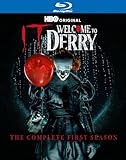
![IT: Welcome to Derry: The Complete First Season [4-Disc Set] [Blu-ray] [Region Free]](https://m.media-amazon.com/images/I/51rMAfjQZTL._SL160_.jpg)
- COMPLETE FIRST SEASON – All episodes on a 4-disc Blu-ray set
- HIGH DEFINITION BLU-RAY – Clear visuals and immersive sound
- STEPHEN KING UNIVERSE – Expands the world of IT
- ORIGIN OF THE HORROR – Explore the beginnings of evil in Derry
- REGION FREE BLU-RAY – Compatible worldwide
How It Connects to the IT Films
While Welcome to Derry stands on its own, it is firmly tethered to the continuity of the recent films. Andy Muschietti has been clear that the show exists in the same cinematic universe, meaning the rules governing Pennywise, Derry, and the cyclical nature of the entity remain consistent.
That connection gives the series added weight. Viewers already know how some of this history ends, which creates dramatic irony as new characters stumble into a pattern of denial, fear, and violence that the films later expose in full.
Staying Faithful to Stephen King’s Canon
Crucially, Welcome to Derry isn’t just mining nostalgia from the movies; it’s drawing directly from King’s text. The novel’s sprawling structure treated Derry itself as a living character, shaped by centuries of supernatural corruption. The series format finally allows that idea to breathe, expanding on lore that the films could only reference in fragments.
Elements like the town’s selective amnesia, Pennywise’s shifting forms, and the sense that evil resurfaces every 27 years are all foundational to King’s canon. By centering those ideas, Welcome to Derry positions itself less as supplemental content and more as a missing chapter, one that enriches the IT saga without diminishing what came before.
Plot Overview: What We Know About the Story, Themes, and Pennywise’s Dark History
At its core, Welcome to Derry is less about a single group of heroes and more about the slow rot of a town conditioned to accept the unthinkable. The series is designed as an ensemble-driven horror saga, following multiple intersecting characters as Derry slides toward one of its darkest chapters. Rather than immediately centering on Pennywise, the story reportedly builds tension through everyday life, letting unease creep in before the supernatural fully announces itself.
This approach mirrors Stephen King’s novel, where terror often emerges from patterns of behavior rather than jump scares. Violence, prejudice, and silence become symptoms of a deeper infection, suggesting that Pennywise doesn’t just haunt Derry, but cultivates it.
Derry as the Main Character
One of the show’s most compelling narrative ideas is its treatment of Derry itself as the protagonist. The town’s history of denial, selective memory, and moral collapse forms the backbone of the plot, with individual storylines illustrating how ordinary people become complicit in extraordinary evil. As in the book, horrific events are often met with shrugs, excuses, or outright erasure.
This thematic focus allows Welcome to Derry to explore horror on a societal level. The terror isn’t only in what Pennywise does, but in how easily the town adapts to his presence, normalizing the abnormal until violence feels inevitable.
Pennywise Before the Clown
While Bill Skarsgård is expected to reprise his role, Pennywise’s presence in Welcome to Derry is reportedly more fragmented and mythic. The series leans into the idea of the entity as an ancient, shape-shifting force rather than a constant on-screen villain. Sightings, rumors, and distorted encounters suggest a creature still coalescing into the form audiences recognize.
This allows the show to explore Pennywise’s influence beyond the clown persona, reinforcing that the smiling monster is only one mask worn by something far older. It also aligns with King’s depiction of the entity as a cosmic predator that adapts to the fears and cultural anxieties of each era.
Recurring Cycles and Buried Atrocities
Narratively, the series appears structured around the idea of cycles, not just Pennywise’s 27-year hibernation, but Derry’s repeated failure to learn from its past. Each storyline feeds into a larger pattern, echoing past atrocities while unknowingly setting the stage for future ones. History, in this version of Derry, isn’t remembered so much as re-enacted.
Rank #3
![IT: Welcome to Derry Season One [Blu-ray]](https://m.media-amazon.com/images/I/51Qbcpl+dJL._SL160_.jpg)
- Blu-ray movie
That cyclical storytelling gives Welcome to Derry a tragic momentum. Even as characters search for truth or escape, the audience understands they are witnessing one turn of a much larger, blood-soaked wheel.
Why This Story Matters in the IT Mythology
By dramatizing events only hinted at in the films, Welcome to Derry deepens the mythology without undermining the Losers’ Club’s eventual victory. It reframes Pennywise not as a singular nemesis defeated once and for all, but as a recurring embodiment of communal failure. The horror becomes systemic, passed down through generations.
In doing so, the series positions itself as an essential expansion of the IT universe. It’s not just filling in gaps, but interrogating the very foundations of why Derry keeps producing monsters, and why it will always try to forget them.
The Return of Derry: Mythology, Cycles of Violence, and Why the Town Is the True Monster
If Pennywise is the blade, Derry is the hand that wields it. Welcome to Derry leans hard into Stephen King’s most unsettling suggestion: that the town itself enables, absorbs, and ultimately perpetuates evil. The series reframes Derry not as a backdrop for horror, but as an active ecosystem where violence is normalized, ignored, and quietly rewarded.
This perspective shifts the fear from jump scares to something far more corrosive. What emerges is a portrait of a community that doesn’t just suffer tragedy, but metabolizes it, turning atrocity into civic amnesia.
A Town That Chooses Not to See
One of the most chilling throughlines in Welcome to Derry is collective denial. Adults dismiss disappearances, authorities look the other way, and neighbors instinctively protect the illusion of normalcy. The horror doesn’t come from ignorance, but from willful forgetting.
Free tools Windows power users keep installed
One-click scans. No signup required.
That moral rot aligns directly with King’s novel, where Derry’s residents unconsciously collaborate with Pennywise by refusing to acknowledge patterns. The show dramatizes this complicity in intimate, everyday moments, making it clear that the monster thrives because the town allows it to.
Institutional Evil and Inherited Silence
Rather than focusing solely on supernatural terror, the series explores how institutions help perpetuate the cycle. Schools, churches, police departments, and even family units become pressure valves, redirecting fear and blame away from uncomfortable truths. Each generation inherits not just trauma, but the rules for staying silent about it.
This approach grounds the cosmic horror in something disturbingly familiar. Pennywise may be ancient, but Derry’s mechanisms of denial feel timeless, echoing real-world patterns of abuse, racism, and communal neglect.
Derry Across Time, Always the Same
Set across multiple decades, Welcome to Derry uses its shifting timeline to underline a grim point: the details change, but the behavior doesn’t. Different fashions, different faces, same outcomes. Violence erupts, explanations are buried, and life goes on.
By revisiting Derry at various historical pressure points, the series reveals how the town resets itself after each tragedy. It’s not haunted by the past so much as structured to repeat it, creating fertile ground for Pennywise’s return.
Rank #4

- Jovan Adepo, Bill Skarsgard, Taylour Paige
The True Monster Beneath the Myth
In positioning Derry as the true antagonist, the series expands the IT mythology in a crucial way. Pennywise becomes less a lone evil and more a symptom of a deeper sickness, an entity empowered by communal failure. The clown feeds on fear, but it’s the town’s indifference that keeps him alive.
That thematic shift is what gives Welcome to Derry its weight within the franchise. It’s not just about where Pennywise came from, but why he was able to stay for so long.
Cast & Characters: Confirmed Actors, New Faces, and the Possible Return of Pennywise
With its thematic focus on Derry as an ecosystem of denial and violence, Welcome to Derry needed a cast capable of grounding cosmic horror in human behavior. HBO’s approach has been to assemble a group of actors known for emotionally precise performances rather than genre shorthand, signaling that this is a character-first expansion of the IT mythology.
The Tool Desk
Outbyte PC Repair FREEClear out junk files and repair common Windows errorsFree Scan →Outbyte Driver Updater FREEScan for outdated or missing drivers - takes under a minuteDriver Scan →Confirmed Cast Members Anchoring Derry
Among the first announced leads is Taylour Paige, whose work in Zola and Ma Rainey’s Black Bottom suggests a sharp ability to convey vulnerability under pressure. Paige is expected to play a central figure in one of the show’s earlier timelines, likely someone whose attempts to confront Derry’s uglier truths put her at odds with the town’s culture of silence.
Jovan Adepo, coming off acclaimed roles in Watchmen and Babylon, also joins the series, bringing gravitas to a story deeply concerned with systemic injustice. His character is believed to intersect with one of the town’s institutional power structures, reinforcing the show’s interest in how authority figures help maintain Derry’s recurring amnesia.
Chris Chalk, another Watchmen alumnus, adds further dramatic weight. Chalk often plays characters navigating moral compromise, making him a natural fit for a series about the quiet decisions that allow evil to flourish. James Remar and Stephen Rider round out the confirmed cast, both actors known for portraying deeply flawed, often dangerous men, suggesting Derry’s adult population will be anything but benign.
New Faces and Generational Storytelling
Because Welcome to Derry spans multiple decades, the cast is designed to rotate perspectives rather than follow a single ensemble throughout. This anthology-like structure allows new characters to step into the spotlight as the timeline shifts, reinforcing the idea that Derry produces the same types of people again and again, regardless of era.
Do these 3 things before closing this tab:
1Scan for outdated or missing drivers - takes under a minute2Repair Windows errors before they cause bigger problems3Fix the driver behind crashes, sound loss and screen glitchesThat approach also gives the series freedom to introduce victims, bystanders, and enablers without the safety net of legacy characters. These are people without future chapters guaranteed, which adds tension and inevitability to their arcs. In a town like Derry, survival is never assumed.
The Question of Pennywise
No casting discussion around an IT project escapes the looming question of Pennywise the Dancing Clown. While HBO has stopped short of issuing a formal announcement, Bill Skarsgård’s involvement as an executive producer has fueled strong expectations that he will reprise the role in some capacity.
Creatively, his return would make sense. Welcome to Derry is not a reboot but a prequel rooted in the same continuity as the 2017 and 2019 films, and Skarsgård’s Pennywise remains the definitive modern incarnation of King’s monster. Whether he appears frequently or is used sparingly, his presence would serve as a connective tissue across decades of terror.
What’s clear is that the series isn’t positioning Pennywise as the sole attraction. By foregrounding Derry’s residents and the actors bringing them to life, Welcome to Derry frames the clown not just as a villain, but as the inevitable result of a town that keeps choosing not to look too closely at itself.
Best Value
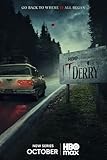
- Product size: 28X43cm
- Original Gift: This poster is the perfect gift for friends and family.
- Safe delivery: Frameless, packaged in paper tubes to ensure safe delivery.
- The perfect choice for decorating your home, office, or any other place in a simple and elegant way.
- Frameless decoration: This poster is designed for frameless hanging, allowing you to adjust according to your own style and preferences.
Creative Team & Vision: Andy Muschietti, HBO’s Involvement, and the Tone of the Series
If Welcome to Derry feels like a natural extension of the IT films rather than a spinoff chasing brand recognition, that’s by design. Andy Muschietti, who directed both IT (2017) and IT Chapter Two (2019), remains creatively embedded in the series, setting the aesthetic and thematic blueprint from the ground up. His fingerprints ensure the show speaks the same visual and emotional language as the films, even as it stretches the mythology backward in time.
Andy Muschietti’s Long-Game Approach to Derry
Muschietti is directing multiple episodes, including the pilot, and serving as an executive producer alongside Barbara Muschietti. This level of hands-on involvement signals that Welcome to Derry isn’t being treated as ancillary content, but as a foundational chapter in the larger IT canon. His direction has always balanced operatic horror with intimate character work, a combination well-suited to a series focused on how fear embeds itself in a community over generations.
Unlike the films, which centered on childhood trauma and friendship, the series allows Muschietti to explore Derry as a living organism. Violence doesn’t erupt out of nowhere here; it’s preceded by silence, denial, and the slow normalization of cruelty. That perspective reframes Pennywise less as an intruder and more as a symptom.
HBO, Max, and the Prestige-Horror Mandate
HBO’s involvement, now under the Max banner, shapes the series in meaningful ways. This is prestige television with the budget, patience, and narrative confidence to linger in uncomfortable spaces rather than rush toward spectacle. The network’s track record with genre storytelling suggests a willingness to let horror simmer through atmosphere, performance, and moral tension instead of relying solely on shock.
Recommended Free Tools
That freedom also allows Welcome to Derry to embrace a darker, more adult sensibility than the films. The violence is expected to be more grounded, the themes more explicit, and the emotional consequences harder to escape. In many ways, the series aligns more closely with the bleakness of King’s novel than with the crowd-pleasing rhythms of a theatrical release.
Showrunners, Structure, and the Shape of Fear
The writing and showrunning duties are led by Jason Fuchs, with Brad Caleb Kane joining to help steer the series’ multi-era structure. Together, they’re tasked with weaving standalone tragedies into a cohesive historical tapestry, one that reveals how Derry’s patterns repeat with chilling consistency. Each era functions as both a self-contained story and a piece of a much larger, older nightmare.
Tonally, Welcome to Derry is positioned as slower, colder, and more corrosive than its predecessors. The horror isn’t just what lurks in the sewers, but what people allow to happen in plain sight. By leaning into that idea, the series aims to make Derry itself the most unsettling presence of all.
Why IT: Welcome to Derry Matters: Franchise Legacy, Horror TV Trends, and Fan Expectations
Reframing the IT Mythology for Television
Welcome to Derry represents the most ambitious expansion of the IT mythology since Stephen King’s original novel. Rather than retelling a familiar story, the series deepens the canon by interrogating the cycles of violence, apathy, and fear that allow Pennywise to thrive. It treats the creature not as a singular villain, but as a recurring consequence of a town that repeatedly fails to protect its own.
Do these 3 things before closing this tab:
1Repair Windows errors before they cause bigger problems2Scan for outdated or missing drivers - takes under a minute3Clear out junk files and repair common Windows errorsThat approach strengthens the franchise by aligning it more closely with King’s worldview. In his work, monsters endure because communities look away, excuse harm, or normalize the unthinkable. By foregrounding that idea, the series elevates IT from a story about survival to a broader indictment of collective guilt.
Horror Television’s Evolution—and HBO’s Role
The timing of Welcome to Derry is no accident. Horror television has entered an era where slow-burn dread and thematic density are prized over episodic shocks, and premium platforms are leading that charge. HBO’s willingness to invest in long-form, adult-oriented horror places the series alongside projects like The Outsider and Lovecraft Country, where atmosphere and subtext matter as much as plot.
This trend allows Welcome to Derry to explore fear as an accumulating force rather than a jump-scare mechanic. Television’s extended runtime gives space to sit with consequences, build generational trauma, and let unease fester. For horror fans, that promises a more psychologically corrosive experience than a two-hour theatrical sprint.
What Fans Want—and What the Series Must Deliver
Expectations are understandably high. Fans of the films want continuity, particularly in how Pennywise is portrayed and how the series echoes the visual and tonal language Muschietti established. Readers of the novel, meanwhile, are looking for deeper cuts: historical horrors, moral rot, and the sense that Derry has always been broken.
What’s actually slowing this PC down?
Pick the symptom - the matching free tool is one click away.
Welcome to Derry sits at the intersection of those demands. It must honor the iconography without leaning on nostalgia, expand the lore without overexplaining it, and scare audiences without diluting the existential weight that defines IT at its best. If it succeeds, the series won’t just complement the films—it will redefine how the story is understood.
Ultimately, IT: Welcome to Derry matters because it treats horror as history, not spectacle. By turning its focus outward—from individual heroes to a complicit town—it positions the franchise for a more mature, unsettling future. For a story built on the idea that evil returns when it’s ignored, television may finally be the medium where IT feels most at home.
Quick Recap
Product prices and availability are accurate as of the date/time indicated and are subject to change. Any price and availability information displayed on Amazon at the time of purchase will apply.




