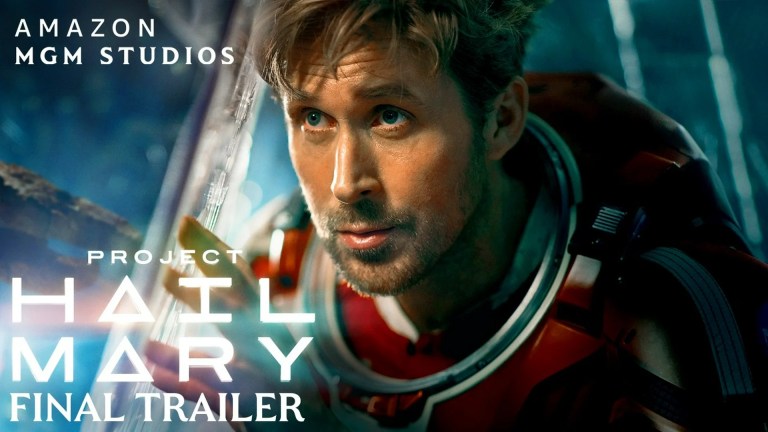
Project Hail Mary makes scientific problem-solving the engine of a character-led space adventure. Ryan Gosling plays Ryland Grace, a science teacher who wakes aboard a spacecraft with no memory and gradually learns that the Sun faces a potentially catastrophic threat. The film’s central appeal is not a technical lecture: it is watching Grace investigate an extraordinary problem, then learn that cooperation may matter as much as ingenuity. NASA confirms that people from the agency consulted with the production, but that involvement is not a scientific certification of the film’s fictional biology or interstellar travel.
What is Project Hail Mary about?
Sony’s official synopsis begins with Grace waking light-years from home, alone and unsure who he is or how he got there. As his memory returns, he discovers that he must investigate a substance associated with the Sun’s decline and try to save Earth. An unexpected friendship changes the mission. The film adapts Andy Weir’s novel, with Phil Lord and Christopher Miller directing and Drew Goddard writing the screenplay. Sony Pictures UK’s film page lists the premise and credits.
| # | Preview | Product | Price | |
|---|---|---|---|---|
| 1 |

|
Project Hail Mary: A Novel | $13.88 | Buy on Amazon |
| 2 |

|
Andy Weir's 3-Book Collection Set (Project Hail Mary, Artemis, the Martian) | $41.22 | Buy on Amazon |
| 3 |

|
Project Hail Mary (Korean Edition) | $35.99 | Buy on Amazon |
| 4 |

|
Project Hail Mary (Deluxe Edition): A Novel | $22.00 | Buy on Amazon |
| 5 |

|
Project Hail Mary (Italian Edition) | $10.49 | Buy on Amazon |
The Associated Press lists a running time of 156 minutes and a PG-13 rating, with the Motion Picture Association descriptor “some thematic material and suggestive references.” AP reviewer Lindsey Bahr awarded the film three and a half stars out of four and described it as a lively, science-loving adventure. Those are AP’s review and rating details, not a measure of universal opinion. Read AP’s review.
How does the movie turn engineering into drama?
Grace’s mission gives the story a chain of problems to investigate rather than a single action-movie obstacle. He has to apply what he knows, work through what he does not know, and find a way to communicate and cooperate with an unfamiliar intelligence. That structure makes scientific reasoning visible as dramatic action: an idea has consequences, and collaboration can change what seems possible.
The Tool Desk
Outbyte PC Repair FREERepair Windows errors before they cause bigger problemsFix Now →Outbyte Driver Updater FREEScan for outdated or missing drivers - takes under a minuteDriver Scan →#1 Best Overall
For an engineering-minded viewer, the most useful distinction is between the method and the premises. The film invites attention to experimentation, inference and problem-solving, but the consulted sources do not offer a technical audit of its spacecraft or its fictional astrophage. NASA’s participation supports a narrower point: the production sought input on human spaceflight and science. It does not establish that the film’s speculative biology, propulsion or interstellar journey are feasible.
What NASA did—and did not—contribute
NASA’s March 20, 2026 account says communications personnel offered informal consultation on human spaceflight and science, while agency astrobiology and astrophysics experts answered production questions. Astronaut Kjell Lindgren also met Gosling for an in-person consultation on set; NASA says its advisers are listed in the credits. Separately, NASA’s Jet Propulsion Laboratory reported that Gosling, Sandra Hüller, Lord, Miller, Goddard and Weir visited JPL to discuss the film and collaboration between science and creative media. These accounts document contact and consultation, not an agency verdict on every scientific detail. NASA’s account of its involvement and NASA JPL’s panel account describe the activity.
Will Boyington, associate administrator for NASA’s Office of Communications, said: “Space exploration captures the public’s imagination, and collaboration between science and storytelling brings that sense of discovery to a wider audience.” The statement, published in NASA’s March 20, 2026 article, describes the value of science-and-storytelling collaboration; it is not an endorsement of the film’s scientific accuracy.
How close is the movie to the book?
The main trade-off is compression. Space.com compares the 156-minute film with a 496-page novel and says the movie cuts much of the scientific exposition to prioritize the emotional relationship between Grace and Rocky. The page count is Space.com’s figure for the edition it discusses, not a universal length for every edition.
Rank #3
That adaptation choice shapes what each version can emphasize. The novel has more room for explanation; the film has to make its discoveries legible within a feature-length story and carry more meaning through performance and relationships. Space.com also points to changes in the ship’s layout, Grace’s early solo period, supporting characters and the timeline. Those are the outlet’s observations rather than a definitive inventory of every change. See Space.com’s comparison of the book and film.
- Technical explanation: The book is the better fit if you want more of the scientific exposition; the film condenses it.
- Pacing: The adaptation must move through the story in 156 minutes, while the novel can spend more time on the route to a solution.
- Grace and Rocky: Space.com describes their relationship as a stronger priority in the movie.
- Supporting characters and events: The film changes or compresses elements of the book, including the ship, Grace’s early isolation and the timeline.
These are useful comparison points, not an objective scorecard. If the movie leaves you wanting the reasoning behind its discoveries, the novel is a natural next step: it offers more space for the story’s technical exposition.
Rank #4
Is it scientifically accurate, or worth seeing after The Martian?
On the evidence available here, there is no independent scientific-accuracy score or measured engineering assessment to cite. NASA’s documented consultation is meaningful context about the production process, but it should not be treated as proof that the film’s extraordinary scientific premises work in reality. A fair way to approach it is as science fiction that foregrounds problem-solving, while keeping the speculative elements distinct from established human-spaceflight expertise.
Viewers who enjoyed The Martian may recognize the pleasure of watching a protagonist use knowledge to confront practical problems. This film’s emphasis, as described by AP and Space.com, also rests on adventure and the Grace–Rocky relationship. Expect a science-loving story rather than a substitute for a technical validation of its imagined technology.
Free tools Windows power users keep installed
One-click scans. No signup required.
Best Value
Where can you watch it?
Amazon’s viewing guide, updated July 3, 2026, says Project Hail Mary is streaming worldwide on Prime Video. Streaming catalogs and prices can vary by location and change over time, so check your local Amazon site for current availability. The same article identifies physical, Kindle and Audible editions of Weir’s novel. Check Amazon’s viewing guide.
Quick Recap
Product prices and availability are accurate as of the date/time indicated and are subject to change. Any price and availability information displayed on Amazon at the time of purchase will apply.