What’s actually slowing this PC down?
Pick the symptom - the matching free tool is one click away.
Yes. FFmpeg can send a live feed from a cloud VPS to YouTube Live over RTMP or, preferably, RTMPS. Whether a free VPS can keep your particular stream running is a separate question: the VM must handle the workload and sustain the required outbound bitrate, and free-tier limits do not guarantee performance or uptime. Oracle Cloud’s Always Free compute is one option to try, but regional capacity and resource constraints apply.
What you need for a VPS-to-YouTube stream
The basic path is a video or other input on the VPS, FFmpeg to process or relay it, and an RTMPS connection from the VPS to YouTube Live. FFmpeg supports multimedia inputs and outputs, and YouTube accepts RTMP/RTMPS ingest. That establishes protocol compatibility, not that a specific command or free VM will work reliably for your video.
- A cloud VM with the operating system, storage, CPU and memory your chosen FFmpeg workload requires.
- An FFmpeg input, such as a video file or playlist, accessible to the VM.
- A YouTube Live stream key, kept private.
- Enough sustained outbound network capacity for the video bitrate, audio, protocol overhead and network variation.
YouTube recommends RTMPS, its SSL-secured form of RTMP. Use a valid YouTube RTMPS endpoint and path, connect on port 443, and send RTMP over SSL. Follow the current endpoint and stream-key instructions in Google’s RTMPS ingestion documentation; never put a real stream key in a public command, script or log.
Choose a bitrate the VM can sustain
YouTube Help recommends running an upload-speed test and matching the encoder settings to the intended resolution and frame rate. Its current H.264 guidance is:
#1 Best Overall

- 【AMD Ryzen 7330U】 – The Efficiency-Tuned Powerhouse,AMD Ryzen 7330U (Zen 3, SMT, 4C/8T) in KAMRUI P2 mini PC crushes rivals: Intel i3-10110U (2C/4T, 2019) and N95 (4 efficiency cores, no HT, single-channel memory). Vs predecessor Ryzen 3 4300U (4C/4T): ~50% faster single-core, ~46% multi-core, 8MB L3 cache (vs 4MB). Beats both Intel chips hugely in multi-core, making heavy multitasking, coding, data work smooth at just 15W TDP. High-end power in a cool, efficient box.
- 【AMD Radeon Graphics】– Triple 4K Vision & Fluidity,The integrated Radeon Graphics (based on the modern Vega architecture with 6 CUs) is a visual beast, outclassing the iGPU offerings from both AMD's prior generation and Intel. The Intel UHD Graphics (i3-10110U/N95) struggles with single-channel memory and low execution units, crippling its gaming performance and barely handling basic 4K video without stuttering. While the older Radeon Vega 5 (4300U) was decent, our 7330U's Radeon Graphics (6 CUs) pushes the boundaries, delivering higher graphics clock speeds (up to 1.8GHz) and significantly better rendering capabilities. It can drive triple 4K@60Hz displays with zero lag, edit photos/videos.
- 【Generous Storage & Easy Expansion】The KAMRUI Pinova P2 mini desktop computers comes with 16GB LPDDR4X RAM (higher frequency, lower power) for buttery‑smooth multitasking, and a 256GB M.2 SSD for blazing fast boot‑up, quick file transfers, and no more long loading screens. It also features two storage expansion slots (1x M.2 2280 SATA/NVMe PCIe 3.0 slot + 1x M.2 2280 SATA slot), supporting up to 4TB total (not included). You’ll have all the space you need for projects, media, and important data.
- 【Triple 4K Display Output】The KAMRUI Pinova P2 mini desktop pc is equipped with HDMI 2.0 ×1 + DP 1.4 ×1 + USB 3.2 Gen2 Type‑C ×1 (with DP Alt Mode), enabling simultaneous triple 4K@60Hz output. Whether for home entertainment, remote work, or conference room presentations, it delivers an immersive visual experience. Two USB 3.2 Gen2 Type‑A ports (up to 10Gbps – 21x faster than USB 2.0) make data transfers and device expansion a breeze.
- 【USB 3.2 Gen2 Type‑C: 10Gbps & Versatile Connectivity】The USB 3.2 Gen2 Type‑C port on the KAMRUI P2 small pc supports 10Gbps data transfer speeds and can also output DisplayPort 1.4 video. Together with Gigabit LAN, Wi‑Fi, and Bluetooth, you get a fast, flexible, and productive connected environment – wired or wireless.
| H.264 output | Listed minimum | Recommended bitrate |
|---|---|---|
| 720p30 | 3 Mbps | 8 Mbps |
| 720p60 | 3 Mbps | 8 Mbps |
| 1080p30 | 5 Mbps | 14 Mbps |
| 1080p60 | 6 Mbps | 17 Mbps |
These figures are YouTube’s codec- and frame-rate-specific recommendations, not guarantees about a VPS connection. Leave headroom above the video bitrate for audio, protocol overhead, other traffic and fluctuations. A provider’s advertised bandwidth ceiling should not be treated as a guaranteed sustained upload rate.
YouTube lists H.264, H.265 and AV1 video; AAC or MP3 audio; frame rates up to 60 fps; constant bitrate (CBR); and a recommended keyframe interval of two seconds, not over four. For stereo audio, its listed recommendation is 128 Kbps at 44.1 kHz. The same guidance lists 1080p30 H.265/AV1 at a 4 Mbps minimum and 10 Mbps recommended, which differs from the H.264 row. See YouTube’s encoder settings, bitrates and resolutions for the current settings and use its default resolution detection unless you have a reason to configure it manually.
Rank #2

- 【Great power in a small computer】Get fast performance from the AMD Ryzen 5 3500U CPU (2.1GHz-3.7GHz, 4 Cores 8 Threads) inside this mini pc, TDP 15W up to 25W. It's perfect for all your home office and business use, like daily computing, web browsing, and smooth media streaming. This small desktop computer handles everyday tasks easily and quietly.
- 【Work on many things at once with lots of storage】This mini PC comes with 16GB of fast DDR4 RAM (expandable up to 32GB), allowing you to smoothly run multiple programs, dozens of browser tabs, and large files all at once. It also features a spacious 512GB NVMe SSD that provides ample storage and delivers dramatically faster boot-ups, app launches, and file transfers compared to a traditional hard drive.
- 【See everything clearly on one or two 4K screens】Connect one or two monitors for more space to work or play. Dual HDMI ports on this mini pc support super sharp 4K Ultra HD video. It's great for doubling your work area for business or watching movies in high definition.
- 【Fast modern connections in a tiny box】Enjoy a better and more stable internet connection with the latest WiFi 6. Use Bluetooth 5.3 to connect wireless headphones, keyboards, and mice without wires. This small pc is very compact to save desk space and has extra USB ports (USB 2.0×2, USB 3.0×2, Type-c 2.0×1, Type-c 3.2 full featured×1, HDMI×2) for your printer, webcam, or other computer accessories.
- 【Reliable Warranty and Support】We provides 1 year warranty for each Mini computers. So you don't need to worry about any product problems. If you have any questions about the product, please contact our customer service, we will provide 24-hour professional technical support and serve you at any time.
Free VPS options and what “free” means
Oracle Cloud Infrastructure (OCI) documents Always Free compute, but the allowance is constrained and does not certify an FFmpeg workload. As checked on October 3, 2026, OCI documents up to two E2.1.Micro AMD VMs, each with 1/8 OCPU and 1 GB RAM, and A1 Arm compute equivalent to 2 OCPUs and 12 GB of memory for Always Free tenancies. OCI also lists 10 TB per month of outbound transfer. Always Free compute must be provisioned in the account’s home region, where capacity may be unavailable. OCI documents an idle-instance reclamation policy as well; consult the current terms before relying on a VM for continuous streaming. OCI’s Always Free resource documentation gives the current limits and conditions.
| Offer | What the provider documents | Practical implication |
|---|---|---|
| OCI Always Free | Up to two E2.1.Micro instances (1/8 OCPU and 1 GB RAM each), A1 resources equivalent to 2 OCPUs and 12 GB memory, and 10 TB/month outbound transfer; home-region provisioning and capacity constraints apply. | A possible place to experiment, subject to eligibility, availability, workload and current limits. None of those allowances promises a particular encode rate or uptime. |
| OCI trial | $300 in credits for up to 30 days; trial resources are distinct from Always Free resources. | Temporary credits are not perpetual free compute. OCI says excess A1 resources may be disabled and later deleted unless upgraded or reduced to the Always Free ceiling. |
| AWS Free Tier | Up to $200 in credits over six months for new customers; AWS says the free account closes after six months or when credits run out unless upgraded. | A time-limited new-customer offer, not an always-free VPS. Check eligible services and terms at signup. |
Provider offers, eligibility and limits can change. Read the current terms before provisioning: OCI Free Tier and AWS Free Tier. Do not assume every account can obtain the same capacity or that a listed monthly data allowance translates to a stable live-stream connection.
Quick wins for a faster PC:
Clear out junk files and repair common Windows errorsFree Scan →Fix the driver behind crashes, sound loss and screen glitchesFind Drivers →Repair Windows errors before they cause bigger problemsFix Now →Rank #3

- 【AMD Ryzen 3 5300U CPU: Outperforms N150 & 3500U】 BOSGAME E5 mini PC is powered by the TSMC 7nm FinFET architecture AMD Ryzen 3 5300U processor (4 Cores, 8 Threads, up to 3.8GHz boost, 6MB total cache). Compared to low-end Intel N150 or 3500U chips which only have 4 single threads and throttle under load, the 5300U delivers over 30% faster multi-core speed. Run 30+ browser tabs, large Excel sheets, and Zoom meetings simultaneously without system lag.
- 【8GB DDR4 RAM & 256GB NVMe SSD Storage】 Installed with high-speed 8GB DDR4 dual-channel memory and a fast 256GB M.2 2280 SSD, eliminating slow boot times and application loading delays. To accommodate growing data requirements, the upgradeable hardware design features dual SODIMM slots that allow you to expand memory up to 64GB RAM, ensuring smooth operation during heavy multitasking.
- 【High-Capacity Dual M.2 SSD Storage Expansion】 Never worry about running out of space for your business files. In addition to the pre-installed 256GB system drive, the motherboard houses an extra empty internal M.2 2280 NVMe PCIe 3.0 slot. This allows you to easily add a second solid-state drive for up to an additional 2TB of storage capacity (upgrades not included) without needing to remove or reinstall the original operating system.
- 【Radeon 6-Core Graphics & Triple 4K Displays】 Integrated with official AMD Radeon Graphics (6 Graphics Cores, 1500 MHz frequency) for casual gaming, photo editing, and crisp 4K media decoding. Featuring 1x HDMI 2.0 port, 1x DisplayPort, and 1x Full-Function Type-C port, the E5 outputs true 4K@60Hz resolution to three monitors at once. This multi-screen setup eliminates constant window-switching for traders, programmers, and office workers.
- 【Dual 2.5GbE LAN Ports for Advanced Networking】 Experience fast wired network transmission speeds up to 2500Mbps without lagging or buffering. The integration of dual 2.5 Gigabit Ethernet ports (powered by Realtek RTL8125 controller) makes this compact computer an exceptional hardware choice for tech enthusiasts. Easily configure it into software routers, hardware firewalls (pfSense, OpnSense), home NAS servers, or local homelabs.
How to set up and validate the stream
- Create the VM. Select a region and instance that your account can actually provision. Confirm its operating system, available storage, CPU architecture, memory, network limits and provider policies. A video transcode uses more compute than relaying an already encoded stream; no provider specification here benchmarks a particular FFmpeg job.
- Install FFmpeg and make the media available. Use the installation method appropriate to the VM’s operating system and verify that FFmpeg can read the chosen file or input. Check that the source’s codec, dimensions and frame rate are compatible with the output you intend to send.
- Create a YouTube Live stream. In YouTube Studio, create or schedule the live stream and obtain its stream key using YouTube’s current live-control interface. Keep the key confidential: anyone who has it may be able to send video to your stream. Do not paste it into a public tutorial, shared terminal transcript or publicly readable script.
- Configure the ingest and encoder. Use YouTube’s current RTMPS endpoint and path over port 443, enable the required SSL transport, and configure a supported video/audio codec. Set CBR, a two-second keyframe interval (and never more than four seconds), and a bitrate appropriate to your resolution, frame rate and measured sustained egress. YouTube’s default resolution detection is the recommended starting point; use the exact current endpoint and interface directions in its RTMPS guide and encoder settings guidance.
- Start FFmpeg and check YouTube Studio. Confirm the process connects and that Studio receives the feed. Review stream health and any messages rather than treating a running FFmpeg process as proof of a healthy broadcast. If Studio reports instability, reduce the bitrate or output quality and retest.
- Run a representative test before depending on it. YouTube recommends testing with representative audio and movement and monitoring stream health. Test for long enough to expose network variation and the actual CPU load of your source and settings. No published success-rate figure establishes that a free VM will handle this setup, and no cited source guarantees continuous availability.
FFmpeg’s documentation explains its multimedia processing capabilities, but the provider specifications and YouTube protocol guidance do not certify one universal command or VM configuration for every input. Build and validate the command for your operating system, source media, selected codecs and current YouTube ingest details using the FFmpeg documentation.
What can interrupt a continuous stream
- Insufficient or variable egress: the VM may not sustain the chosen bitrate even if its advertised ceiling looks adequate. Test the actual stream and leave network headroom; lower resolution, frame rate or bitrate if health warnings persist.
- CPU or memory pressure: encoding or other VM activity may exceed a small instance’s resources. Distinguish a transcode from relaying an already encoded feed, and monitor resource use during a representative test.
- Provisioning or regional capacity: OCI Always Free compute is tied to the account’s home region, and capacity may be unavailable. A listed allowance does not mean an instance can be provisioned on demand.
- Trial expiry or resource reclamation: temporary trial credits expire, and OCI documents idle reclamation and limits on excess A1 resources. Review each provider’s current terms and account status rather than assuming the VM will persist unchanged.
- Stream-key exposure or incorrect ingest settings: protect the key and verify the current RTMPS endpoint, path, port and YouTube Studio stream configuration.
- Copyright and live-content rules: having a valid technical feed does not give permission to broadcast its contents. Use media you own or are licensed to stream, and follow YouTube’s policies. Reused-content and monetization decisions are separate from whether the feed connects; a working stream does not establish eligibility for monetization.
Or let it run in the cloud
If your aim is a continuous YouTube channel built from uploaded videos, StreamNeo is a managed alternative to keeping FFmpeg on your own VPS: upload a recording or build a playlist, add your YouTube stream key once, and go live. Its cloud service loops uploaded videos, so nothing has to stay on at home. It streams the uploaded quality up to 4K 60fps at one flat price per slot, with no re-encode or quality tiers, and automatically recovers if YouTube drops the stream. Each slot includes 10 GB storage pooled across active slots, 24/7 looping and playlists, and StreamNeo team support. The first day is free with no card; one free day is available per account. The Monthly price is $9.99 per month. StreamNeo streams to YouTube only and plays uploaded videos rather than going live from a camera. Learn more at StreamNeo or start the free day.
Quick Recap
Best Value

- WHY CHOOSE CORE I3-10110U - Better single-core performance: The Core i3-10110U has a higher peak boost clock (4.1 GHz) compared to the Ryzen 3 4300U and the Intel Alder Lake N150 series, making it better for tasks that rely on fast single-core performance (e.g., web browsing, office apps). Better multi-thread performance via Hyper-Threading: the Core i3-10110U offers better performance in multi-threaded workloads compared to the Ryzen 3 4300U, especially for light productivity work and multitasking.
- 16GB RAM MEMORY & 512GB SSD STORAGE - GMKtec Nucbox G3 PRO mini pc is prebuilt with 16GB DDR4 RAM SO-DIMM DUAL CHANNEL, you will enjoy a speedier experience with Built-in 512GB M.2 Hard Drive. Our mini desktop pc boots up in seconds, work on multiple browser tabs, software applications and quickly transfers files. There is a primary slot and secondary expansion storage. Primary slot is M.2 2280 PCIE/SATA and secondary slot is M.2 2242 SATA .
- RICH INTERFACE - Nucbox core i3 mini computer is equipped with USB 3.2*4,up to 5Gbps/S, HDMI(4K@60Hz)×2, 3.5mm Audio Jack. Supports WiFi 6, and Gigabit Ethernet RJ45 2.5GbE network connectivity, Bluetooth 5.2. This Mini PC supports multiple device connection and can be used with servers, monitoring equipment, office equipment, displays, projectors, televisions, etc.
- 4K DUAL SCREEN DISPLAY - Mini desktop computer is equipped with upgraded Intel Graphics(max 1000MHz), supports 4K video playback and AV1 decoding, connect the pc with a projector as a home theatre, enjoy a variety of entertainments. Two HDMI 2.0 ports allows you to multi-task efficiently on two 4K@60Hz displays.
- UPGRADED COOLING FAN - The G3 PLUS has upgraded the cooling fan to reduce fan noise and thermals. We are using an upgraded thermal paste as well to help reduce heat on the CPU.
Rank #4
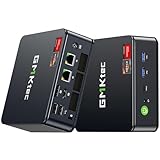
- Office Gaming Mini PC - UPGRADED GMKtec Nucbox M5 Ultra Series is equipped with the powerful AMD Ryzen 7 7730U processor, 8 Cores/16 Threads, Base 2.00GHz (Power Saving Quiet Mode) with Turbo Boost up to 4.50GHz (Performance Mode) in BIOS settings, Based on the ZEN 3+ architecture, this small but powerful mini pc delivers satisfying results in productivity, office work, and gaming. 35% Performance increase over AMD Ryzen 5 7430U/ Ryzen 7 5700U, 5600U, 5560U, 5500U.
- 32GB DDR4 RAM & 512GB PCIe SSD - Installed with DDR4 32GB RAM Dual Channel (2x16GB), the Nucbox M5 Plus mini pc support expansion to 64GB RAM. Featured with 512GB M.2 2280 PCIe 3.0 SSD, support dual slot expansion to 4TB SSD. (Upgrades not included)
- DUAL NIC LAN 2.5G RJ45 - Fast Network Speeds: Enjoy up to 2500Mbps data transmission speed without worrying about lagging. Ideal for working, gaming, and surfing the internet. Great for Untangle, Pfsense or as a server office PC.
- Mini Desktop Computer with 4K Triple Screen Display - Nucbox M5 Ultra integrates AMD Radeon Graphics 8 Cores 2000 MHz GPU to deliver powerful graphics processing power to easily handle the demands of complex design software, 4K@60Hz UHD video editing, and playback. It can connect to 3 display screens simultaneously.
- Fast Internet WiFi 6E + BT5.2 Connection - GMKtec Mini PC with WiFi-6E Wireless, have 2.5G/5G/6G triple band, more faster and lower latency. Bluetooth 5.2 allowing you more quickly to connect other wireless devices (headset, mouse, keyboard, etc.) Interface features 2*USB3.2 ports, 2*USB2.0 ports, 1*HDMI 2.0 port(4K@60Hz), 1*USB-C port(PD/DP/DATA), 1*DP Port, 1*Audio 3.5mm (HP&MIC), 1*DC Power Port.
Product prices and availability are accurate as of the date/time indicated and are subject to change. Any price and availability information displayed on Amazon at the time of purchase will apply.