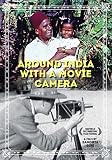
Around India with a Movie Camera is Sandhya Suri’s archival documentary about how India appeared in films made between 1899 and 1947. Drawing on the BFI National Archive, it brings travelogues, newsreels and home movies into an edited sequence that asks viewers to look not only at what the footage shows, but at who filmed it and how the images frame India.
What is Around India with a Movie Camera about?
The documentary gathers films made by British, French and Indian filmmakers across the period from 1899 to 1947. Its material ranges from travelogues and newsreels to intimate family films. Rather than presenting those images as a complete or neutral record of Indian life, Suri arranges them into themes and contrasts that bring their perspectives into view.
| # | Preview | Product | Price | |
|---|---|---|---|---|
| 1 |
|
Around India With A Movie Camera | $29.98 | Buy on Amazon |
| 2 |
![Airport Terminal Pack [DVD]](https://m.media-amazon.com/images/I/51u7TvlKDzL._SL160_.jpg)
|
Airport Terminal Pack [DVD] | $8.93 | Buy on Amazon |
| 3 |

|
Miracle | $3.99 | Buy on Amazon |
The British Film Institute describes the film as engaging with colonialism, changing viewpoints and the histories leading up to independence. Coonoor Kripalani, writing for the Association for Asian Studies, notes that scenes of Indian daily life appear alongside British activity, and that much of the material comes from expatriate family films as well as news footage. That is one reviewer’s description of the compilation, not a claim that every sequence fits a single category.
How does the film shape the archive?
Suri directed and edited the film, produced by Nicola Gallani, with a score by Soumik Datta. The edit is central to its meaning: footage recorded for different purposes and by different people is selected, placed beside other images and linked through transitions. The result is an argument made through juxtaposition, not simply a collection of historical clips.
What’s actually slowing this PC down?
Pick the symptom - the matching free tool is one click away.
#1 Best Overall
- Shrink-wrapped
In an interview with Scroll.in, Suri said, “I am working towards the viewers making meaning out of the footage.” She described looking for recurring images and themes, including a colonial “playground” motif, and deciding how one sequence should lead into another. She also said she preferred to end with a question: “how are things going to be, and what is the legacy?” Those remarks explain her intentions; viewers may draw different conclusions from the finished film.
What can the different kinds of footage reveal?
The archive invites comparisons, though its categories overlap. A newsreel may serve a public or official purpose; a family film records domestic life from the camera-holder’s position. Travel imagery can present a place as spectacle, while everyday scenes may offer a less formal view. Comparing footage made by British, Indian and French filmmakers can also draw attention to who holds the camera and what the images choose to show.
Rank #2
- Factory sealed DVD
- Newsreels and home movies: Consider how public events and family scenes differ in subject, framing and intended audience.
- Travel images and domestic observation: Notice whether a place is presented for an outside viewer or encountered as part of ordinary life.
- Different filmmakers: The makers’ backgrounds offer a useful axis for comparison, but they do not by themselves explain each film’s point of view.
- Changing historical context: Images spanning nearly five decades sit against the political changes that preceded independence; a compilation can suggest that shift without representing every experience of it.
Suri has described recurring interests in exoticism and maharajas in the archive, and her interest in the sometimes-problematic relationship between Britain and India. These are her account of the material and her editorial lens, not proof that every filmmaker shared the same outlook.
Why does one 1899 film have the wrong place in its title?
The BFI’s press release identifies an early film titled Panorama of Calcutta, India (1899), but clarifies that its images show the ghats of Varanasi from the waterfront, not Calcutta. The discrepancy is a small but telling reminder that an archival title is itself a piece of evidence to question: labels can preserve an error even when the moving images offer clues to a different place.
Rank #3
Who made the film, and when was it released?
Sandhya Suri directed and edited Around India with a Movie Camera; Nicola Gallani produced it, and Soumik Datta composed the score. The dates depend on what a listing is dating: the British Council UK Films Database gives the project year as 2017, while the BFI identifies the film as 2018. It is therefore clearest to describe it as a 2017 project released or screened in 2018, rather than assigning it one unqualified year.
Runtime listings differ slightly. The British Council database lists 72 minutes, while the BFI Player catalog lists 1 hour 13 minutes. These are the respective catalog figures, rather than evidence of different cuts.
Where can you watch it?
The BFI Player catalog page lists the documentary and is the place to check current viewing availability. Access terms can change, so confirm them on the page. A current physical DVD edition or marketplace listing is not established here.
Quick Recap
Sources and further details
- BFI: “New archive compilation film goes Around India with a Movie Camera” — project, archive span and director’s selection process.
- British Council UK Films Database — project record, format and listed runtime.
- BFI: “India on Film: 1899–1947 — Treasures from the BFI National Archive” — archival context and the correction to the 1899 film’s location.
- Association for Asian Studies: Coonoor Kripalani’s review essay — a reviewer’s account of the film’s images and sources.
- Scroll.in interview with Sandhya Suri — the director’s comments on editing and the ending.
- BFI Player catalog — current listing and viewing route.
Product prices and availability are accurate as of the date/time indicated and are subject to change. Any price and availability information displayed on Amazon at the time of purchase will apply.




