Ustad Allarakha was born on April 29, 1919, making 2019 his birth centenary year. In a 2019 interview with Scroll.in, his son, tabla player Fazal Qureshi, remembered a musician who taught through close listening, explored rhythmic possibilities beyond familiar conventions, and treated music as a collaborative art. Fazal’s account is both a portrait of his father and a first-hand view of how that musical legacy was passed on.
How did Fazal Qureshi learn from his father?
Fazal says he learned largely by watching Allarakha practise and imitating what he heard, rather than beginning with written notation for the tabla’s spoken syllables, or bols. When his father was away, he sometimes returned to concert recordings to revisit a kaida—a foundational tabla composition—and examine its variations. Fazal recalls that his father could tell when he had learned the material.
That process combined imitation with analysis. In the Scroll interview, Fazal explained: “Analysis is important, and because of that I am able to add my variations to his compositions – I follow the same patterns.” His recollection suggests a tradition in which a student first absorbs a composition closely, then studies how it works well enough to create within its framework.
What did Allarakha’s teaching emphasize?
Fazal describes his father’s teaching as organized but attentive to individual students. Learners could be grouped by level, while Allarakha still focused on each person. The aim, as Fazal recalls it, was not simply to reproduce a composition: students were encouraged to understand how a variation was made and eventually develop variations of their own.
#1 Best Overall

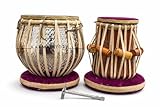
- Brass Bayan -Head Diameter 9.5 in// 12 in tall 6.6 lb
- Dayan - Wood-Head Diameter 5.5'' in // 11'' in tall 8.4 lb
- Quality Product crafted in India, Handmade Fine Tabla Set
- Includes: padded tabla gig bag, tuning hammer, high-quality cushions, and covers
- PLEASE NOTE - This is a Handmade Instrument, Minor Nano Scratches/Chips or Dust Might be Present
He also remembers a teacher deeply committed to his students. Fazal says Allarakha continued going to teach even when he was unwell, and that having a classroom made it possible to teach many learners. These are his son’s memories of the work and the person behind it, rather than a record of the institute’s current operations.
Why did Fazal call his father an “all-round musician”?
Fazal’s admiration rests on more than Allarakha’s command of tabla accompaniment. He recalls his father exploring rhythmic cycles that other performers were not then playing, accompanying South Indian musicians and Western classical violinists, working with international drummers, composing film music, and working as a vocalist with All India Radio. The Indian Express’s centenary profile also places Allarakha’s radio and film work within the broader course of his career.
Rank #2
For Fazal, that breadth is central to how his father should be remembered: “I’d like people to remember him as an all-round musician.” He also described Allarakha as ahead of his time. That is his son’s considered assessment, grounded in the examples he gives, not a measurable ranking of musicians.
What does the centenary tell us about Allarakha’s legacy?
The Alla Rakha Foundation biography gives Allarakha’s birth date as April 29, 1919; the centenary therefore fell in 2019. The date also situates Fazal’s interview as a centenary-year reflection, not a current anniversary report. Independent context comes from the National Endowment for the Arts profile of Zakir Hussain, which describes a household where Allarakha taught students and musicians gathered—an environment in which musical learning was part of daily life.
The Tool Desk
Outbyte PC Repair FREEClear out junk files and repair common Windows errorsFree Scan →Outbyte Driver Updater FREEScan for outdated or missing drivers - takes under a minuteDriver Scan →Rank #3

- 3KG black brass bayan, rich resonance and deep sustain.
- Handmade goat-skin puddi, syahi hand-applied and centred by craftsman Md. Ashraf in Delhi.
- Dense Sheesham dayan, 5-5.5 inch head, tuned to C#.
- Two velvet cushion rings, carry bag, tuning hammer.
- Individually tested before packing. Maharaja Musicals, since 1999.
Fazal’s account makes the legacy tangible at the level of practice: listening, copying, studying a composition’s internal logic, and then contributing a variation. It also broadens the picture of a tabla master beyond performance alone, toward teaching and exchange across musical traditions.
Independent reader supportYour contribution helps us test, update, and keep practical guides available for everyone.How does Fazal remember Allarakha as a father and teacher?
Fazal remembers his father as calm and affectionate, saying that he did not scold the children. He also recalls Allarakha treating students impartially, valuing their talent rather than their family status or wealth. Those details are intimate family recollections, and are best understood as Fazal’s testimony about the character he experienced at home and in the classroom.
Quick Recap
Best Value

- PREMIUM SHEESHAM WOOD CONSTRUCTION – Crafted from durable red sheesham wood for rich resonance, warm tonal depth, and long-lasting durability. The naturally polished wooden body enhances sound clarity while delivering the authentic traditional appearance musicians appreciate.
- CRISP & BALANCED DAYAN SOUND – Designed to produce sharp, bright, and expressive treble tones essential for Indian classical music, bhajan, kirtan, devotional sessions, practice, and live performances. Precision syahi placement supports clear tonal projection.
- EASY & ACCURATE TUNING – Equipped with strong leather straps and traditional wooden gatta blocks that allow stable tuning adjustments and consistent pitch control. Built for both beginners learning tabla and experienced musicians seeking dependable performance.
- AUTHENTIC HANDCRAFTED INSTRUMENT – Carefully handcrafted by skilled Indian artisans using traditional techniques passed down through generations. Features hand-braided gajra, precision-crafted pudi, and a premium finish that reflects true Indian musical heritage.
- PERFECT FOR STUDENTS, PRACTICE & PERFORMANCE – Suitable for music learners, professional artists, meditation music, bhajan groups, stage performances, home practice, and gifting. Includes cushion base for stability and instrument protection during use.
Rank #4

- Steel bayan, 9-9.25" head, handmade goat-skin puddi, syahi hand-applied and centred.
- Sheesham wood dayan, 5-5.5" head, tuned to C#.
- Two velvet cushion rings, carry bag, tuning hammer.
- Individually tested before packing, made by craftsmen in Delhi.
- Maharaja Musicals. Since 1999. Made in India.
Sources and further reading
- Scroll.in: Fazal Qureshi on his father, Alla Rakha — the 2019 interview behind the recollections and quotations in this article.
- The Indian Express: Allarakha centenary profile — historical context on his career.
- Alla Rakha Foundation biography — birth date and family context.
- National Endowment for the Arts: Zakir Hussain profile — context on the musical household where Allarakha taught.
Product prices and availability are accurate as of the date/time indicated and are subject to change. Any price and availability information displayed on Amazon at the time of purchase will apply.




