Do these 3 things before closing this tab:
1Clear out junk files and repair common Windows errors2Scan for outdated or missing drivers - takes under a minute3Repair Windows errors before they cause bigger problemsRed theatre curtains are a convention, not a rule with one known inventor. The familiar red velvet and gold-fringe look became prevalent in 19th-century European theatres, where it coordinated with richly decorated auditoriums. Curtains themselves are much older: they have long hidden and revealed the stage, while also marking the boundary between the audience’s world and theatrical fiction.
Before red: what theatre curtains were for
Theatre curtains existed long before the iconic red-and-gold design. A scholarly history describes Roman curtains used to conceal some or all of the stage and traces how curtains developed practical, decorative and symbolic roles over time. They controlled what an audience could see, creating suspense before a performance and separating the playing space from the viewers.
That separation has meaning as well as practical use. Scholar Agnieszka Kuczyńska describes the curtain as “the border of two worlds”: the viewer’s reality and the theatrical action’s “illusive fiction.” The curtain’s familiar opening and closing turns that boundary into part of the performance. Read Kuczyńska’s history of the theatrical curtain.
How red velvet became the familiar look
The European Theatre Lexicon says red velvet curtains with gold fringe prevailed in the 19th century, as Italian-style playhouses spread. Their colors and materials harmonized with the decoration of the auditorium, making the curtain part of a coordinated interior and giving the stage a ceremonial frame. That historical fashion is the strongest explanation for why red became so closely associated with theatre.
The Tool Desk
Outbyte Driver Updater FREEFix the driver behind crashes, sound loss and screen glitchesFind Drivers →Outbyte PC Repair FREERepair Windows errors before they cause bigger problemsFix Now →#1 Best Overall
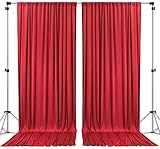
- HIGH QUALITY MATERIAL: Made from 100% premium polyester, these backdrop drapes are stain and wrinkle-resistant, ensuring an elegant look through 75+ wash cycles. Perfect for any event requiring a sophisticated touch.
- GENEROUS DIMENSION: Each order includes 2 polyester curtains, each measuring 5 feet wide by 10 feet high. Combined, they create a stunning 10 feet wide by 10 feet high backdrop, perfect for larger settings.
- VERSATILE USES: Ideal for weddings, receptions, parties, bridal and baby showers, birthdays, dessert tables, and more. These curtains also work well with pipe and drape systems, adding a decorative touch to any occasion.
- PROFESSIONAL QUALITY: Features serged sides and bottom for a clean, finished look, with a 4-inch rod pocket on top for easy hanging. Single layer, unlined, and semi-opaque, these drapes offer a polished appearance.
- SAFETY CERTIFIED: Inherently Fire Retardant (IFR) and certified under NFPA 701 standards, providing peace of mind during events. Perfect for indoor use where safety is a priority.
Red was not universal, and curtains did not always use plain fabric. The lexicon records painted designs, including a Paris Opera curtain painted to imitate red velvet, as well as a grey velvet curtain chosen to suit its room. These examples show that curtains could either complement the auditorium or present a painted image of their own. See the European Theatre Lexicon’s account of theatrical curtains.
In a 2010 discussion of theatrical design, Victoria and Albert Museum author Jane Pritchard called red “a colour associate with theatre.” That observation describes an established association; it does not establish a single origin or a requirement that theatres use red. Read Pritchard’s V&A discussion of red in theatre.
The decorative curtain is not the fire curtain
The grand drape at the front of a stage is primarily decorative and helps conceal or reveal the performance space. A fire curtain is a separate safety barrier intended to divide the stage from the auditorium in a fire. Historical fire curtains were sometimes made of metal; they are not the reason the decorative curtain became red.
Rank #2

- Extreme Blackout technology blocks out 100% of outside light
- Energy Efficient design reduces energy lost through your windows by up to 50%
- Thermal properties help keep summer heat and winter chill out of your home
- Noise reduction by up to 45% helps you get a sounder, more uninterrupted sleep
- Built-in rod pocket fits curtain rods up to 1.5" in diameter
Fire was a serious hazard in theatres lit with gas lamps. The London Fire Brigade Museum credits Chief Officer Captain Sir Eyre Massey Shaw with devising a theatre fire curtain in 1794, describing early examples as metal barriers intended to divide the theatre from the auditorium. The museum also reports that by 1884, 41 theatres had burned across the world, in which 1,200 people died. Those figures are the Brigade’s historical account, not an independently reconstructed global census. Read the London Fire Brigade Museum’s account of fire in theatres.
Free tools Windows power users keep installed
One-click scans. No signup required.
When a safety curtain becomes artwork
A safety barrier can also carry artistic meaning without becoming the decorative front drape. Rudolf Eisenmenger designed the Vienna State Opera safety curtain in 1954–55. Its design prompted controversy, and later artists reinterpreted the safety-curtain medium. The example shows how even a functional division between stage and audience can become part of a theatre’s visual identity. Read Robert Fleck’s account of the Vienna State Opera safety curtain.
Quick Recap
What the history does—and does not—establish
- Theater curtains have ancient precedents, but the familiar modern red velvet and gold-fringe style is especially associated with 19th-century European interiors.
- The curtain’s functions include concealing the stage, shaping anticipation and framing the transition into theatrical fiction.
- Red is a powerful convention, not a universal standard. Historical sources document other colors and painted designs.
- The history does not establish a definitive inventor, first red curtain or single exclusive reason for choosing red. Popular claims that red was selected to hide fire-retardant chemicals or because it inherently improves lighting are not supported by the cited sources.
Product prices and availability are accurate as of the date/time indicated and are subject to change. Any price and availability information displayed on Amazon at the time of purchase will apply.




