Urban Dictionary is a crowdsourced online dictionary of slang and cultural expressions. Instead of having editors settle on one polished definition for each term, it lets contributors submit multiple definitions and examples. That makes it useful for encountering informal or emerging language—and means an entry should be read as one contributor’s account, not proof of a universal meaning.
What is Urban Dictionary?
Aaron Peckham founded Urban Dictionary in 1999 as a crowdsourced resource for slang and a parody of conventional dictionary websites, according to the Library of Congress. Its purpose is to document informal language as people use it, including expressions that may be new, local, humorous, or absent from edited dictionaries.

In a July 7, 2020 post, founder Aaron Peckham described the site’s aim as documenting language as it evolves while challenging the authority of traditional dictionaries. The idea is not to provide a single final ruling on every word, but to collect accounts of how people use or understand expressions.
How does Urban Dictionary work?
Contributors submit definitions
Users submit definitions and usage examples. A headword—the word or phrase being defined—can have several entries, sometimes with sharply different explanations or tones. A 2018 scholarly study describes the site’s content as heterogeneous: contributions vary in quantity and can preserve personal, humorous, conflicting, or locally specific interpretations rather than combining them into one edited entry.
What’s actually slowing this PC down?
Pick the symptom - the matching free tool is one click away.
#1 Best Overall
Readers interpret the entries
Because entries are not uniformly edited into a single account, readers need to consider who might use a term, where and when it appears, and whether the definition reflects a wider pattern or only one contributor’s view. Spelling variants and context can matter, and some definitions may be inaccurate, poorly edited, opinionated, or offensive.
The site can therefore be evidence of how contributors characterize language. An entry alone does not establish that a meaning is broadly accepted, appropriate for formal writing, or endorsed by Urban Dictionary or the wider community.
Rank #2
How is it different from an edited dictionary?
| What to compare | Urban Dictionary | Professionally edited dictionaries |
|---|---|---|
| Capturing new usage | User submissions can record emerging slang and variants quickly. | Editorial selection can make inclusion slower. |
| Consistency | Multiple contributors produce entries with varied quality, tone, and perspective. | Editors apply selection and editorial standards across entries. |
| Range of viewpoints | Entries can preserve personal or subcultural perspectives, which are not automatically representative. | Entries are shaped by editorial decisions rather than an open collection of individual submissions. |
| Best use | Explore informal usage and possible meanings; check context and corroborate important interpretations. | Consult for more consistently edited definitions, especially when writing formally or interpreting language in a high-stakes setting. |
Neither format answers every language question equally well. Urban Dictionary can surface a possible informal meaning; an edited reference and the surrounding context are better checks when accuracy or formality matters.
What do the published counts tell us?
Available figures are historical snapshots, not current totals. The Library of Congress reported that, at the start of 2014, Urban Dictionary had more than seven million definitions and received about 2,000 new entries a day. Those figures describe the collection and activity at that time.
Free tools Windows power users keep installed
One-click scans. No signup required.
A 2018 exploratory study measured a corpus of 1,620,438 headwords and 2,661,625 entries, an average of 1.643 entries per headword. These are measurements of the study’s corpus, not a live count of the website. No current total is established by those figures.
How should you read a definition?
- Look at the surrounding entries. Multiple definitions may show that a term has more than one reported use.
- Check context. A phrase may be specific to a particular group, place, time, or situation.
- Assess the entry critically. A contributor’s confidence does not establish accuracy or representativeness.
- Corroborate consequential interpretations. For formal writing or a high-stakes decision, consult edited references and the original context rather than relying on a crowdsourced entry alone.
- Notice offensive content. A definition may describe an offensive or violent term; its presence does not by itself show endorsement or broad acceptance.
What is known about moderation?
In a March 16, 2021 update, Peckham said Urban Dictionary had replaced volunteer publication decisions with review by its own moderation team for new and flagged definitions. He also distinguished describing an offensive or violent term from endorsing or promoting it. This is a dated account of a change, not confirmation of the site’s current staffing, review times, or exact enforcement workflow.
Rank #4

- Used Book in Good Condition
Is there a print edition?
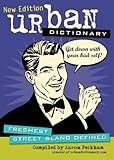
Yes. Urban Dictionary: Freshest Street Slang Defined, credited to urbandictionary.com and Aaron Peckham and published by Andrews McMeel Publishing, is a trade paperback listed by Simon & Schuster. It is a selected print collection, not a complete or current copy of the live website.
Quick Recap
Best Value

- Sold as 1 Each.
- Revised and updated edition of the best-selling dictionary covering core vocabulary with over a hundred new entries and senses
- Book contains 960 pages
- ISBN: 9780877790952
- Features more than 75000 definitions and over 8000 usage examples to aid understanding
Product prices and availability are accurate as of the date/time indicated and are subject to change. Any price and availability information displayed on Amazon at the time of purchase will apply.