Quick wins for a faster PC:
Fix the driver behind crashes, sound loss and screen glitchesFind Drivers →Clear out junk files and repair common Windows errorsFree Scan →Scan for outdated or missing drivers - takes under a minuteDriver Scan →Laxmichand Shah, known as Babla, worked in Hindi film music alongside his brothers Kalyanji-Anandji, while building a separate career as the leader of Babla and His Orchestra. A 2017 interview with Scroll.in traces how his film-session work, overseas stage shows and recordings for Gujarati diaspora audiences came together in his association with disco dandiya.
Who was Babla?
Babla was the professional name of Laxmichand Shah, a musician whose career connected Hindi film production, live orchestra shows and dance recordings. He worked with his brothers Kalyanji-Anandji, but also led his own group, Babla and His Orchestra. The account below follows the recollections and career details in Rudradeep Bhattacharjee’s September 25, 2017 Scroll interview; personal claims and anecdotes are attributed to Babla or to that article.

What did Babla do in Hindi film music?
According to the interview, Babla joined Kalyanji-Anandji’s work around Jab Jab Phool Khile (1965), first as a session musician and later as their rhythm arranger. The article distinguishes his role from overall arranger Jaikumar Parte and orchestra conductor Frank Fernand. Babla said he was often asked to create title music, naming Johny Mera Naam, Kashmakash, Heera and Don.
The interview also credits him with composing several songs, including “Zindagi Ka Safar” from Safar (1970), “Khaike Paan Banaraswala” and “Pyar Zindagi Hai” from films released in 1978, and “Laila Main Laila” from Qurbani (1980). These are the interview’s attributions; they should not be read as a complete or independently verified film-credit record.
#1 Best Overall

- AUTHENTIC INDIAN INSTRUMENT: Wooden Khartal Cymbal, also known as Manjeera or Kartal, is a traditional Indian percussion instrument.
- PERFECT FOR DEVOTIONAL MUSIC: Ideal for Kirtan, Bhajan, and other spiritual performances, adding a rich, resonant sound to worship sessions.
- WOODEN CONSTRUCTION: Crafted with wood for a warm, natural tone that enhances the traditional sound of Indian devotional music.
- NARAD MUNI KARTAL STYLE: Designed in the classic Narad Muni Kartal style, staying true to the authentic roots of Indian musical tradition.
- CONVENIENT PAIR: Comes as a complete set of 1 pair, ready to play right out of the box for both beginners and experienced musicians.
How did Babla and His Orchestra develop?
Scroll reports that Babla started the orchestra in 1963, initially playing at events and performing mostly film instrumentals. One segment was called “Around The World With Rhythm.” Babla recalled touring with Mukesh in the West Indies and North America in 1964. He said the experience made him pay attention to lighting, sound and stage clothing; later, he bought psychedelic lights in London and used slide projections to introduce performers.
The interview gives the group’s early milestones as follows:
Rank #2

- Brass Bayan -Head Diameter 9.5 in// 12 in tall 6.6 lb
- Dayan - Wood-Head Diameter 5.5'' in // 11'' in tall 8.4 lb
- Quality Product crafted in India, Handmade Fine Tabla Set
- Includes: padded tabla gig bag, tuning hammer, high-quality cushions, and covers
- PLEASE NOTE - This is a Handmade Instrument, Minor Nano Scratches/Chips or Dust Might be Present
- 1970: Its first professional show, at Mumbai’s Novelty theatre.
- May 1972: Its 100th show, at Shanmukhananda in Mumbai. The interview reports that Ashok Kumar and Dilip Kumar sang and Amitabh Bachchan danced.
- 1974: Its first performance abroad, in Fiji.
On the return journey from Fiji, a stop in Singapore led Babla to buy a MiniKorg, his first keyboard, according to the interview. He also recalled acquiring a lali, a percussion instrument, in Fiji. The article mentions his use of bongos and dholak, as well as tumba, timbales and octobans in Indian music and dandiya contexts. Babla claimed he was the first in India to use rotodrums on “Laila Main Laila”; that claim is his recollection, not an independently established distinction.
What was disco dandiya, and what did Babla contribute?
Disco dandiya brought a dance-oriented, disco-influenced sound to music associated with Navratri celebrations. The interview does not establish that Babla originated the style, but it documents his strong association with it. His Babla Presents Nonstop Disco Dandia, released in 1981, began a series that the article says became annual.
Outdated Drivers Are Slowing You Down
One free scan finds every outdated or missing driver and matches the right update for your exact hardware.Free scan · exact hardware matchWindows Errors? Fix Them Before They Spread
Repair common Windows errors and clear accumulated junk for a smoother, more stable PC - no reinstall needed.Free scan · no reinstallRank #3

- SIZE - 3 Inches - Small - The surface of the Indian Folk Drum or Dumroo, made from leather, allows a high speed combination of beats unlike any other musical instrument. The shell is made from Wood, sourced from Authorized Government Channels to ensure sustainability of the environment, as well as livelihood of the Artisans
- HOW TO USE - Very simply, just place your index and middle finger along with your thumb around the center of the Dumroo, which is to be held horizontally, so that the leather is facing left and right (and not up and down). Then, very quickly, rotate your wrist back and forth on its axis (like unscrewing a bulb) so that the little orange balls tied to the rope swing with the wrist motion to beat the sides of the drum, to then create the intended rhythmic sounds the Dumroo is meant for! Ea
- TRADITION - It is widely used in classical dance as part of the instrument sets belonging to folk bands. It is often used in Indian film music, and the local Indian folk music of Jamaica, Suriname, Guyana, Caribbean, South Africa, Mauritius, and Trinidad and Tobago, where it was brought by indentured immigrants. In the Fiji Islands the Dumroo is widely used for Indian folk music, bhajan and kirtan.
- GREAT GIFT IDEA - Each piece is unique and comes right from the heartland of India, that is its villages. Use this piece of history and folk culture to decorate your home, or gift to anyone so inclined
- YOUR PRODUCT IS SAFE - The product is packed securely & safely and then exported directly to the Amazon Fulfillment Centers in the US, and fulfilled using the quickest and safest logistics partners, while being covered by the Amazon returns, refunds & replacement policy
Babla described the record as a practical way for Gujarati diaspora communities to dance when bands from India were not being invited to their Navratri events: “Those days, you did not have bands being invited from India during navratri. So, this way, people could just play the record and dance along with the music.” The album turned the live-event energy of dandiya into something listeners could play at home or at a gathering.
The interview also names Babla’s Disco Sensation (1980), Aratis in Disco (1981) and Yesterday Once More (1982), which it describes as featuring instrumental covers of older film songs. It mentions a later album of instrumental versions of ghazals associated with Pankaj Udhas and Anup Jalota.
Rank #4
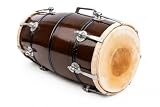
- SIZE - 14 Inches (L) x 7 Inches (Diameter - Bass side) x 5 Inches (Diameter - Treble side). The surface of the Indian Folk Drum, made from leather, allows a basic combination of rhythmic high and low pitches. The shell is made from Mango Wood, sourced from Authorized Government Channels to ensure sustainability of the environment, as well as livelihood of the Artisans
- HOW TO USE - Very simply, just use both your left, and right hands to gently bang either side of the drum, to create the intended rhythmic sounds the drum is meant for. The drum can be tuned by adjusting any of the 14 bolts with a tuning spanner, which comes included in your purchase.
- TRADITION - It is widely used in classical dance. It is often used in Indian film music, and the local Indian folk music of Jamaica, Suriname, Guyana, Caribbean, South Africa, Mauritius, and Trinidad and Tobago, where it was brought by indentured immigrants. In the Fiji Islands the dholak is widely used for Indian folk music, bhajan and kirtan. It is mostly used in India
- GREAT GIFT IDEA - Each piece is unique and comes right from the heartland of India, that is its villages. Use this piece of history and folk culture to decorate your home, or gift to anyone so inclined
- YOUR PRODUCT IS SAFE - The product is packed securely & safely and then exported directly to the Amazon Fulfillment Centers in the US, and fulfilled using the quickest and safest logistics partners, while being covered by the Amazon returns, refunds & replacement policy
For a promotional disco dandiya event in Bandra, Babla estimated a crowd of 8,000 to 10,000 and cited 4,000 security personnel. Those figures are his recollection as reported by Scroll, not independently verified attendance or staffing counts.
Independent reader supportYour contribution helps us test, update, and keep practical guides available for everyone.How did overseas shows shape his later music?
Overseas travel was part of Babla’s stage career and influenced the instruments and production ideas he brought back. The 1964 tour with Mukesh made him think about lighting and presentation; later tours brought encounters with equipment and musical styles. In the West Indies, he heard Trinidadian singer Sundar Popo. Babla said he liked the songs but not their musical treatment.
Best Value
The interview says Babla and singer Kanchan recorded Kaise Bani (1982) and Kuchh Gadbad Hai (1984), and toured extensively during the 1980s and 1990s. It reports that Kanchan died in 2004. In the 2017 interview, Babla described himself as doing selected shows; the article notes a dandiya performance in Antwerp in 2016 and says his last West Indies trip was in 2010. These are time-bound details from that interview, not an update on his current performance schedule.
Why Babla’s story links film music and diaspora dance
Babla’s career moved across roles that are easy to separate on a credit list but connected in practice: rhythm work in film sessions, an orchestra built around live instrumental performance, and records designed to make dance music available beyond the concert stage. His account of disco dandiya is especially grounded in that last purpose: a recording could bring Navratri music to communities that could not readily book a band from India.
Quick Recap
Product prices and availability are accurate as of the date/time indicated and are subject to change. Any price and availability information displayed on Amazon at the time of purchase will apply.




