Recommended Free Tools
Budhaditya Mukherjee’s place in post-independence sitar music grew from a combination of deep training in the Imdadkhani tradition and a personal search for sound and phrasing. His career joined that musical work to early public recognition, international performance and major honors, including the Padma Bhushan in 2019. “Defining sitariya” is a description of that contribution, not a formal award or institutional title.
What shaped Mukherjee’s musical identity?
Mukherjee’s musical identity began at home. He started learning sitar from his father, Pandit Bimalendu Mukherjee, at age five. The Aga Khan Museum describes Bimalendu as a doyen of the Imdadkhani Gharana, placing his son’s early instruction within a specific lineage rather than an isolated apprenticeship.

That inheritance was a foundation, not a boundary. A 2019 Scroll.in profile by Arnab Chakrabarty describes Mukherjee as engaging with the sound of sitarist Vilayat Khan and with phrasing associated with sarangi players, while developing his own repertoire and approach. The Indian Music Archive also situates his playing among these influences. The result is best understood as a synthesis: a musician working from a gharana tradition while listening closely to other instrumental and vocal idioms.
How did his career begin?
Mukherjee’s public career took shape while he was still young. His artist-published biography says he won the All India Radio music competition in 1970 and became an A-grade artist of All India Radio and Doordarshan in 1975. His own biography records a stage appearance in Calcutta in 1976; the Scroll.in profile recounts a 1977 LP release. These milestones are reported by those sources and should not be mistaken for a complete account of his early performances.
Do these 3 things before closing this tab:
1Repair Windows errors before they cause bigger problems2Scan for outdated or missing drivers - takes under a minute3Clear out junk files and repair common Windows errors#1 Best Overall
Music was not his only early path. According to his artist-published biography, he graduated first in his class in metallurgical engineering in 1977 and received a gold medal before devoting himself to sitar. The sequence gives context to the seriousness with which he pursued music, without implying that formal engineering training itself explains his musical style.
What distinguishes his approach to the sitar?
A sound shaped by listening
In the Scroll.in profile, Mukherjee acknowledges Vilayat Khan’s tonal quality and articulation as an influence. He described the aspiration this way: “Since I always wanted to present my music within the sonic ambience of this great Ustad, it was but natural that my musical desires would be inspired by him.” The statement identifies an influence openly; it does not make Mukherjee’s work simply an imitation. The profile also points to sarangi musicians Ram Narayan, Gopal Mishra and Bundu Khan, and to vocalist Jagdish Prasad in connection with Mukherjee’s engagement with tappa.
Rank #2

- Instrument: Persian Quality Setar By Nava
- Bowl: Mulberry, Neck: Walnut, Pegs: Walnut
- Length of Instrument: 86 cm, Length of strings: 66 cm,
- It comes with soft case and extra strings
Instrument and musical vision
The same 2019 profile reports that Mukherjee spent 15 years researching sitar construction in pursuit of an instrument suited to the sound he wanted. That account connects his artistic identity to the instrument itself: tone is not only a matter of performance technique, but also of the physical sitar and the player’s musical aims. The sources do not establish that any particular commercially available model reproduces his instrument or sound.
Vocal inflection and repertoire
Mukherjee’s artist-published biography describes his music in terms of gayaki ang, a vocal-inflected approach to instrumental playing, and the development of raga material. The reported connection to tappa is another example of his interest in bringing vocal ideas into sitar performance. These descriptions help explain the range of his musical references; they are source-specific characterizations, not a universal technical verdict on his style.
Windows Errors? Fix Them Before They Spread
Repair common Windows errors and clear accumulated junk for a smoother, more stable PC - no reinstall needed.Free scan · no reinstallOutdated Drivers Are Slowing You Down
One free scan finds every outdated or missing driver and matches the right update for your exact hardware.Free scan · exact hardware matchRank #3

- Acoustic-Electric Sitar. Can be played both ways. Comes installed with acoustic strings and a spare electric string set (magnetic strings). Simply change 3 brass strings to convert to electric
- Full cedar wood construction; the best wood for sitars to withstand the high tension created by over 21 Strings! Adds to the life of your Sitar dramatically and also ensures more consistent tuning
- Real bone bridges and brass frets, top of the line.
- 7 Main String RAVI SHANKAR configuration
How did performance and teaching broaden his work?
Mukherjee’s career extended beyond India through performances and teaching. His artist-published biography says he had performed in 26 countries and lists 47 commercial releases through July 2003. Those are dated, self-reported figures, not current totals: the available sources do not provide an independently audited count of his present-day concerts, touring countries or releases.
The same biography records teaching at an institute in Venice from 1983 and at Rotterdam from 1995. A 2013 NAAD Foundation biography describes him as a visiting expert at Rotterdam from 1995 to 2005. The accounts differ in scope: one says “since 1995,” while the older event biography supplies an endpoint of 2005. Together, they document a substantial teaching connection without establishing a single definitive end date.
Rank #4
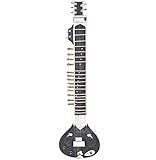
- BRAND NEW ORIGINAL SITAR
- FULLY TUNED, PROFESSIONAL QUALITY - KHARAJA PANCHAM STYLE
- SINGLE TOOMBA SITAR - BLACK COLOR - EXQUISITE CELLULOID WORK - CAMEL BONE BRIDGES
- INCLUDES PADDED GIG/TRAVEL BAG FOR SITAR, MIZRABS AND EXTRA SET OF STRINGS
- INSTRUMENT HAND CRAFTED IN INDIA - PROFESSIONALLY TESTED BEFORE DISPATCH!
What do his major honors recognize?
The Aga Khan Museum biography lists Mukherjee’s Sangeet Natak Akademi Award in 2010 and Padma Bhushan in 2019. The Government of India describes the Padma Bhushan as recognizing “distinguished service of a high order.” The category’s general definition explains the honor’s stated level; the museum biography is the source for Mukherjee’s individual award record.
These honors form part of the public recognition of a career that began early and developed across performance, teaching and recording. They do not reduce his contribution to a single style or prize. His significance lies in the conjunction of inherited training, deliberate musical choices and sustained engagement with audiences in different settings.
What’s actually slowing this PC down?
Pick the symptom - the matching free tool is one click away.
Quick Recap
Best Value
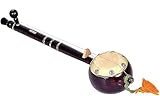
- Sale For - Pack Of 1 | Type - Musical Instrument Iktara
- Material - Wooden | Color - Multicolor
- Item Size - Length - 22 Inches (Approx)
- Pure Handmade Fine Crafted Indian Musical Playing Instruments Wooden Iktara.
- It is used in genres like bhajans, kirtans, and other forms of music.
Product prices and availability are accurate as of the date/time indicated and are subject to change. Any price and availability information displayed on Amazon at the time of purchase will apply.




