Do these 3 things before closing this tab:
1Repair Windows errors before they cause bigger problems2Fix the driver behind crashes, sound loss and screen glitches3Clear out junk files and repair common Windows errorsGoogle’s interactive Doodle honoring Wilbur Scoville launched on January 22, 2016, marking what would have been his 151st birthday. Scoville is remembered for the pepper-pungency test that gave rise to the Scoville scale. Its original method relied on trained tasters and serial dilution; modern laboratories can measure capsaicin with instruments such as high-performance liquid chromatography (HPLC).
Who was Wilbur Scoville?
Wilbur Scoville was an American chemist born in 1865 in Bridgeport, Connecticut. Google’s Doodle archive describes him as a researcher, professor of pharmacology and officer of the American Pharmaceutical Association. He is best known for developing the organoleptic test used to measure pepper pungency.

The Doodle’s title was “Wilbur Scoville’s 151st Birthday.” Google credited Olivia When as its Doodler and presented the work as an interactive game. When described the concept as a comic fighting game; the archive recounts her process of storyboarding, prototyping, creating character art and animating the scenes. Google’s Doodle archive includes her account and the interactive experience.
Google also notes that Scoville wrote The Art of Compounding and says the book includes an early mention of milk as an antidote to pepper heat. That is Google’s description of the book, rather than an independently established claim that it was the first such mention.
#1 Best Overall
What is the Scoville scale?
The Scoville scale expresses the pungency of chili peppers in Scoville Heat Units (SHU). The National Institute of Standards and Technology (NIST) says pharmacologist Wilbur Scoville invented it in 1912. The scale is named for its creator, but SHU does not measure literal temperature: it represents how much dilution was needed in the original test before tasters could no longer detect pepper heat.
The burning sensation comes from capsaicinoids, a family of compounds in hot peppers. Capsaicin is the most abundant capsaicinoid in hot peppers, according to NIST. It activates heat-sensing receptors, making the mouth feel as if it is burning even though its temperature has not actually risen. NIST explains the chemistry and measurement in “How Do You Measure the ‘Heat’ of a Pepper?”
Rank #2
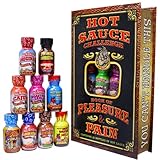
- THE HOT SAUCE CHALLENGE SET: We dare you and your friends to make it through all 12– 0.75-ounce bottles in this set. This set includes: Bacon Hot Sauce; Chile Lime Hot Sauce; Sriracha Hot Sauce; Cajun Hot Sauce; Original Hot Sauce; Wasabi Hot Sauce; Roasted Garlic Hot Sauce; Habanero Hot Sauce From Hell; Hot Sauce From Hell Devil's Revenge; Ghost Pepper Hot Sauce.
- TOP- NOTCH QUALITY: This hot sauce gift set is made only with the best ingredients like habanero peppers, cayenne peppers, jalapeño peppers, sriracha, wasabi and chili lime. Some sauces in this set contain 1 million Scoville capsicum extract, that's enough to make your mouth burn like hell!
- THE ULTIMATE HOT SAUCE GIFT SETS: Looking for a unique hot sauces gift to give to loved ones this holiday season but can't decide what they'll like? Surprise them with this hot sauce set that's perfect for true fans of heat. With 12 different tantalizing flavors, they're bound to find their new favorite.
- PERFECT HOT SAUCE SAMPLER: They say variety is the spice of life, so here's a hot sauce variety pack that will definitely spice things up! Why pick just one hot sauce when you can have 12? Not only does this set deliver with its unique flavors but also with its convenience. The travel size bottles are perfect to take on the go, so now you'll never need to leave the house without that favorite hot sauce.
- A NEW PARTY FAVORITE: With the hottest hot sauce variety pack around, this hot sauce gift set was made to be taste-tested by friends! What better way to entertain guests at your next party than by challenging them to try all 12 flavors.Hot sauce challenge set hot sauce sampler set hot sauce variety pack hot sauce gift sets hot sauce variety hot sauce assortment hot sauces gift hot sauce box set hot sauce gift pack hottest hot sauce gift set hot sauce sampler pack sauces gift set
How did Scoville’s original test work?
- Extract the pepper compounds. Capsaicinoids were extracted from the pepper sample.
- Dilute the extract. The extract was diluted with sugar water in successive steps.
- Have trained tasters assess it. Tasters sampled the dilution to determine whether they could still detect heat.
- Record the threshold. The number of dilutions required until the heat was no longer detectable determined the result: more dilutions meant a higher SHU rating.
This was a sensory test, not a thermometer reading or a direct count of how hot a pepper feels to every person. Because detection depends on human tasters, the result could vary with the tasting panel as well as with the pepper sample.
How hot are different peppers?
NIST gives the following comparison values. They are reported ranges or values in its explainer, not guarantees for every pepper of a variety. NIST notes that growing temperature, soil and location can affect pepper heat.
Recommended Free Tools
Rank #3

- This Is a Book for People Who Love Hot Sauce
- ABIS BOOK
- Trapeze
| Pepper | Reported heat |
|---|---|
| Bell pepper | 0 SHU |
| Poblano | 1,000–1,500 SHU |
| Jalapeño | 2,000–8,000 SHU |
| Thai pepper | 50,000–100,000 SHU |
| Ghost pepper | 855,000–1,041,427 SHU |
| Pepper X | 3.2 million SHU |
These figures, presented by NIST without a separate publication year for the underlying pepper measurements, are useful for comparing the examples but should not be treated as fixed values for every individual pepper.
Independent reader supportYour contribution helps us test, update, and keep practical guides available for everyone.Is the Scoville scale still used?
Scoville’s original organoleptic test and modern laboratory measurement are different methods. NIST describes high-performance liquid chromatography (HPLC) as a modern analytical approach that separates, identifies and quantifies components in a sample, including capsaicin. It avoids relying on a tasting panel to detect pungency. Modern measurements may still be expressed in SHU, but that does not mean an instrument is repeating Scoville’s original human-taster test.
Quick Recap
Rank #4

- RETRO KITCHEN DECOR: Our fun wall art decorative metal signs can be widely used in many places, such as kitchen, dining room, living room, garden, cafe, office, hotel and other places, adding a touch of fun to your decoration
- Suitable Size: Measures 8 inches x 12 inches (20cm x 30cm) providing an appropriate display size for various wall spaces and decorative arrangements
- High Quality Material: This kitchen tin sign is made of 100% rust-free sturdy aluminum that is not easy to bend, will not rust, will not fade, and is easy to store and reuse for many years
- EASY TO HANG: The vintage metal sign comes with four pre-drilled holes for easy installation, simply hang it up and enjoy the decorative appeal it brings to your space
- SCOVILLE CHILI SCALE DESIGN: Features a vintage-style Scoville chili scale graphic that adds humorous and educational kitchen wall art showcasing different chili pepper heat levels
Product prices and availability are accurate as of the date/time indicated and are subject to change. Any price and availability information displayed on Amazon at the time of purchase will apply.




