A home theater can be as simple as a TV and soundbar in a bedroom or as involved as a projector, AV receiver, and multiple speakers in a dedicated room. The right setup depends less on room size than on viewing distance, light, seating, speaker placement, wiring limits, and how much complexity you want to manage.
Start by measuring the room and choosing the main seat. Then select a display and audio system the space can support. Good placement and calibration usually matter more than adding speakers your room cannot accommodate.
What counts as a home theater?
A home theater is any viewing setup designed to make films, television, games, or other video feel more immersive through a suitable display, sound system, and seating. It does not require a projector, a dedicated room, or a particular speaker count. Dolby describes arrangements for dedicated theaters as well as living rooms and compact guest bedrooms in its home theater setup guide.
- Personal cinema: A TV with its built-in apps or a streaming device, plus a soundbar or 2.0/2.1 speakers. This is often enough for a bedroom, office, or small apartment.
- Family-room theater: A large TV or suitable short-throw projector, paired with an expandable soundbar or a 3.1/5.1 speaker system. HDMI ARC/eARC and basic room correction can simplify use.
- Dedicated theater: A large TV or projector and screen, an AV receiver or processor, separate speakers, one or more subwoofers, and potentially acoustic treatment and dedicated wiring.
In a layout such as 5.1.2, the first number represents ear-level speakers, the second the subwoofer channel designation, and the third height speakers. The notation describes the intended layout, not necessarily the number of physical boxes in every consumer product. For example, a soundbar can render several channels from one enclosure.
Outdated Drivers Are Slowing You Down
One free scan finds every outdated or missing driver and matches the right update for your exact hardware.Free scan · exact hardware matchPC Slower Than It Used to Be?
A free scan shows the junk files, broken settings and background clutter dragging Windows down - then fixes them in one click.Free scan · Windows 10 & 11#1 Best Overall
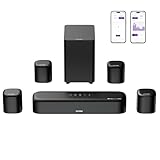
- 7.1ch Dolby Atmos Surround Sound System for TV: This 7.1ch sound bar features 3 main channels for crisp dialogue and 4 surround speakers. Power the rear right surround speaker to pair it wirelessly with sound bar. The setup delivers an immersive surround sound audio experience, making you feel fully engaged in the action. Note: Recommended for space of 108 to 270 ft².
- 4 Surround Speakers for Home Theater Sound System: The Aura A60 Pro soundbar for tv comes with 2 wired front surround speakers and 2 wired rear surround speakers, positioned to create a wide, room-filling soundstage. The rear speakers connect wirelessly with the soundbar, minimizing cable clutter and optimizing space efficiency.
- Dolby Atmos Delivers an Immersive 3D Soundscape: This 7.1ch dolby atmos soundbar enhances your listening experience with multidimensional audio that surrounds you from every direction, upgrading your home theater with powerful, dynamic sound that brings each scene to life.
- 5.25-inch Wired Subwoofer with BassMX Technology: The Aura A60 Pro sound bar comes with a 5.25" wired subwoofer powered by BassMX technology to boost low-frequency performance. An optimized magnetic structure and diaphragm produce deep, powerful bass. Enjoy enhanced low-end sound and experience the impact of every beat.
- Precision Audio Tuning Redefined: Customize your audio experience with the Ultimea App, designed for precise sound control. It provides 121 professionally tuned EQ presets across styles such as Bass, Pop, Classical, and Rock, along with 10-band control and 6 tailored EQ modes including Movie, Music, Voice, Sport, Game, and Night. Using the advanced “Customize” option, you can adjust audio details to suit your personal taste, ensuring every sound is tuned exactly how you prefer.
Measure the room before choosing equipment
Room dimensions, furniture, and the position of the main seat determine what can fit and where it can go. A rectangular room is often easier to arrange than a square or irregular one, but no single room ratio guarantees good sound. Electronic correction cannot fully compensate for blocked speakers, severe seating asymmetry, or poor geometry.
- Measure the room’s length, width, and ceiling height.
- Mark doors, windows, fireplaces, radiators, vents, outlets, and built-in furniture.
- Choose a likely screen wall and seating area. Note whether the seat can be centered on the screen.
- Measure viewing distance from the seated eye position to the screen plane, and record the usable screen-wall width.
- Decide whether the room must remain a living space, and how much light you can control.
- Note where speaker wire could run, whether speakers can be mounted, and where powered wireless speakers could plug in.
- Consider neighbors, shared walls, upstairs rooms, and quiet hours before choosing a subwoofer or target volume.
Furniture is part of the plan, not an afterthought: it affects screen height, center-speaker placement, surround obstructions, seating symmetry, bass, and reflections.
Choose the setup your space can support
Bedroom or office
A TV sized to the actual viewing distance and a compact soundbar or 2.1 system are practical starting points. A projector is usually less convenient unless you can darken the room, meet the throw-distance requirement, and accommodate its installation. Keep the screen comfortable from the bed or desk, avoid burying the soundbar in a cabinet, and use night mode if louder effects could disturb others. Low ceilings or beams may also make upward-firing Atmos effects less convincing.
Apartment or rental
A TV with a soundbar, 3.1 system, or modest 5.1 setup can work without permanent construction. Wireless surrounds still need power, and the wireless link can depend on the product, distance, obstructions, network conditions, and firmware. Keep bass at a neighbor-conscious level; isolation feet may reduce some vibration transmitted through a surface, but they do not soundproof a room. Favor reversible placement and cable-routing solutions before considering in-wall wiring or ceiling speakers.
Small living room
Use the largest unobstructed wall that avoids glare, and center the primary seat when possible. A soundbar with optional subwoofer and surrounds is simpler and less visually intrusive; a 3.1 AV receiver system offers more flexibility and a dedicated center channel. If adding 5.1, place surrounds where the room allows rather than forcing them behind a couch in positions that do not suit the layout. Keep cable runs out of walkways.
Open-plan living room
Position the screen on the most acoustically enclosed wall you can use, and define the listening area with the seating and, if helpful, a rug. A soundbar or front-stage system may be more credible than rear speakers when the room has no useful surround positions. Open space lets sound spread into adjacent areas, and seating may be far off-axis; do not expect a perfectly even surround experience in every seat. If windows cannot be covered, a TV is generally easier to use than a projector.
Rank #2

- Simplified 5.1ch Dolby Atmos Setup: Enjoy immersive 4D sound with real Dolby Atmos and 5.1-channel audio. Five built-in speakers, including two side-firing drivers, create wide surround without rear speakers. Precision DSP ensures <0.5 ms latency for smooth, theater-like sound. Setup takes less than 1 minute.
- Voice Clarity Enhancement: VoiceMX technology uses advanced DSP algorithms to isolate and enhance vocal frequencies in real time. Dialogue remains crisp and easy to follow by separating speech from background effects and music, even at low volumes or during intense scenes.
- 300W Output with 6-Driver System: Featuring five precision-tuned full-range drivers and a dedicated wired wooden subwoofer, the system delivers up to 300W of peak power for bold, room-filling sound. With a frequency response of 45 Hz–18 kHz and a maximum SPL of 99 dB, it reproduces everything from subtle nuances to explosive cinematic effects.
- 18 mm High-Excursion Driver: Powered by BassMX technology, the wired wooden subwoofer features a 18 mm high-excursion driver, a 5.3L tuned cabinet, and a high-density magnetic circuit. This design delivers deeper, tighter bass with greater air displacement and enhanced low-frequency performance—bringing more realism to every scene.
- HDMI eARC for True Dolby Atmos: HDMI eARC supports up to 37 Mbps of bandwidth, unlocking the full potential of lossless Dolby Atmos 5.1-channel audio. Compared to standard ARC, eARC delivers richer surround effects and greater detail. CEC integration allows the TV and soundbar to work together with unified control.
Basement
Basements can offer better light control and more freedom to run wiring, making a projector or wired AV receiver system easier to plan. Before bringing in electronics or acoustic materials, check for moisture and flooding risks. Account for HVAC noise, low ceilings, concrete or masonry reflections, ventilation, and bass transmission through framing. Preserve required access and egress, and plan equipment service access before closing walls.
Dedicated theater
Design around the main listening position before planning extra rows or buying equipment. Establish the seats, screen, front speakers, surrounds, height speakers, subwoofer locations, cable routes, ventilation, and access in that order. Too many seats can force compromises in screen angle, speaker geometry, and bass response. Treat reflections or bass problems after assessing the room rather than covering every surface by default.
What’s actually slowing this PC down?
Pick the symptom - the matching free tool is one click away.
TV or projector: which fits the room?
Choose a TV when the room has daylight or uncontrolled light, the seating is close, everyday viewing is important, or you want straightforward installation. TVs are also often the more convenient choice when gaming latency, HDR brightness, and using the screen without lowering a screen or darkening the room matter.
Choose a projector when you want a much larger image than a practical TV can provide, the room can be darkened, and seating distance and installation allow it. Plan for throw distance, screen size and aspect ratio, mounting, power and HDMI routing, fan noise, ventilation, and where the speakers can sit around the screen. Light-colored walls and ceilings can reflect stray light and reduce perceived contrast.
There is no universally correct screen size. Dolby offers a rule of thumb of viewing distance in inches divided by 1.5 to estimate screen size in inches: its examples pair about 82.5 inches of viewing distance with a 55-inch screen, and about 97.5 inches with a 65-inch screen. Treat this as a starting point, not an industry law. Sitting too close can make it hard to take in the whole image or reveal pixels; sitting too far can make the image feel small. A very large screen may also be uncomfortable at a short distance or for viewers sensitive to motion or visible pixel structure. See Dolby’s screen and room guidance.
For a projector, judge brightness in the actual room and at the intended image size; there is no useful universal brightness or screen-gain figure without those conditions. If the image looks washed out, first check ambient light, image size, screen, picture mode, HDR behavior, and reflected light before assuming that a brighter projector is the only answer.
Quick wins for a faster PC:
Repair Windows errors before they cause bigger problemsFix Now →Fix the driver behind crashes, sound loss and screen glitchesFind Drivers →Clear out junk files and repair common Windows errorsFree Scan →Rank #3

- Your purchase includes: 1 AV receiver, 5 speakers, 1 Sub-Woofer and Speaker wire.Waterproof : No
- Dimensions: AV Receiver – 17” W x 6” H x 12” D | Four Speakers (each) – 4” W x 6” H x 4” D | Center speaker – 10” W x 4” H x 4” D | Subwoofer – 11” W x 11” H x 13” D
- Technical specs: HDMI – 4 | Standby Power Consumption – ≤ 0.2 W | Frequency Response – 28Hz/25kHz
- Bluetooth for streaming all your favorite music and podcasts. No wireless functionality
- Easy setup with Yamaha YPAO room optimization and flexible speaker placement options, including virtual cinema front
Choose an audio system: soundbar, 3.1, 5.1, or Atmos
| System | What it adds | Best fit | Main trade-off |
|---|---|---|---|
| TV speakers | No additional equipment | Temporary use, very tight budgets, or background television | Often limited in dialogue clarity, bass, and convincing surround sound |
| Soundbar | Clearer, more direct sound than many TV speakers; some models add a subwoofer or virtual surround | Bedrooms, apartments, rentals, and rooms where simplicity matters | Less placement flexibility than separate speakers; surround and height effects depend on the product and room |
| 3.1 AVR system | Left, center, right, and subwoofer | Dialogue and front-stage quality when rear speakers are impractical | Requires an AVR, separate speakers, and more installation than a soundbar |
| 5.1 AVR system | Adds left and right surround speakers to the front stage and subwoofer | Rooms where side or rear speaker placement is feasible | Wiring and credible speaker geometry are required |
| Atmos AVR system | Adds height channels for overhead effects | Rooms and listeners that support correctly positioned height speakers | More wiring, channels, setup, and dependence on room geometry and compatible content |
A soundbar is a sensible stopping point when dialogue is clear and ease of use matters most. A 3.1 system is often a better fit than poorly positioned rear speakers when dialogue and front-stage impact are the priorities. A correctly placed 5.1 system can outperform a poorly placed 7.1.4 arrangement.
What to look for in a soundbar
Check for HDMI ARC/eARC compatibility with the TV, a dedicated center/dialogue channel, dialogue enhancement or night mode, room correction if offered, and optional subwoofer or surround expansion if you may want it later. Confirm that the TV and soundbar support the audio formats you intend to use. Upward-firing Atmos drivers do not produce the same result as correctly placed ceiling or height speakers; their effect depends on ceiling height and reflectivity, room geometry, and seating.
What an AV receiver does
An AV receiver receives and processes sources, routes video, processes and amplifies audio, and powers passive speakers. Choose one based on the number of channels you need, the inputs and video formats your sources require, room-correction features, ventilation space, and upgrade plans—not wattage alone. Dolby publishes room-area power ranges, but amplifier ratings are difficult to compare across brands because test conditions, impedance, distortion limits, and the number of driven channels vary. Its guidance is a reference, not a substitute for comparing specific receiver specifications.
Dolby recommends HDMI 2.1 or higher for appropriate modern pass-through needs, but the requirement depends on source resolution, refresh rate, HDR format, and audio path. Check the bandwidth certification and supported formats of the actual cable and devices rather than replacing every HDMI cable automatically.
Do these 3 things before closing this tab:
1Scan for outdated or missing drivers - takes under a minute2Repair Windows errors before they cause bigger problems3Fix the driver behind crashes, sound loss and screen glitchesWhen Atmos is worth adding
Consider Atmos if you value overhead effects, the room supports suitable speaker positions, and your receiver has the processing and amplification channels required. Common layouts include 5.1.2, 5.1.4, and 7.1.4; the last two digits refer to height speakers. Four height speakers can support more convincing front-to-back overhead movement than two in a suitable room, but more channels are not automatically better. Dolby’s Atmos speaker setup guide covers layout options and calibration. An Atmos logo on equipment alone does not guarantee an overhead effect: content, signal handling, placement, and room conditions all matter.
Place the screen, seats, speakers, and subwoofer
Screen and main seat
Center the screen on the primary viewing area, avoid direct glare, and choose a comfortable height and viewing angle. Leave space for a center speaker near the screen rather than allowing furniture to block it. Establish the main seat first; speaker placement and calibration should serve that position, then be checked at secondary seats.
Rank #4

- An all-in-one home theater package - The YHT-4970U comes with a Dolby Atmos AV Receiver (Yamaha RX300A), a 5.1 speaker package (two front channel speakers, a center channel speaker, two surround channel speakers, and a powered subwoofer), plus a subwoofer cable and speaker wire all in one box.
- Step into lifelike sonic worlds - Dolby Atmos and DTS Virtual:X for deeply dimensional, lifelike sound that draws you into every moment of your favorite entertainment, plus crystal-clear dialogue so you can hear every word.
- Stunning visual realism - Supports ultra-high definition 4K/120 and 8K/60 video, high-performance HDMI switching, advanced Dolby Vision and HDR10+ dynamic range technologies, HDMI eARC/ARC and next-gen gaming features like ALLM and VRR.
- Room Correction - Experience perfect sound in any room. An included setup microphone measures your room’s acoustics and speaker characteristics, allowing the receiver to automatically optimize sound performance.
- Easy streaming with Bluetooth Multipoint - Stream all your favorite music, podcasts and audiobooks wirelessly. Built-in Bluetooth Multipoint lets you pair two source devices and instantly switch between them.
Front left, center, and right speakers
- Place left and right speakers symmetrically around the screen and aim them toward the main seat when practical.
- Keep the center speaker aligned with the screen. If it must sit below the screen, angle it toward seated ear height.
- Avoid enclosing speakers in cabinets unless the manufacturer permits it and the enclosure does not obstruct the drivers.
Dolby’s placement guidance emphasizes symmetry and speaker pairs forming triangles with the listening position. See its home theater setup guide.
Surround and height speakers
Place left and right surrounds beside or somewhat behind the main seating area according to the chosen layout, with broadly symmetrical positions. Do not put both directly behind a couch when the system is intended to provide side-surround information. If the room has only one usable side wall, treat the result as a compromise; calibration cannot create missing geometry.
Recommended Free Tools
Use ceiling speakers when they can be installed in suitable positions. Upward-firing modules need an unobstructed reflection path and a compatible ceiling and seating arrangement; beams, fans, textured surfaces, and tall furniture can interfere. Dolby provides detailed Atmos installation guidelines, including a warning to verify automatically calculated distances because calibration can sometimes misidentify distances for Atmos-enabled speakers.
Subwoofer placement
Bass changes with room and seat position: a subwoofer can sound boomy in one seat and weak in another. A corner can increase output but may also worsen uneven bass. Try more than one location before committing, then calibrate. Multiple subwoofers can make bass more consistent across seats, but add space, wiring, cost, and calibration complexity. A physically larger subwoofer is not automatically better for a small room. Dolby recommends at least one subwoofer for a cinematic system and notes that larger rooms may benefit from multiple units; that is Dolby’s recommendation, not a universal requirement.
Control light and reflections
Lighting
For a projector, blackout curtains and dimmable lighting can be central to image quality. For either display type, avoid direct light on the screen and consider controlling front and rear lighting separately. Keep nearby surfaces from reflecting light back onto the image. Bias lighting behind a TV is an option if it does not wash out the picture. Dolby also recommends light control in its room setup guidance.
Acoustic treatment is not soundproofing
Begin with reversible measures: a rug between speakers and seating, curtains over large windows, upholstered furniture, or bookshelves and irregular furnishings on hard walls. Acoustic panels at first-reflection points can help when reflections are a problem. Add bass traps only after identifying a bass issue. Thin foam may reduce some high-frequency reflections, but it is not a substitute for broadband absorption or bass treatment.
Best Value

- 5.1.2ch Surround Sound System: A 5.1.2-channel system featuring up-firing speakers, surround sound, and a powerful subwoofer creates lifelike, multidimensional audio. Feel the Sky Around You—raindrops falling from above, helicopters circling overhead, thunder rumbling in all directions. Sound isn’t just around you, it engulfs you, as if the ceiling disappeared. This is Dolby Atmos: not just heard, but felt.
- Up-Firing Drivers with Neodymium Core: The up-firing channels use neodymium internal magnets and 18-core large voice coils to enhance height precision and vertical throw. This aerospace-grade configuration ensures better high-frequency dynamics, delivering focused and elevated sound images that unlock the true potential of Dolby Atmos.
- 360° SurroundX Audio: SurroundX technology combines two rear surround speakers and dual up-firing Atmos drivers to build a true 360° sound field. Powered by intelligent spatial algorithms, the system precisely positions audio around and above you—enhancing Dolby Atmos with a more natural, three-dimensional soundstage. Note: Not compatible with DTS.
- Lossless Audio Transmission: Unlock full Dolby Atmos performance with HDMI eARC, supporting up to 37Mbps bandwidth for lossless 5.1.2-channel audio. Compared to regular ARC, eARC delivers richer detail and better surround effects with no compression. With CEC, your TV and soundbar work as one—power, volume, and input sync automatically for effortless control.
- Advanced App Control: Customize every detail of your audio experience with the Ultimea App. Fine-tune your surround sound with 13-step level adjustment (-6 to +6), optimize with a 10-band graphic EQ, and choose from 121 preset sound settings. Enjoy seamless OTA updates that unlock new features and keep your system performing at its peak.
Acoustic treatment controls reflections inside the room. Sound isolation reduces sound entering or leaving it and generally requires construction measures such as mass, decoupling, sealing, and appropriate design. Foam and isolation feet alone do not soundproof a room.
Independent reader supportYour contribution helps us test, update, and keep practical guides available for everyone.Connect the sources and configure the system
There are two common signal paths. The best choice depends on the actual TV, AVR, source, cable, and supported video and audio formats.
- TV with soundbar: Streaming device or console → TV → soundbar through HDMI ARC/eARC.
- AVR system: Streaming device, console, or disc player → AVR → TV or projector.
- Alternative AVR path: Source → TV → AVR or sound system through eARC, useful when a display’s gaming features make direct connection to the TV preferable.
Connecting sources directly to the AVR can simplify switching and format handling. Connecting a source directly to the TV can be preferable for some displays and gaming setups. Verify that every device in the chain supports the video and audio formats you need.
- Connect the audio device to the TV’s port labeled ARC/eARC, and select that input on the soundbar or AVR.
- Enable ARC/eARC and HDMI-CEC if the devices require them for control and audio return. Names and menus vary by manufacturer, operating system, and firmware.
- Set the TV’s audio output to the intended HDMI output and choose passthrough or bitstream where supported. If formats fail, temporarily select PCM or stereo to isolate a handshake or compatibility issue.
- On the display, check the correct input, picture mode, HDR behavior, motion processing, Game mode where relevant, overscan settings, and energy-saving features that may alter the image.
- For a projector, check focus and alignment and ensure ventilation. Avoid relying on extensive digital keystone correction without checking the projector maker’s guidance, since correction can affect image quality.
- On an AVR, verify speaker assignments, speaker-size and crossover settings, subwoofer level, and levels for the center, surround, and height channels.
- Set dialogue enhancement, night mode, and lip-sync delay only as needed; avoid applying delay compensation in multiple devices at once.
Calibrate, test, and refine
Automatic calibration can optimize levels, distances, and response, but it does not fix blocked speakers or unsuitable placement. Follow the equipment maker’s microphone instructions: place the microphone at the main listening position, use the normal room setup, and do not hold it or put it on a couch cushion unless the manufacturer directs you to do so. Review the resulting distances and levels; if Atmos effects sound wrong, check the height-speaker assignments and distances manually.
Test with familiar material rather than relying only on a setup tone:
- A dialogue-heavy scene and a quiet scene
- A bass-heavy scene
- A clear left-to-right pan and a scene with surround activity
- Native Atmos content, if the system supports it
- A familiar music track and a game with positional sound
Listen from the main seat and secondary seats. A system can sound excellent in one position and uneven elsewhere. Re-run calibration after moving the couch or speakers, adding a subwoofer, changing the screen or cabinet, or adding thick curtains or panels. Dolby recommends recalibrating after speaker or furniture changes in its setup guide.
Troubleshoot common home theater problems
| Problem | Check | Recovery |
|---|---|---|
| No sound | TV output selection; soundbar/AVR input; cable in the ARC/eARC ports; required CEC and ARC/eARC settings; source audio format | Power-cycle the TV and audio device, try another source or app, then temporarily select PCM or stereo to isolate a format-handshake problem. |
| Stereo instead of surround | Whether the content, app, plan, and source provide surround; whether the TV passes audio through; AVR decoding mode; speaker wiring and assignments | Test known surround content and confirm the receiver is not downmixing. Dolby notes that format support depends on the complete source, app, display, receiver, and content chain; see its home theater guide. |
| Dialogue is hard to hear | Center speaker presence and placement; soundbar obstruction; room reflections; the content mix | Raise the center channel slightly, try dialogue enhancement or night mode, move the speaker nearer screen height, or reduce reflections with a rug or curtains. Do not assume the whole system needs to be louder. |
| Weak Atmos effect | Whether the content is Atmos; signal handling; height-speaker assignment and distances; ceiling and seating suitability; obstructions | Test native Atmos material, verify the incoming format and configuration, and use direct-radiating ceiling or height speakers if the room allows. Atmos-capable hardware alone does not guarantee a strong overhead effect. |
| Boomy bass | Subwoofer near a corner; seat position; subwoofer gain; AVR double-routing bass | Try another subwoofer or seat location, lower gain, and run room correction again. Consider bass treatment or multiple subwoofers only if the room and calibration process justify them. |
| Washed-out projector image | Ambient light, image size, projector mode, screen type, HDR tone mapping, wall and ceiling reflections, focus | Control light or reduce image size before assuming a brighter projector is the answer. |
| Wireless surrounds disconnect | Power, wireless link, router placement and congestion, firmware, distance, obstructions, and any required hub | Restore power and connection, reduce obstructions, and check manufacturer guidance. Choose wired speakers or an AVR system if predictable, serviceable connections are a priority. |
| Lip-sync delay | Whether processing is adding delay; whether the issue occurs with all sources or only one app; audio-delay settings on TV and AVR | Disable unnecessary video processing, shorten the signal path, and adjust delay in one device. Record current settings before firmware updates. |
Spend in the order that solves your real limitation
Prioritize the parts that address the room’s actual shortcomings. If dialogue is unclear, focus on speaker placement or a center/dialogue channel before adding height speakers. Add a subwoofer when bass is the limitation and the room and neighbors can accommodate it. Add surrounds only when you can place them credibly. Choose a projector only if light control, throw distance, installation, and image size make sense. Reserve room in the plan for cables, mounts, ventilation, and any treatment the space actually needs.
For an AV receiver, compare powered channels, inputs, required HDMI and gaming formats, Atmos support, room correction, subwoofer outputs, pre-outs if you may add amplification, network features, physical depth, and ventilation. For a display, compare size at your seating distance, bright-room performance, HDR, gaming requirements, HDMI inputs, mounting, and—if it is a projector—throw distance, screen, noise, and installation. A professional installer is worth considering for in-wall or ceiling wiring, projector mounting, electrical work, basement construction, acoustic isolation, multi-subwoofer calibration, or complex control systems; Dolby notes that calibration experts can assist with advanced Atmos systems in its speaker setup guide.
The Tool Desk
Outbyte PC Repair FREEClear out junk files and repair common Windows errorsFree Scan →Outbyte Driver Updater FREEScan for outdated or missing drivers - takes under a minuteDriver Scan →Quick Recap
Final setup checklist
- The screen and main seat are centered for the primary viewer, with comfortable viewing distance and no major glare.
- The center speaker or soundbar is unobstructed; front speakers are placed symmetrically.
- Surround and height speakers are installed only where their geometry is credible.
- The subwoofer has been tested in more than one location and set to a comfortable level.
- Sources use a verified HDMI path, and the TV and audio system output a format they both support.
- Room correction has been run and its speaker assignments, levels, and distances have been reviewed.
- Dialogue, bass, surround, gaming audio, and night mode have been tested with familiar material.
Product prices and availability are accurate as of the date/time indicated and are subject to change. Any price and availability information displayed on Amazon at the time of purchase will apply.




