Windows Errors? Fix Them Before They Spread
Repair common Windows errors and clear accumulated junk for a smoother, more stable PC - no reinstall needed.Free scan · no reinstallCrashes, No Sound, or Screen Glitches?
Random freezes, missing sound and display glitches usually trace back to one bad driver. Find and replace yours safely.Free scan · under a minuteQuentin Tarantino has made crime stories, martial-arts revenge epics, westerns, war fantasies and exploitation-inflected films. Those labels overlap, but they help show how he takes familiar movie pleasures and reshapes them. As he put it in a BAFTA interview, he wants to transcend a genre while still delivering “100% of a genre movie.” Here are five traditions his films have handled especially well—and five directions we’d like to see him explore. The second list is opinion, not a prediction: the available interviews do not establish what his next project will be.
What does it mean for Tarantino to “nail” a genre?
It does not mean making a film that fits one tidy category. Tarantino’s films often draw on several traditions at once: crime can meet revenge, westerns can borrow from exploitation cinema, and a war film can become historical fantasy. A useful measure is whether a movie delivers the pleasures audiences associate with its genre while finding a distinctive way to use its conventions.


That approach is consistent with Tarantino’s own description of his method in the BAFTA interview. The selections below are critical categories, not an official or mutually exclusive taxonomy.
Five genres Tarantino has nailed
1. Crime and gangster films
Reservoir Dogs and Pulp Fiction are the essential crime-film anchors. They make criminal lives and criminal schemes the story’s terrain, but they do not follow a single, straightforward rise-and-fall template. Pulp Fiction rearranges its stories and shifts attention among characters, turning the crime film into a puzzle of intersecting episodes.
Free tools Windows power users keep installed
One-click scans. No signup required.
#1 Best Overall
In a 1993 Film Comment interview, Tarantino described Pulp Fiction as a break from the gangster genre “for a while.” That comment captures how consciously he treats genres as forms to enter, alter and leave—not fixed boxes.
2. Martial-arts revenge
Kill Bill began with a revenge-story idea and grew into a martial-arts epic, as recounted in the BAFTA interview. Its scale and shifting influences let it play as a revenge narrative as well as a showcase for martial-arts cinema’s stylized confrontations. It succeeds by embracing the form’s heightened action rather than treating it as decoration.
3. War film
Inglourious Basterds is Tarantino’s clearest war-film entry, though it is not a conventional account of combat. It uses the setting of the Second World War to construct an alternate-history fantasy, combining the tension of a wartime story with Tarantino’s taste for dialogue-heavy confrontations and audacious revision. The Guardian describes his movement into the war-film tradition; the filmography also lists the movie among his features.
4. Western
Django Unchained and The Hateful Eight show two different ways Tarantino works with the western. The first brings a revenge story into the western landscape; the second builds a tense, confined ensemble story from the genre’s frontier setting. Neither needs to be a pure example of the form to make its conventions—violence, isolation and the mythology of the West—central to the experience.
Rank #3

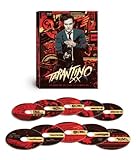
- Own four of Tarantino's greatest films in one convenient blu-ray bundle.
In 2013, the Guardian reported on Tarantino discussing another western. That is historical context, not evidence of a current plan.
5. Exploitation and grindhouse cinema
Death Proof, made as part of the Grindhouse project, is the natural example of Tarantino working with exploitation traditions. “Exploitation” covers a broad range of filmmaking rather than one narrow genre, so it is more precise to describe the film as drawing on that tradition than to assign it a single subgenre. The Guardian also places B-movies among the traditions in Tarantino’s range.
Rank #4
Five genres we’d love to see him tackle next
This is a wish list, not a forecast. Tarantino’s interviews document interests he expressed at particular times, but they do not establish what he intends to make next.
1. A 1930s gangster film
This is the most direct bridge between a past interest and the crime films he has already made. In a 2015 Time Out interview, Tarantino said a 1930s gangster film—“that kind of John Dillinger thing”—might be the one genre left that still appealed to him. A period setting could let him revisit criminal codes and outlaw mythology through a different era’s visual language.
Best Value
![Pulp Fiction – Limited Edition, Steelbook / 1994 (Special Features) [4K UHD + Blu-ray] [Region Free]](https://m.media-amazon.com/images/I/51AA-vLbrFL._SL160_.jpg)
- Limited Edition Steelbook — Collectible premium packaging featuring exclusive artwork and a durable metal case for a standout addition to your movie collection.
- Stunning 4K UHD & Blu-ray Combo — Experience Quentin Tarantino’s cult classic in breathtaking 4K Ultra HD resolution with HDR, plus the included Blu-ray for versatile viewing options.
- Region Free Playback — Compatible with any player worldwide, making it perfect for international fans and collectors.
- Classic 1994 Crime Masterpiece — Relive the iconic storytelling and unforgettable characters from one of cinema’s most influential films
- Packed with Special Features — Includes bonus content such as behind-the-scenes footage, interviews, and director commentary for an immersive fan experience.
2. A genuinely frightening horror film
Tarantino made the qualification himself: in the same 2015 interview, he said, “if I had all the time in the world,” he would love to make a “really, really scary horror film, like The Exorcist.” That is an expressed wish with a caveat, not confirmation of a project. His gift for suspenseful conversations could make a horror story compelling before the danger even appears.
3. Science fiction
A science-fiction film would be an unverified wish from us, not a genre Tarantino has said he plans to tackle. It would give him a new world in which to play with familiar obsessions—power, identity and competing versions of a story—while asking him to build rules and atmosphere beyond the historical settings that dominate much of his work.
4. A traditional mystery
We’d also like to see Tarantino make a mystery whose central pleasure is solving a case. His films often scatter clues and rearrange information, but a more traditional whodunit would put deduction, suspects and fair-play reveals at the center. This is our suggestion, not a reported interest of his.
5. A musical
A musical would be another genuinely new challenge: not simply a film with memorable needle drops, but one in which songs and performance carry the story. It could bring his affection for cinematic style into a form with its own demanding conventions. There is no claim here that Tarantino has expressed a current interest in making one.
What about comedy?
Comedy has more history in the conversation than the other speculative picks. In 1993, Tarantino named comedies among the genres he wanted to do in the Film Comment interview. That does not mean he has never made comedy: comic elements appear in his genre-bending films. A full-on comedy would be interesting as a distinct form, but it is not necessary to pretend the existing work is humorless.
Quick Recap
Product prices and availability are accurate as of the date/time indicated and are subject to change. Any price and availability information displayed on Amazon at the time of purchase will apply.




