Do these 3 things before closing this tab:
1Repair Windows errors before they cause bigger problems2Fix the driver behind crashes, sound loss and screen glitches3Clear out junk files and repair common Windows errorsAfrican drumming has shaped modern music through specific traditions, migrations and exchanges—not through one universal “African beat.” Its influence can be heard in the layered rhythms and grooves that developed in African diasporic music, including New Orleans jazz, and in distinct contemporary African genres such as Afrobeat, Afrobeats and amapiano. There is no reliable percentage for how much of North American music derives from West African music; the evidence supports tracing particular routes and practices, not assigning a single origin to whole genres.
1. Interlocking rhythms make a groove feel layered
In some musical traditions, several rhythmic parts sound at once: one part may establish a pulse while others add contrasting patterns. The result is not simply a succession of drumbeats but a texture in which the parts relate to one another. “Polyrhythm” is a useful term for this kind of layered rhythmic activity, but it does not describe every African tradition or every African recording.
Smithsonian Folkways’ account of Congo Square describes African and Afro-Caribbean exchanges among people arriving from places including Saint-Domingue (Haiti) and Cuba. It connects rhythmic practices at those gatherings with the music that later developed in New Orleans. The 1954 collection African and Afro-American Drums offers a listening route across examples from different African regions and the diaspora, making it possible to hear variety rather than assume one shared pattern.
2. Syncopation plays with the listener’s expectations
Syncopation places emphasis in a way that pulls against, or complicates, the beat a listener expects. A steady pulse can remain present even when accents fall elsewhere. In the New Orleans history described by Smithsonian Folkways, syncopation is one element associated with Congo Square’s musical exchanges and with later local forms.
Free tools Windows power users keep installed
One-click scans. No signup required.
#1 Best Overall
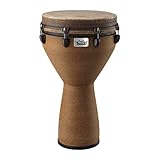
- Package Dimensions: 46.5 cms (L) x 47.0 cms (W) x 72.5 cms (H)
- Product Type: Instrument Parts And Accessories
- Package Quantity: 1
- Country Of Origin: United States
That connection is best understood as influence through exchange and transformation—not as proof that every syncopated passage in jazz, pop or rock descends directly from one African source. To listen for it, follow the underlying pulse and notice which accents seem to lean ahead of it, answer it or interrupt its regularity.
3. A shared pulse helps musicians move together
Rhythm can do more than supply accents: it can give an ensemble a shared sense of movement. Smithsonian Folkways describes pulse beats at Congo Square and links the gatherings’ rhythmic practices to New Orleans music. In a parade or dance setting, a clearly felt pulse can help musicians and dancers coordinate while leaving room for individual parts to vary.
This is one way to hear the relationship between percussion and groove: the pulse provides a point of reference, while the surrounding parts give the music its particular character. The connection is historical and musical, not a claim that every African or African-diaspora ensemble uses the same rhythmic arrangement.
Rank #2
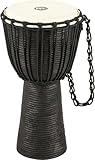
- LEARN TO PLAY IN MINUTES: deep bass in the center, bright slaps on the edge; easy to pick up—even if you’ve never played before
- WHY IT MATTERS: start making music now without time-consuming practice; join drum circles, jam with friends, play acoustic shows, or teach rhythm
- HAND-CARVED MAHOGANY SHELL: hand-carved from one solid piece of certified mahogany grown in managed forests (NOT glued-together pieces)—provides deep sound and looks great on display
- NATURAL GOAT SKIN HEAD: classic warm tone with clear attack; durable and responsive for multiple playing styles, with natural color and texture variations that make every drum unique
- COMES TUNED: ships pre-tuned with Mali Weave rope tuning; high-strength nylon ropes are pre-stretched so it sounds good out of the box and holds its pitch
4. New Orleans second-line playing shaped jazz drumming
New Orleans is a documented example of African and Afro-Caribbean musical practices meeting local traditions and developing into new forms. Smithsonian Folkways names ragtime, brass bands, jazz, Mardi Gras Indian chants, rhythm and blues, and funk among the music associated with Congo Square’s legacy. That history describes a crossroads, not a single-source explanation for each genre.
Quick wins for a faster PC:
Fix the driver behind crashes, sound loss and screen glitchesFind Drivers →Clear out junk files and repair common Windows errorsFree Scan →Scan for outdated or missing drivers - takes under a minuteDriver Scan →Drummer Baby Dodds makes the jazz connection more specific. Smithsonian Folkways calls him a master of the second-line groove and a foundational influence on jazz drums. His example shows how a local New Orleans practice could inform a developing instrument role; it does not mean African drumming alone invented the jazz drum set.
5. Brass-band and parade traditions adapted rhythmic heritage locally
In New Orleans, rhythmic traditions became part of a local musical world that included brass bands and second-line playing. These forms bring together percussion, melody and movement in public, communal settings. Congo Square is one important historical crossroads in that story, alongside the many exchanges that shaped the city’s music.
Rank #3
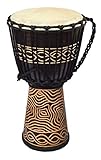
- Authentic Maori-Style Design – Beautifully handcrafted djembe featuring traditional-inspired carving and rich natural finish.
- Premium Mahogany Wood – Solid mahogany shell delivers deep bass tones and crisp high notes with excellent resonance.
- High-Quality Goat Skin Head – Durable natural goat skin provides warm, vibrant sound and responsive playability.
- Strong Alpine Cord Tuning System – Heavy-duty rope tuning ensures stable tension and long-lasting performance.
- Protective Rubber Base – 24 inches tall with a 12-inch head diameter (11 inch playing area), finished with a rubber bottom to protect floors and the drum base.
The wider lesson is that influence does not require a tradition to survive unchanged. Musicians can retain or adapt rhythmic ideas while working with different instruments, languages, dance practices and community settings. The result belongs to its own place and history as well as to the traditions that helped shape it.
6. Rhythm and blues and funk carry related, but varied, histories
Smithsonian Folkways includes rhythm and blues and funk among the New Orleans forms linked to Congo Square’s rhythmic legacy. That connection helps explain how rhythmic practices can travel through local styles and influence music beyond a single performance tradition.
The Tool Desk
Outbyte Driver Updater FREEFix the driver behind crashes, sound loss and screen glitchesFind Drivers →Outbyte PC Repair FREERepair Windows errors before they cause bigger problemsFix Now →It would overstate the evidence to say that every R&B or funk style has an identical ancestry, or that all of either genre can be traced to Congo Square. Both labels encompass many artists and histories. The useful point is narrower: New Orleans music provides a documented example of African and Afro-Caribbean exchange contributing to a local musical landscape that includes these genres.
Rank #4

- LEARN TO PLAY IN MINUTES: deep bass in the center, bright slaps on the edge; easy to pick up—even if you’ve never played before
- WHY IT MATTERS: start making music now without time-consuming practice; join drum circles, jam with friends, play acoustic shows, or teach rhythm
- HAND-CARVED MAHOGANY SHELL: hand-carved from one solid piece of certified mahogany grown in managed forests (NOT glued-together pieces)—provides deep sound and looks great on display
- NATURAL GOAT SKIN HEAD: classic warm tone with clear attack; durable and responsive for multiple playing styles, with natural color and texture variations that make every drum unique
- COMES TUNED: ships pre-tuned with Mali Weave rope tuning; high-strength nylon ropes are pre-stretched so it sounds good out of the box and holds its pitch
7. Contemporary African genres show influence as continuing exchange
Contemporary African popular music is not one genre, and it should not be treated as a preserved version of an ancient drumming tradition. The Associated Press distinguishes Fela Kuti’s Afrobeat from newer Afrobeats styles and describes amapiano as a separate South African blend. These examples show musicians combining influences in different periods and places.
| Genre | What it refers to | How the AP describes it |
|---|---|---|
| Afrobeat | A genre popularized by Nigerian musician and political activist Fela Kuti in the 1970s. | A blend of jazz, funk and traditional West African rhythms. |
| Afrobeats | A broad label for newer, varied styles; it is not another spelling for Afrobeat. | A blend of distinct West African music styles. |
| Amapiano | A contemporary South African genre, distinct from both Afrobeat and Afrobeats. | A blend of South African kwaito, African jazz, house music and soulful vocals. |
The AP reported in 2023 that Spotify attributed growth of more than 500% in Afrobeats streaming since 2017 to the platform. That is a dated streaming figure reported by AP, not a current growth rate or a measure of African music’s overall influence. The AP also quoted Empire president Tina Davis saying, “A lot of the music we love today that’s outside of Africa originated or had a root in African music.” It is a broad industry viewpoint, not a quantified historical finding.
Independent reader supportYour contribution helps us test, update, and keep practical guides available for everyone.How to listen for influence without flattening the history
Smithsonian Folkways’ African and Afro-American Drums (1954) juxtaposes recordings from African regions and the diaspora, including jazz drumming by Baby Dodds. As you listen, compare the recordings rather than treating them as examples of a single sound.
Best Value

- Seven eye-catching metallic colors, Freestyle Colorsound Djembes are just 12-1/2" high with a durable 7" synthetic head
- Each djembe is made from a lightweight, synthetic shell material, making them ideal for music educators and drum circle enthusiasts
- Includes Blue(TFCDJ-7MB), Green(TFCDJ-7MG), Red(TFCDJ-7MR), Orange(TFCDJ-7MO), Yellow(TFCDJ-7MY), Indigo(TFCDJ-7MI) and Violet(TFCDJ-7MV)
- Texture: Is one rhythmic pattern in the foreground, or do several interlocking parts share attention?
- Accent and pulse: What keeps the beat steady, and where do accents play against it?
- Ensemble role: Does percussion lead, answer another part, mark a transition or sustain the groove?
- Historical setting: Are you hearing an African tradition, a diaspora transformation, a New Orleans exchange or a contemporary African genre?
- Period and genre: Keep Afrobeat, Afrobeats and amapiano distinct rather than grouping them under one label.
What the historical record can—and cannot—establish
Historical accounts can identify particular exchanges and musical pathways, but they do not make every later resemblance proof of direct descent. Smithsonian Folkways reproduces architect Benjamin Henry Latrobe’s observation: “The allowed amusements of Sunday have, it seems, perpetuated here those of Africa among its former inhabitants.” This is a period observation quoted in the Smithsonian account; by itself, it does not establish the exact ancestry of a later genre.
The same care matters when discussing composer Louis Moreau Gottschalk. His compositions have often been attributed to visits to Congo Square, but Smithsonian Folkways says there is no documentation that he visited. The account considers it more likely that he learned Creole melodies and rhythms from Sally, his family’s enslaved nurse. The distinction between a documented route and a later attribution matters when making claims about musical influence.
Smithsonian Folkways also quotes Jelly Roll Morton: “Of course, you have to have these little tinges of Spanish in it in order to play real good jazz.” The account explains that Morton was referring to the habanera rhythm, connecting the “Spanish tinge” in New Orleans jazz with Afro-Caribbean rhythmic exchange. The example points to the layered cultural routes behind the music rather than a simple African-to-American line.
Quick Recap
Product prices and availability are accurate as of the date/time indicated and are subject to change. Any price and availability information displayed on Amazon at the time of purchase will apply.




