From biblical granaries to razor-sharpening powers, people have imagined many explanations for Egypt’s pyramids beyond the familiar alien story. These ten claims are not equally credible: some document how later generations interpreted the monuments, while others are unsupported speculation or political conspiracy theories. The archaeological baseline is much less mysterious: ancient Egyptians built the pyramids, although the exact construction sequence for Khufu’s Great Pyramid remains debated.
What archaeology establishes—and what remains uncertain
Archaeology Magazine identifies Khufu as the builder of the Great Pyramid at Giza. Its 2007 account estimates that the monument used about 2 million stone blocks averaging 2.5 tons each, stood 481 feet tall when completed, and remained the world’s tallest structure for more than 3,800 years. Those figures convey the scale of the work; they do not establish one definitive method for moving and raising every block.
Researchers have proposed straight or spiral external ramps, cranes, and an internal ramp. Architect Jean-Pierre Houdin’s internal-ramp proposal was summarized by the magazine with the phrase “the ramp still exists—inside the pyramid!” It remains a proposal, not a confirmed reconstruction. A straight ramp would require substantial length and material, helping explain why researchers have considered other routes, but engineering difficulty is not evidence for levitation, lost civilizations, or supernatural builders.
In 2017, the ScanPyramids team reported a void above the Grand Gallery measuring at least 30 metres, detected using three muon technologies and independent analyses. The authors cautioned: “While there is currently no information about the role of this void…” Its function was unknown; the finding does not establish that it is a chamber, a ramp, or evidence for any of the theories below.
Crashes, No Sound, or Screen Glitches?
Random freezes, missing sound and display glitches usually trace back to one bad driver. Find and replace yours safely.Free scan · under a minutePC Slower Than It Used to Be?
A free scan shows the junk files, broken settings and background clutter dragging Windows down - then fixes them in one click.Free scan · Windows 10 & 11#1 Best Overall

- EXCAVATE 3 UNIQUE DIG BRICKS – Explore ancient Egypt with pyramid, Sphinx, and pharaoh-shaped dig bricks—each hiding its own treasures!
- GEMSTONES & REPLICA ARTIFACTS – Discover 3 genuine gemstones and 3 detailed artifacts inspired by Egyptian history and mythology.
- LEARN HIEROGLYPHICS – Includes a fun activity booklet that teaches kids how to write using authentic Egyptian hieroglyphs.
- COMPLETE ARCHAEOLOGY KIT – Comes with high-quality digging tools, a full-color Learning Guide, and everything needed for excavation.
- HANDS-ON STEM EXPERIENCE – This kit encourages curiosity and discovery through hands-on science activities and learning about ancient Egyptian history!
Ten theories and stories that don’t involve aliens
1. The pyramids were Joseph’s granaries
Some medieval European accounts treated the Egyptian pyramids as grain stores linked to the biblical story of Joseph. The 14th-century Book of John Mandeville called them “Joseph’s Granaries.” This is best understood as reception history: visitors explained unfamiliar monuments through stories they already knew, not as an account supported by archaeological evidence about the pyramids’ construction or purpose.
2. Noah built the Great Pyramid
In 1859, John Taylor argued that the Great Pyramid encoded divinely inspired mathematical truths and attributed its construction to Noah. The claim belongs to nineteenth-century pyramidology. It is a historical example of religious and mathematical speculation, not an alternative supported by archaeological evidence for the monument’s builders.
Rank #2
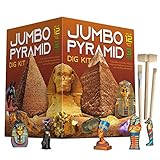
- 💡Explore The History Of Ancient Egypytian Civilization: Travel to ancient the Egypt to learn everything about its amazing pyramids. It provides young geologists with information about these wonderful wonders of the world and many aspects of development, enhances kid's active learning awareness in play, and enjoys happy time with family and friends.
- 📖Fun And Learning: Satisfy children's curiosity, enhances their cognitive domain, and unlock more unknow puzzles about the ancient civilization.It's conducive to the child's early cognitive development.
- 💎 Mummy Dig Kit Includes: This Giant Pyramid contains 12 Egyptian toys, chisel, hammer, brushe, Includes adventure guide give the young geologists to gain a deeper understanding of ancient Egyptian civilization.
- 🎁 An Educational Gift For All Ages: It is the perfect holiday,birthday, children’s day gift idea. This classic puzzle game will never go out of style. Now add to cart now and give your kids a surprise.
- 🏆Satisfaction Guaranteed: All of our products come with a 100% satisfaction guarantee. If there is any question with the JUMBO PYRAMID DIG KIT for kids, please feel free to contact us. We will be sure to help you with our best service.
3. The pyramid predicted the apocalypse
Astronomer Charles Piazzi Smyth extended pyramidology by reading biblical chronology into measurements of the Great Pyramid’s Grand Gallery. His interpretation helped popularize an 1881 apocalypse prediction. The predicted event did not happen; the episode illustrates how measurements can be made to serve a prior belief rather than independently verify it.
4. Satan directed the pyramid’s construction
In 1928, Jehovah’s Witness leader Joseph T. Rutherford argued that Satan directed the pyramid’s construction and encoded knowledge in its stone. This was a religious polemic against Christian pyramidology, not an archaeological construction theory. It tells us about a dispute over religious interpretation, not who built the monument.
Do these 3 things before closing this tab:
1Scan for outdated or missing drivers - takes under a minute2Clear out junk files and repair common Windows errors3Fix the driver behind crashes, sound loss and screen glitchesRank #3

- Inspires Creativity: This detailed building set encourages children to think creatively, allowing them to design and construct an iconic masterpiece. It’s an engaging way to bring their imagination to life through hands-on building.
- Develops Fine Motor Skills: The precise assembly required in this set helps children improve their fine motor skills, honing hand-eye coordination and attention to detail with every small piece they fit together.
- Builds Problem-Solving Skills: By following complex instructions and understanding patterns, symmetry, and quantity, kids will develop their spatial awareness and mathematical skills while also fostering their problem-solving abilities.
- Promotes Communication and Teamwork: Working on this set with others encourages teamwork and collaboration. Children and adults alike can share ideas, delegate tasks, and work together to build a stunning structure, improving communication and cooperative skills.
- Encourages Focus and Relaxation: For adults, building this set can provide a relaxing and immersive experience. The intricate puzzle-like process promotes focus, mindfulness, and stress relief, making it a great way to unwind.
5. The pyramids were hills cut down from the top
An 1884 newspaper account described a proposal that builders shaped isolated hills into pyramids by progressively cutting them down from above. The account records the speculation but supplies no archaeological evidence to support it. It should be treated as a historical conjecture, not a competing explanation established by excavation or geological study.
6. Atlantis spread pyramid-building around the world
In 1882, Ignatius Donnelly proposed that a lost civilization called Atlantis spread culture and pyramid-building traditions around the world. That sweeping story collapses distinct monuments into one origin narrative. Archaeologist Kenneth Feder, quoted in the 2014 Gizmodo account, pointed to differences in the forms, uses, building episodes, and dates of Egyptian and Mesoamerican pyramids. Similar broad shapes do not, by themselves, demonstrate a shared builder or source.
Rank #4
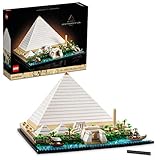
- Travel back in time to the 26th century BC. and discover the Great Pyramid of Giza and its surroundings with this LEGO set for adults
- Includes 2 smaller pyramids, 2 mortuary temples, Sphinx statue, workers' village, an obelisk and a section of the Nile River with a barge
- Lift the outer structure to reveal the Royal chambers, main tunnels & a system that may have been used to move the stone blocks during construction
- Includes a booklet with illustrated instructions, plus details about the Great Pyramid of Giza's history & how LEGO designers created this model
- A challenging and immersive creative activity for adults leaves you feeling refreshed and with a rewarding sense of accomplishment
7. Israel or Jewish people secretly built the pyramids
The Gizmodo account reports accusations by Egyptian researcher Amir Gamal alleging Israeli involvement in misrepresenting archaeological history. This is a political conspiracy allegation, not an evidence-based account of pyramid construction. It should be attributed to the claimant rather than repeated as fact, and it is distinct from archaeological debate about building methods.
8. Workers levitated the blocks
Edgar Cayce and later writers proposed that mental powers, magic, or sound could levitate pyramid stones. Such claims draw on folk stories and speculative reinterpretations of acoustics; the account provides no archaeological evidence that levitation was used to move blocks. Laboratory demonstrations of acoustic levitation do not establish that ancient builders used it on pyramid-scale stones.
Free tools Windows power users keep installed
One-click scans. No signup required.
Best Value

- Accurate representation of the Pyramid of Giza for educational or decorative use
- 3D printed with durable PLA plastic for long-lasting use
- Includes a comprehensive lesson plan for teaching about ancient Egypt
- Ideal for classrooms, homeschooling, or history projects
- Made in Beaverton, Oregon with precision and care.
9. Giza’s pyramids map Orion’s Belt
Robert Bauval argued that the layout of the Giza pyramids corresponds to the three stars of Orion’s Belt and supports a much earlier construction date. The 2014 Gizmodo account relays criticisms involving map orientation and angular mismatch. The geometry should therefore be presented as a disputed interpretation, not a settled astronomical demonstration; the available material here does not independently resolve the measurements.
10. Pyramid shapes have special powers
Twentieth-century proponents claimed pyramid-shaped objects could preserve food, sharpen blades, improve health, or affect other substances. The Gizmodo account recounts the claims and notes a 1959 patent for Karl Drbal’s razor-blade sharpener. A patent and reports of proponents’ claims do not establish that the effects are real. No controlled test establishing these benefits is identified here, so pyramid power is a cultural belief, not a verified property or a basis for product recommendations.
Independent reader supportYour contribution helps us test, update, and keep practical guides available for everyone.New hypotheses are not proof of old theories
Not every unconventional proposal belongs in the same category as pyramidology or conspiracy claims. A 1991 paper summarized in the American Concrete Institute’s record examined stones and reported natural geological features, nearby quarry rock matching much of the pyramid stone, and no detected geopolymeric cementitious material in the sample studied. Those findings apply to the examined material; they should not be inflated into a claim about every stone ever used.
A separate, newer proposal concerns Djoser’s Step Pyramid at Saqqara—not Khufu’s Great Pyramid at Giza. INRAE describes research proposing a hydraulic system involving a shaft mechanism and water supply. The authors characterize it as a new research direction. Lead author Xavier Landreau, president of Paleotechnic, said: “This work opens up a new line of research for the scientific community: the use of hydraulic power to build the pyramids of Egypt.” That is a research avenue concerning a different monument, not proof that water elevators built the Great Pyramid.
Quick Recap
How to tell a real construction question from a bizarre theory
- Identify the claim. Is it about who built a monument, how blocks were moved, what a structure was for, or how later visitors interpreted it?
- Check the site and date. A proposal about Djoser’s Step Pyramid at Saqqara does not automatically explain Khufu’s Great Pyramid at Giza; Egyptian and Mesoamerican monuments also belong to different traditions and periods.
- Ask what evidence the claim predicts. A construction hypothesis should be assessed against physical evidence and the monument itself, not only resemblance, religious symbolism, or a striking story.
- Keep uncertainty in proportion. The exact final assembly sequence is not known, but uncertainty about a method does not erase strong evidence for ancient Egyptian organization and engineering. National Geographic’s account of pyramid conspiracies makes the same distinction between open questions and evidence-based archaeological work.
- Distinguish a proposal from a finding. A reported void, a patent, or an author’s new hypothesis is not confirmation of the role or effect someone assigns to it.
Product prices and availability are accurate as of the date/time indicated and are subject to change. Any price and availability information displayed on Amazon at the time of purchase will apply.