You can rotate a prerecorded video before sending it to YouTube Live by applying an FFmpeg video filter on the Raspberry Pi, then encoding the result and sending it to the current YouTube server URL and stream key. Rotation usually requires video processing and re-encoding; it is not something to assume will work with stream copy. The exact command and achievable quality depend on your Pi model, operating system, FFmpeg build, source file, and upload connection, so test the complete workflow before relying on it for a broadcast.
What you need to decide first
Before setting up the broadcast, check what the source file contains and what you want viewers to see. A video may already be sideways in its pixels, or its display-orientation metadata may instruct a player to rotate it. The desired result may be portrait, landscape, or a particular crop within a fixed frame.

- Inspect orientation: Play the file on a device that respects display metadata and confirm whether it already appears correctly oriented.
- Choose the output frame: Decide whether to rotate the entire picture, fit it inside a landscape or portrait canvas with empty space, or crop part of the image to fill the frame. Cropping can remove content near the edges.
- Check audio and duration: Confirm the soundtrack is present and note the file’s duration. Looping and orientation are separate parts of the workflow.
- Check the Pi and network: Identify the exact board, OS, FFmpeg build, storage location, and wired or wireless connection you plan to use. Do not infer encoding performance from the board model alone.
FFmpeg documents video filters, including transpose-related filters, in its filter reference. The filter you choose and its order in the chain depend on the intended orientation and any scaling, fitting, or cropping you need. Inspect the output on a local player before streaming; metadata-aware playback can otherwise make a wrong rotation appear correct.
Set up the Raspberry Pi
The Pi needs a boot medium with an operating system, an appropriate power supply for the specific model, and a stable network connection. Raspberry Pi’s getting-started documentation recommends at least 8 GB of boot media for Raspberry Pi OS Lite and at least 32 GB for the Desktop and Full images. Those figures cover the OS boot medium, not a video archive; size storage separately if your recordings will live on the Pi.
Recommended Free Tools
#1 Best Overall

- Includes Raspberry Pi 5 with 2.4Ghz 64-bit quad-core CPU (8GB RAM)
- Includes 128GB Micro SD Card pre-loaded with 64-bit Raspberry Pi OS, USB MicroSD Card Reader
- CanaKit Turbine Black Case for the Raspberry Pi 5
- CanaKit Low Noise Bearing System Fan
- Mega Heat Sink - Black Anodized
- Install Raspberry Pi OS: Choose an image appropriate to how you will operate the board. Raspberry Pi OS Lite is a suitable option to consider for a headless setup.
- Enable remote access if needed: Configure SSH or Raspberry Pi Connect if you will manage a headless Pi remotely, following Raspberry Pi’s current setup instructions.
- Install or verify FFmpeg: Check that the installed build includes the filters and encoder you intend to use. Builds can differ; the presence of FFmpeg alone does not establish that a particular filter or hardware encoder is available.
- Place and inspect the source video: Keep the file accessible for the whole broadcast, and verify its orientation, image dimensions, frame rate, video and audio codecs, and sound before building the streaming command.
- Connect the network: Use Ethernet or Wi-Fi, but judge the connection by stable upload performance under the actual streaming conditions rather than a brief peak result.
Rotate and prepare the video
Apply the rotation as part of the video-processing path before the outgoing stream reaches YouTube. A transpose filter is one way to rotate decoded frames. If the video must be rotated, resized, or cropped, FFmpeg generally has to process the video frames; do not assume that copying the original video stream unchanged will preserve an arbitrary rotation operation.
There is no verified, hardware-tested command for every Pi, OS, FFmpeg build, input file, and target format. Treat filter syntax and encoder availability as setup-specific. First make a short local test output using your installed FFmpeg build, then play it back and check orientation, framing, motion, and audio. Confirm that any display-orientation metadata has not caused a second rotation.
Rank #2

- Includes Raspberry Pi 4 4GB Model B with 1.5GHz 64-bit quad-core CPU (4GB RAM)
- Includes Pre-Loaded 32GB EVO+ Micro SD Card (Class 10), USB MicroSD Card Reader
- CanaKit Premium High-Gloss Raspberry Pi 4 Case with Integrated Fan Mount, CanaKit Low Noise Bearing System Fan
- CanaKit 3.5A USB-C Raspberry Pi 4 Power Supply (US Plug) with Noise Filter, Set of Heat Sinks, Display Cable - 6 foot (Supports up to 4K60p)
- CanaKit USB-C PiSwitch (On/Off Power Switch for Raspberry Pi 4)
Choose the final frame deliberately
- Rotate: Use a rotation or transpose filter appropriate to the direction required by the source and intended output.
- Fit: Preserve the whole image within the selected canvas if cutting off content is unacceptable; this can leave unused space around the picture.
- Crop: Fill the canvas by discarding parts of the image only if the resulting composition keeps important material in frame.
- Check captions and overlays: If any are part of the recording, make sure they remain legible and are not clipped after rotation or cropping.
Configure YouTube Live and encoder settings
Create or schedule the live stream in YouTube Live Control Room and copy the current server URL and stream key into the encoder. YouTube’s instructions say: “To start streaming, enter your YouTube Live server URL and stream key into your encoder.” Use the current values shown for your stream rather than an endpoint copied from an old tutorial. Keep the stream key private: anyone who obtains it may be able to send video to your channel.
YouTube recommends RTMPS, a secure extension of RTMP. Google’s developer guide describes RTMPS ingestion using a valid YouTube endpoint and application path on port 443. For a normal creator workflow, copy the current RTMPS server URL shown in Live Control Room instead of hard-coding an address from another setup. See Google’s RTMPS ingestion guide and YouTube’s encoder setup instructions.
YouTube’s encoder settings guide supports H.264, H.265/HEVC, and AV1 ingestion, up to 60 fps, CBR, and AAC or MP3 audio. It recommends a two-second keyframe interval and says not to exceed four seconds. Its H.264 bitrate guidance includes the following targets:
| H.264 output | YouTube recommended bitrate |
|---|---|
| 720p at 30 fps | 5 Mbps |
| 720p at 60 fps | 8 Mbps |
| 1080p at 30 fps | 10 Mbps |
| 1080p at 60 fps | 17 Mbps |
These are YouTube ingest recommendations, not evidence that a particular Raspberry Pi can encode the selected resolution and frame rate. Compare the target bitrate with stable available upload capacity, leaving room for network variation. If the Pi cannot process the rotated video at the desired settings, reduce the target or prepare a suitable file in advance using another system. YouTube transcodes incoming live video into versions for viewers, so your encoder sends one selected output rather than a separate rendition for every viewer.
Rank #4
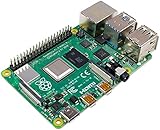
- Broadcom BCM2711, quad-core Cortex-A72 (ARM v8) 64-bit SoC @ 1. 5GHz
- 2. 4 GHz and 5. 0 GHz IEEE 802. 11b/g/n/ac wireless LAN, Bluetooth 5. 0, BLE
- 2 × USB 3. 0 ports, 2 x USB 2. 0 Ports
- 2 × micro HDMI ports supproting up to 4Kp60 video resolution
- Micro SD card slot for loading operating system and data storage
Loop the recording and start the broadcast
Rotation, file looping, and connecting to YouTube are distinct tasks. Configure the file input to repeat only if you want the recording to continue after it reaches the end. Verify how your FFmpeg setup handles looping, timestamps, and audio at the file boundary: a repeated file can introduce a pause, timestamp discontinuity, or audible jump if the chosen method and source do not join cleanly.
- Make a short local test: Process representative footage with the chosen rotation, frame, video encoder, and audio settings. Confirm the result’s orientation and sound.
- Test looping separately: Let the recording reach its end and check whether the next pass begins without an unwanted gap or audio discontinuity.
- Open the YouTube stream: In Live Control Room, select or create the intended stream and copy its current server URL and key into your encoder.
- Start the encoder: Confirm it connects and that YouTube receives the intended image and audio. Monitor stream health and any messages in Live Control Room.
- End it deliberately: Stopping the encoder ends the outgoing stream. YouTube says streams under 12 hours are automatically archived; check the current Live Control Room status and archive after the broadcast.
For the test, use movement and audio similar to the material planned for the actual broadcast, as YouTube recommends. A still image and silence are not a meaningful test of how your real recording will behave.
Best Value
- Includes Raspberry Pi 5 16GB with 2.4Ghz 64-bit quad-core CPU (16GB RAM)
- Includes 128GB Micro SD Card pre-loaded with 64-bit Raspberry Pi OS, USB MicroSD Card Reader
- CanaKit Turbine Black Case for the Raspberry Pi 5
- CanaKit Low Noise Bearing System Fan
- Mega Heat Sink - Black Anodized
Copyright and YouTube channel considerations
Having a recording file does not by itself establish that you have permission to broadcast its video, music, narration, or other included material. Confirm that you own or have the necessary rights for every part of the recording, and review YouTube’s current live-stream and copyright requirements before scheduling a stream. Also consider whether repeatedly broadcasting the same recording fits your channel’s intended format and applicable YouTube monetization policies; a technically successful loop does not guarantee monetization or policy approval.
Local Raspberry Pi or cloud streaming?
Running FFmpeg on a Pi keeps the workflow under your control, but the board, power, storage, network, and encoder process must all remain available. If your priority is to keep prerecorded content running without leaving a computer at home, StreamNeo is a cloud alternative for YouTube: upload a video or build a playlist, add your YouTube stream key once, and go live. It loops uploaded video from the cloud; it does not broadcast from a camera.
Or let it run in the cloud
With StreamNeo, nothing has to stay on at home. Each slot streams the uploaded video as supplied, up to 4K 60fps, at one flat price per slot, with no re-encode or quality tiers; it can recover automatically if YouTube drops the stream. The first day is free with no card, one free day per account. Monthly billing is $9.99 per month. StreamNeo is a YouTube-only service for prerecorded uploads, with 24/7 looping and playlists and 10 GB storage per slot, pooled across active slots. See StreamNeo for details. Start the free day with StreamNeo.
Troubleshooting
| Symptom | Likely cause | What to check |
|---|---|---|
| The picture is still sideways or rotates twice | The source’s pixels and display-orientation metadata may not agree, or both the player and filter may be rotating it. | Inspect the original and processed file in a metadata-aware player. Confirm the filter direction and verify the actual output frame before connecting to YouTube. |
| The stream connects but the image is stretched or cropped badly | The rotation, scaling, fit, or crop choices do not match the target canvas. | Check the processed output locally at the intended dimensions. Choose whether to preserve the whole image with space around it or crop deliberately to fill the frame. |
| YouTube does not receive the stream | The URL or stream key may be wrong, stale, or entered in the wrong field; the endpoint or connection may also be unavailable. | Copy the current server URL and key from Live Control Room, check the encoder’s connection messages, and use RTMPS where available. Do not share the key while troubleshooting. |
| YouTube reports poor stream health or viewers see interruptions | The upload may be unstable or unable to sustain the selected bitrate; the Pi may also be unable to process the chosen output continuously. | Compare stream health with the selected settings, measure stable upload capacity, and test a lower resolution, frame rate, or bitrate. YouTube’s table is guidance for ingestion, not a Pi performance guarantee. |
| The broadcast freezes or stutters after a while | Encoding load, thermal conditions, network variation, or a failure in the looping workflow may be involved. | Test the entire run on the same board and build, check system load and temperature, and observe whether the problem occurs at the file boundary or independently of it. |
| There is a pause or audio jump at the loop point | The selected file-loop behavior may not provide continuous timestamps or seamless audio between repetitions. | Test several loop boundaries with the actual recording. Adjust the looping approach or prepare a version whose end and beginning join more cleanly. |
What to record when validating a Pi setup
Because available hardware encoding, FFmpeg filters, and sustained performance vary by setup, document the exact configuration that passes your own test: Pi model, operating system, FFmpeg version and build, source codec and dimensions, chosen rotation and output settings, and how long the stream ran without interruption. This makes it possible to reproduce a working setup and avoids treating one configuration’s result as a guarantee for another board.
Quick Recap
Product prices and availability are accurate as of the date/time indicated and are subject to change. Any price and availability information displayed on Amazon at the time of purchase will apply.



