FieldStation42 is not an over-the-air receiver or a downloadable television simulator. It is a standalone Raspberry Pi/Linux “nostalgia machine” that turns locally stored television programs into scheduled, simulated broadcast channels—then uses a physical control box and deliberately added noise to make changing stations feel like it did decades ago.
Television before infinite choice
Before streaming menus, viewers generally turned on the set and joined whatever a station was broadcasting at that moment. The appeal was partly the programming, but also the ritual: waiting through a channel change, discovering an unfamiliar show, seeing commercials and station announcements, and knowing that every channel had continued running even while the viewer watched another one.
FieldStation42, created by Shane C. Mason, is designed to restore that experience. The project’s primary reference point is late-1970s and early-1980s U.S. television, with simulated network and local channels presented on a period-appropriate color CRT. The project was featured by Hackaday on September 26, 2024, while its Hackaday.io project page documents the implementation.
The important distinction is architectural: FieldStation42 plays digitized or locally stored media. It does not use an antenna to receive live broadcasts. Its software makes an archive behave like a group of television stations.
#1 Best Overall

- Large Portable Screen You Can Carry -- Enjoy your favorite TV shows and DVDs on the go with this portable TV with DVD player, featuring a crisp 15.6-inch HD screen. Great for travel, outdoor adventures, or home entertainment. 180° adjustable rubber-armored stand protect – locks securely on any surface at any angle or hung on a hook.
- Access Over-the-Air TV & FM Channels — The built-in antenna lets you enjoy local channels where signals are available. Simply plug in the included antenna and scan for channels. reception quality depends on your location and surroundings, please place it near a window or outdoors, away from home electronics. Channel availability varies by location.
- Built-in DVD Player -- Why carry a separate DVD player? Enjoy both your DVD library and over-the-air TV on this portable DVD player – the ultimate space-saver for travel and home. Play DVD, DVD ±R(RW), CD, CD ±R(RW), SVCD ±R(RW), VCD, (Not Blu-ray or Dolby discs).
- 5000mAh Long-Lasting Battery -- Enjoy up to two full movies on a single charge. The built-in non-removable 5000mAh battery features integrated protection circuitry for safer, more reliable use at home, on road trips, during beach outings, or in unexpected power outages.
- HDMI & USB & SD Card & AV Ports -- Easily connect streaming devices via the HDMI input. The USB and micro SD card ports allow you enjoy music, videos, photos and texts from your media files. With the AV out function, you can transfer both video and audio to your TV for a larger screen experience.
What FieldStation42 actually does
A normal media player waits for the viewer to choose a file. FieldStation42 instead maintains programming schedules for simulated stations. Each station can have its own clock, content library, daypart rules, commercials, bumpers and overnight behavior.
The stated goal is for a believable program to be playing when the television is switched on. Changing channels should reveal another station already in progress, rather than restarting a show from its opening frame. That continuity is the project’s central technical challenge and its most important difference from a playlist.
The documented design includes:
- Multiple simulated channels.
- Locally stored video organized by station and schedule.
- Weekly rotating programming.
- Programming arranged around hour and half-hour boundaries.
- Commercial and station-bumper insertion.
- True-to-time replay, so a viewer joins a program partway through.
- User-controlled channel changes.
- Optional sign-off and off-air video.
The project’s example television universe includes three major networks, PBS and local channels. Its programming is arranged around familiar dayparts: morning news and talk shows, afternoon soaps, family-hour programs, prime time and late-night television with Carson-style scheduling. That structure matters because a convincing broadcast day needs more than a collection of popular shows; it needs the habits and constraints that surrounded them.
The Raspberry Pi is the station master
The main Raspberry Pi performs the higher-level work. Python-based software manages the media files, builds or reads station catalogs, calculates what should be playing, and controls the displayed channel. The project documentation says the software can run on any Linux system with video acceleration, so a Raspberry Pi is the creator’s chosen compact platform rather than an absolute hardware requirement.
Outdated Drivers Are Slowing You Down
One free scan finds every outdated or missing driver and matches the right update for your exact hardware.Free scan · exact hardware matchPC Slower Than It Used to Be?
A free scan shows the junk files, broken settings and background clutter dragging Windows down - then fixes them in one click.Free scan · Windows 10 & 11A second device, the Raspberry Pi Pico, handles the physical controls. It communicates with the main computer over UART serial lines and can read switches or contacts attached to a channel selector. The documented control box includes a Neopixel strip and momentary switches. One switch signals the display software to shut down, while another signals a complete system shutdown.
This separation is sensible. The Linux computer handles scheduling and video playback; the small microcontroller handles immediate physical input. It also makes the project feel like an appliance rather than a desktop computer running a script.
An antenna rotator becomes a channel selector
The most memorable piece of hardware is a repurposed antenna-rotator control box. Traditional rotators turned a rooftop directional antenna toward different transmitters. In FieldStation42, the box no longer participates in reception. It becomes a tactile metaphor for tuning between stations.
Rank #2
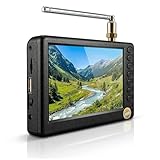
- PORTABLE TV : This product is a portable TV that complies with the standard. What's more, it can be used not only to watch analog TV, but also to watch digital TV and ATV.the product is equipped with a TV stand on the basis of the small screen, which is convenient for users to use.
- SUPPORT FOR :The product has a USB port, Memory Card slot, can play U disk content, supports 1080p video, MKV, MOV, WMV, MP4, FLV, MPEG1‑4, MP3 and other functions.
- 1500MAH RECHARGEABLE BATTERY :The product is equipped with a 1500mAh rechargeable lithium battery, which has a long service life per and can be used outdoors, such as travel, camping, etc.RECEIVING CHANNEL: ATV 48.25Mhz ~ 863.25Mhz;Digital TV VHF (50MHz ~ 230Mhz);UHF of Digital TV (474Mhz ~ 862Mhz)
- HIGH SENSITIVITY ADJUSTER :The of a TV is of prior importance, so this product is equipped with high sensitivity adjuster, which makes the receiving ability much .
- QUALITY ASSURANCE :100% brand new and the quality of our products is guaranteed and can be used without hesitation.We supply fast and convenient return or replace service to insure purchasing without worries.If you have any questions, please feel to us.
Mason added electrical contacts to the knob and connected them to the Pico. Turning the control tells the main Raspberry Pi which simulated station to display. The physical action preserves something that a keyboard shortcut or touchscreen cannot: the resistance, movement and deliberate uncertainty of old television hardware.
What’s actually slowing this PC down?
Pick the symptom - the matching free tool is one click away.
A more practical recreation could use a rotary encoder, ordinary knob or push buttons. Those options are easier to source and may be more reliable, but they sacrifice some of the historical character. The rotator is valuable not because it improves video playback, but because it gives the software a convincing physical interface.
Why the picture fades when you change channels
FieldStation42 adds fading and noise during channel changes to imitate an antenna moving between transmitters. The effect helps bridge the gap between a clean digital file and the messy experience of analog television.
It is still an emulation. The software-generated effect is controllable and repeatable, unlike real reception problems such as multipath interference, weak signals, sync instability or unpredictable snow. It should also not be confused with modern digital television, which often fails abruptly rather than gradually degrading into analog-style noise.
The best result is not necessarily the most severe effect. A short transition can suggest tuning; an extended one may feel like a playback error. The project’s broader idea is that imperfections are part of the interface, not defects to be eliminated.
Building something similar
1. Choose the display
A vintage CRT provides the strongest period feel: scanlines, phosphor glow, physical styling and a more convincing presentation of simulated noise. It is also heavy, fragile, power-hungry and difficult to source. Older sets may have failing components, limited inputs or expensive repair needs.
A modern LCD or OLED is safer and easier to maintain. It can make the software more reliable, especially if the display accepts a computer’s output directly, but its sharp image and flat-panel styling weaken the illusion. A practical compromise is a CRT used only as an external display, or a modern screen concealed inside a vintage cabinet.
Rank #3

- LOADED FEATURES: Don't settle for less! USB & HDMI inputs for external audio/video playback, Dual AV inputs for use with DVD players or Game Systems, Headphone Jack, Built in Speaker, Full Band Digital TV Tuner, Remote Control, Built in Stand, even comes with a car charger!
- BUILT IN BATTERY: We had power outages and deserted camping in mind! Our TV has a built in rechargeable battery that can last 4 Hours + of play time so you don't miss any important news or your favorite game when your on the go! Included is a 12 volt AV power charging cord so you can recharge your TV.
- MAJOR COMPATIBILITLY : HDMI, AVI, MOV, MPEG 1, MPEG 2, MPEG 3, MPEG4, XVID, AVC, MP4, H.264, HEVC(H.265), FLV, MKV, MP3, JPEG, WMV, RMVB, AVI, MKY, 3GP, Audio interface, Video In, Audio-R, Audio-L interface, USB, ATSC, NTSC, AC/DC.
- ENDLESS CONNECTIVITY: Computer monitors, security cameras, Apple TV, Amazon Firestick, Roku, Slingbox, Chromecast, DVD players and of course gaming consoles! You can even connect to the computer host as the display that can allow you to use your TV as a computer monitor!
Safety warning: do not open a CRT television unless you are qualified to work around its high-voltage circuitry and understand safe discharge and servicing procedures. FieldStation42 does not require reproducing the CRT’s internal electronics.
2. Prepare the playback computer and storage
Use a Raspberry Pi or another Linux computer with adequate hardware video acceleration. Store the media locally so the system can operate without an internet connection. Storage requirements depend entirely on the size and encoding of the archive; smooth playback depends on the hardware, codec, resolution, bitrate and storage device, not merely on whether a file has a supported extension.
Do these 3 things before closing this tab:
1Repair Windows errors before they cause bigger problems2Scan for outdated or missing drivers - takes under a minute3Clear out junk files and repair common Windows errorsThe project page documents support for MP4, MPG, MPEG, AVI, MOV and MKV files. That is format support, not a guarantee that every file using those containers will play smoothly on every Pi.
3. Organize the media as stations
Separate programming by simulated station and maintain distinct collections for shows, commercials, bumpers, station identifiers, sign-offs and off-air material. The scheduler needs fallback behavior for missing or insufficient content. Without it, a station can reach an empty time slot and expose the limits of the archive.
The project also documents temporal folder hints, including month, quarter and date-range naming. These can help select programming that fits a particular period or season rather than presenting an entirely random archive.
4. Configure the broadcast clock
Define the station’s dayparts and schedule, then decide how the station behaves overnight. A station can continue programming, go off the air, or play a sign-off sequence. The project documentation gives this example for configured sign-off and off-air media:
Free tools Windows power users keep installed
One-click scans. No signup required.
'sign_off_video': "catalog/anthem_signoff.mp4",
'off_air_video': "catalog/off_air_pattern.mp4",
A schedule can specify a 3 a.m. sign-off with:
3: {'event' : 'signoff'}According to the project documentation, the sign-off video plays once at the top of the hour, after which the off-air video loops for the remainder of the hour if configured. Unspecified time slots are treated as off-air.
Rank #4

- PORTABLE ATSC DIGITAL TV + FM RADIO - Watch your favorite shows anywhere with this 5" portable TV. Compatible with ATSC digital TV, analog TV, and ATV — plus built-in FM radio for music and news. Perfect for areas with limited smartphone reception.
- USB & TF CARD PLAYBACK — SUPPORTS 1080P - Play videos, music, and photos directly from USB drive or TF card. Supports 1080P video formats including MKV, MOV, AVI, WMV, MP4, FLV, MPEG1-4, and MP3 audio. Entertainment without internet or TV signal.
- 1500mAh RECHARGEABLE BATTERY - Built-in rechargeable lithium battery provides long-lasting power for outdoor use. Perfect for camping, road trips, RV travel, and backyard gatherings. No need to search for an outlet.
- 5" HD SCREEN WITH HIGH-SENSITIVITY TUNER - Crystal-clear 5" TFT-LED display with 1920×1280 resolution for vibrant, images. High-sensitivity tuner ensures strong signal reception — even in remote camping sites or moving vehicles.
- VERSATILE USE WITH REMOTE & STAND - Ideal for kitchen cooking, bedroom, office desk, RV travel, camping, and outdoor activities. Comes with remote control and TV stand for hands-free viewing. Compact size fits anywhere — take it wherever you go.
5. Add the controls
A Pico can read switches, contacts or a custom selector and send channel-change commands over UART. Build in software shutdown behavior rather than simply cutting power. Vintage control hardware may require debouncing, and oxidized contacts can produce multiple false inputs.
6. Test continuity and failure behavior
Start the system at different times of day, change channels repeatedly and verify that every station appears to have been running independently. Test overnight transitions, missing files, empty schedules, corrupt media and sudden power loss. Also check that the computer’s video output matches the CRT or modern display’s available input and that audio is routed correctly.
The hardest part is not the Raspberry Pi
The computer and microcontroller are comparatively straightforward. The difficult work is editorial and archival: assembling enough material to make each station coherent, choosing programs for particular dayparts, filling commercial breaks, and keeping the schedule aligned to the clock.
Recommended Free Tools
A library can contain sitcoms, dramas, news broadcasts, specials, commercials and station material, but quantity alone will not create a convincing station. Commercial slots may be too short or too long. A missing bumper may disrupt a half-hour boundary. A show may be unavailable for the period a schedule expects. The system therefore needs fallback rules, catalog management and deliberate programming choices.
There is also a legal boundary. Digitizing or downloading copyrighted programs does not automatically grant redistribution rights. Private archival playback is different from publishing a simulated channel, streaming an archive or showing it publicly. Commercials, station IDs, network logos, news footage and music can each involve separate rights. The available project sources do not establish that its entire media library is cleared for public distribution.
Independent reader supportYour contribution helps us test, update, and keep practical guides available for everyone.How the project has evolved
The project remains an ongoing maker project rather than a consumer product. Its documented updates show the software becoming more flexible:
- September 30, 2024: JSON station configuration was added, while Python-module configurations remained usable.
- October 20, 2024: Subfolder support, code reorganization, an installation script, expanded setup documentation and automatic creation of missing station runtime directories were added.
- November 2, 2024: Support expanded for MP4, MPG, MPEG, AVI, MOV and MKV files; commercial and bumper filling was improved; and a subdirectory-reading issue was fixed.
- November 6, 2024: Temporal scheduling hints for month, quarter and date-range folders were added.
The documentation also describes a --rebuild_catalog option that forces catalogs to be rebuilt before schedules are generated. For a single station, it says to delete that station’s catalog.bin file. Readers should use the repository documentation for current installation details; the project page does not establish every dependency, path convention or operating-system assumption needed for a turnkey guide.
Quick wins for a faster PC:
Repair Windows errors before they cause bigger problemsFix Now →Fix the driver behind crashes, sound loss and screen glitchesFind Drivers →Best Value

- Versatile 7-Inch LCD Screen, No TV: Experience high-definition video playback with our portable video radio combo featuring a large 7-inch LCD screen, supporting both 720p or 1080p resolutions through USB or Micro SD Card for an enhanced viewing experience. And also, our video radio features a handy leather carry handle and a 90° movable support frame for optimal viewing angles. Note: No TV function.
- Robust AM FM Reception: The radio screen measures 1.46*0.78 inches, providing a clear display for quick access to radio numbers. It supports auto search and storage of stations, or you can easily input frequencies using the number key function. A long telescopic metal antenna for strong reception, FM 87.5-108MHz , AM 520-1730kHz, SW 4.75-21.95 MHz.
- Bluetooth with Superior Sound Quality: Connect any Bluetooth device to this portable video radio combo and enjoy your favorite music wirelessly. Equipped with a 5W high-performance speaker, this portable digital radio ensures loud and clear sound quality, complemented by a 3.5mm earphone jack for private listening, making it perfect for music, stories, or movies on the go. Note: No transmitter function.
- Support USB/Micro SD Card: This AM FM radio portable supports USB/Micro SD card music playback up to 128GB. Beyond radio and video, this portable digital radio supports MP3 music playback, e-book reading, and photo browsing with USB/Micro SD cards, making it an essential gadget for multifunctional entertainment.
- User-Friendly Design: Made from premium ABS plastic, this rechargeable portable radio is built to withstand daily use while maintaining a stylish aesthetic, ensuring longevity and reliability in various environments. Lightweight at just 1.26 lbs, with dimensions of 8.8 x 4.6x 1.3 inches, our AM/FM shortwave radio ensures easy operation for users of all ages, making it an ideal choice for families and individuals alike.
Common problems
The schedule is wrong
Check the station configuration, directory structure and catalog contents. A stale catalog or malformed configuration can make the software appear to ignore newly added media. Use --rebuild_catalog, or remove the affected station’s catalog.bin as documented.
A channel is empty
The requested slot may have no content, a file may be missing, commercial inventory may be insufficient, or a sign-off event may have been triggered. Add fallback programming or explicit off-air media, then test the station at multiple times of day.
Playback stutters
Check hardware acceleration, encoding profiles, storage performance and the number of simultaneous players. Transcoding to a consistent, hardware-friendly format and reducing resolution or bitrate may help. Verify one station before scaling the system to several.
The channel control behaves erratically
Look for contact bounce, noisy vintage hardware, incorrect UART wiring and ambiguous shutdown commands. Add hardware or software debouncing, log incoming serial commands and test the Pico separately. If reliability matters more than historical accuracy, replace the old contacts with a rotary encoder.
The limits of the illusion
FieldStation42 does not claim that older television was objectively better. It recreates a particular media ritual: limited choice, scheduled programming, physical controls, advertising, interruptions and the possibility of finding something unexpected.
That limitation is precisely why the project is interesting. Streaming services optimize for immediate selection. FieldStation42 uses software to reconstruct the feeling of having less control. The archive becomes more engaging when it behaves like a living broadcast service rather than a folder of files.
Its strongest idea is not the Raspberry Pi, the CRT or even the antenna rotator considered separately. It is the combination of an independent station clock, carefully organized local media, tactile channel selection and controlled imperfection. Together, those parts make recorded television feel as though it is happening now.
Quick Recap
Product prices and availability are accurate as of the date/time indicated and are subject to change. Any price and availability information displayed on Amazon at the time of purchase will apply.
The Tool Desk
Outbyte Driver Updater FREEFix the driver behind crashes, sound loss and screen glitchesFind Drivers →Outbyte PC Repair FREEClear out junk files and repair common Windows errorsFree Scan →