Do these 3 things before closing this tab:
1Scan for outdated or missing drivers - takes under a minute2Clear out junk files and repair common Windows errors3Fix the driver behind crashes, sound loss and screen glitchesOn the surface, Groundhog Day sells itself as a clever romantic comedy with a high-concept hook: what if you had to relive the same day forever? It arrives wrapped in the reassuring rhythms of a Bill Murray vehicle, complete with small-town quirks, verbal irony, and a love story that appears destined to snap everything back into place. That familiarity is the film’s first sleight of hand, inviting viewers to relax before quietly pulling the rug out from under their assumptions about time, meaning, and personal change.
The genius of the premise is how quickly the joke curdles into something unsettling. Phil Connors isn’t merely stuck in a loop for comedic inconvenience; he’s trapped in a world where consequences evaporate, progress is illusory, and tomorrow has been canceled. What initially feels like a playground for wish fulfillment slowly reveals itself as a metaphysical prison, one that strips life down to its barest philosophical question: if nothing ultimately changes, why act at all?
| # | Preview | Product | Price | |
|---|---|---|---|---|
| 1 |

|
Groundhog Day - 4K + Blu-ray + Digital | $21.99 | Buy on Amazon |
| 2 |

|
Groundhog Day | $16.40 | Buy on Amazon |
| 3 |
|
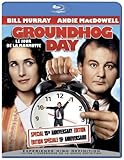
Groundhog Day (Special 15th Anniversary Edition) | $13.07 | Buy on Amazon |
| 4 |
![Groundhog Day [Blu-ray] [1993]](https://m.media-amazon.com/images/I/51pRfGmWEJL._SL160_.jpg)
|
Groundhog Day [Blu-ray] [1993] | $17.96 | Buy on Amazon |
| 5 |
![Groundhog Day (15th Anniversary Special Edition) [Blu-ray]](https://m.media-amazon.com/images/I/51Zacl9tLtL._SL160_.jpg)
|
Groundhog Day (15th Anniversary Special Edition) [Blu-ray] | $8.87 | Buy on Amazon |
This is where Groundhog Day stops behaving like a rom-com and starts functioning like a philosophical thought experiment disguised as studio entertainment. The film quietly tests existentialism, flirts with nihilism, borrows the logic of Buddhist samsara, and interrogates the idea of free will without ever announcing its intentions. Its enduring power comes from that trapdoor quality, the way it lures audiences in with laughs and romance, then leaves them wrestling with ideas most comedies never dare to touch.
Phil Connors as the Modern Existential Hero: From Narcissism to Nihilism
At the center of Groundhog Day’s philosophical engine is Phil Connors himself, a protagonist who begins the film not as a hero, but as a petty tyrant of his own small universe. He is smug, dismissive, and convinced that the world exists to either bore or admire him. In existential terms, Phil starts in a state of bad faith, defined entirely by ego, habit, and the assumption that meaning should be handed to him rather than earned.
#1 Best Overall
- A weatherman (Bill Murray) is trapped in a personal time warp on the worst day of his life. Co-stars Andie MacDowell.
The time loop doesn’t create Phil’s flaws; it simply removes the distractions that once hid them. With no future to plan for and no past that carries weight, his narcissism is exposed as hollow. What initially feels like freedom quickly becomes a mirror, forcing Phil to confront the emptiness of a self built solely on superiority and sarcasm.
The Illusion of Absolute Freedom
Phil’s first response to the loop is hedonistic experimentation, the fantasy version of existential freedom. If nothing matters tomorrow, why not indulge today? He eats recklessly, manipulates people without guilt, and treats human connection as a game with cheat codes.
This phase mirrors a common misunderstanding of existentialism: the belief that freedom without consequence equals fulfillment. Groundhog Day systematically dismantles that illusion. Pleasure becomes repetitive, conquest turns mechanical, and even indulgence loses its ability to distract from the underlying problem of meaning.
When Freedom Collapses Into Nihilism
Once pleasure fails, Phil slides into something darker. If nothing changes and no action has lasting impact, then nothing has value. This is the film’s most explicit flirtation with nihilism, played not for jokes, but with surprising emotional weight.
Recommended Free Tools
Phil’s suicide attempts are often remembered as comic set pieces, yet they function philosophically as the logical endpoint of a worldview where existence feels arbitrary. Death itself becomes meaningless when tomorrow refuses to acknowledge it. The loop denies even nihilism its final escape, trapping Phil in a purgatory where despair cannot end.
An Existential Hero Without a Quest
Unlike traditional heroes, Phil is not given a prophecy, a villain, or a mission. His journey is inward and unwitnessed. No one remembers his sacrifices, his failures, or his growth, which makes every choice he makes ethically pure in existential terms.
This is where Phil becomes a modern existential hero, closer to Camus’ Sisyphus than to any romantic lead. His task is not to escape the loop, but to decide who he is within it. Meaning is no longer something he expects the universe to provide; it becomes something he must actively create, one repeated day at a time.
Phil’s evolution from narcissism to nihilism is not the end of his arc, but the necessary collapse that clears the ground for transformation. Groundhog Day insists that before a person can live meaningfully, they must first survive the terrifying realization that life offers no guarantees, no cosmic scoreboard, and no automatic redemption.
The Eternal Return: Time Loops, Nietzsche, and the Horror of Meaninglessness
At the heart of Groundhog Day’s time loop lies a concept that predates cinema by more than a century: Friedrich Nietzsche’s idea of the eternal return. The thought experiment is deceptively simple and quietly terrifying. What if you had to live your life exactly as it is, over and over again, for eternity?
The Eternal Return as a Psychological Trial
Nietzsche didn’t propose the eternal return as a literal cosmology so much as a moral stress test. Could you affirm your life so completely that you would welcome its infinite repetition? Phil Connors is subjected to this test without consent, stripped of novelty, progress, and escape.
The horror of the loop is not that Phil is stuck in time, but that time is stripped of meaning. Without consequences or change, days lose their narrative shape. Life becomes an endlessly replaying tape, daring Phil to either recoil in disgust or learn how to say yes to existence as it is.
Repetition Without Progress
Most time-loop stories hinge on optimization: learn the pattern, solve the puzzle, escape the maze. Groundhog Day initially toys with this expectation, only to deny it. Phil masters the town, the people, even chance itself, and still remains trapped.
The Tool Desk
Outbyte Driver Updater FREEFix the driver behind crashes, sound loss and screen glitchesFind Drivers →Outbyte PC Repair FREERepair Windows errors before they cause bigger problemsFix Now →This is where the film diverges from fantasy and enters philosophy. Mastery does not save Phil because mastery alone does not justify existence. The loop exposes a modern anxiety Nietzsche diagnosed long before cinema: that control and intelligence, without meaning, only deepen despair.
The Horror Beneath the Comedy
The film’s light tone often masks how unsettling its premise truly is. Phil is functionally immortal, yet condemned to stagnation. He remembers everything, while the world forgets him daily, erasing his identity each morning at 6:00 a.m.
This asymmetry creates a uniquely modern form of horror. Phil is overburdened with memory in a universe that refuses to acknowledge it. His consciousness becomes a prison, echoing Nietzsche’s fear that awareness without affirmation leads not to enlightenment, but to paralysis.
From Eternal Return to Amor Fati
Nietzsche’s challenge was not merely to endure repetition, but to love it. Amor fati, the love of one’s fate, demands more than acceptance; it requires wholehearted affirmation. Groundhog Day dramatizes how impossible this feels at first, and how radical it becomes when achieved.
Phil’s eventual shift is not marked by a revelation about the loop’s rules, but by a change in his relationship to repetition itself. When he stops treating the day as an obstacle to overcome and begins treating it as a life worth living, the eternal return loses its terror. The same day remains, but Phil is no longer at war with it.
Rank #2
- A weatherman (Bill Murray) is trapped in a personal time warp on the worst day of his life. Co-stars Andie MacDowell.
In this way, Groundhog Day transforms Nietzsche’s bleakest thought experiment into a cinematic exploration of meaning under extreme conditions. The loop does not break because Phil solves it, but because he answers its philosophical challenge. Faced with an existence that offers nothing new, he learns how to live as if every moment deserves to be lived again.
Suicide, Despair, and the Limits of Free Will Inside the Loop
Once mastery and affirmation fail to release Phil from the loop, the film moves into its darkest territory. What follows is not played for shock, but for inevitability. If knowledge, control, and even love of fate cannot end the repetition, then the question becomes unavoidable: if nothing matters, why continue at all?
This is where Groundhog Day stops flirting with philosophy and commits to it. The comedy thins, the premise hardens, and the loop reveals its final cruelty. Phil is free to do anything, except leave.
What’s actually slowing this PC down?
Pick the symptom - the matching free tool is one click away.
The Logic of Despair
Phil’s suicide attempts are not cries for attention or melodramatic gestures. They are the logical conclusion of a consciousness trapped in infinite sameness. If tomorrow always resets, then death itself loses its meaning as an escape.
The film presents this with unsettling calm. Phil steps into oblivion repeatedly, only to wake up to the same song, the same room, the same day. The joke, if there is one, is cosmic and merciless: even annihilation has been neutralized.
This is existential despair stripped of romanticism. Phil is not afraid of death; he is bored by life and denied even the dignity of finality. The loop does not punish him with pain, but with the impossibility of consequences.
Camus and the Absurd Man
Albert Camus famously argued that suicide is the fundamental philosophical question. If life has no inherent meaning, is it worth living? Groundhog Day stages this question inside a high-concept narrative that refuses easy answers.
Crashes, No Sound, or Screen Glitches?
Random freezes, missing sound and display glitches usually trace back to one bad driver. Find and replace yours safely.Free scan · under a minuteWindows Errors? Fix Them Before They Spread
Repair common Windows errors and clear accumulated junk for a smoother, more stable PC - no reinstall needed.Free scan · no reinstallPhil’s attempts echo Camus’ notion of the absurd: the confrontation between human longing for meaning and a silent, indifferent universe. The loop never explains itself, never negotiates, never rewards despair with release. It simply continues.
Crucially, the film sides with Camus’ conclusion without quoting him. Suicide is shown not as liberation, but as another failed strategy, another attempt to force meaning onto a system that refuses it. Phil cannot exit the absurd by destroying himself, because the absurd is not located in his body, but in his relationship to existence.
Why Free Will Breaks Down
At first glance, Phil appears to have absolute freedom. He faces no consequences, no aging, no permanent loss. Yet the loop reveals the paradox at the heart of free will: choice without stakes collapses into emptiness.
Every decision resets. Every act is erased. Free will, in this context, becomes performative rather than transformative. Phil can choose anything, but nothing he chooses endures.
This is the film’s quiet indictment of modern fantasies about unlimited freedom. Without continuity, responsibility, or vulnerability, freedom becomes meaningless. Phil’s despair is not caused by too many limits, but by the absence of any that matter.
The Refusal of Escape as Moral Test
The brilliance of Groundhog Day is that it does not allow Phil to win by opting out. Suicide, like manipulation and mastery before it, is framed as an evasion rather than a solution. The loop functions less like a prison and more like a moral filter.
Phil must confront the possibility that existence does not owe him novelty, justice, or explanation. The only variable left is how he chooses to inhabit the day, not how he escapes it.
This transforms despair into a test of ethical imagination. If life cannot be ended, optimized, or solved, can it still be lived well? The film does not answer immediately, but it makes clear that despair is not the final state, only the last illusion to be stripped away.
Free tools Windows power users keep installed
One-click scans. No signup required.
Why the Film Never Feels Cruel
Despite its bleak implications, Groundhog Day never feels nihilistic. The suicide montage is brief, restrained, and emotionally distant by design. The film does not linger because its interest lies elsewhere.
What matters is not Phil’s desire to disappear, but what remains when disappearance fails. By denying him escape, the loop quietly insists on another possibility, one that neither despair nor free will can access directly.
In doing so, the film prepares the ground for its most radical idea: that meaning is not discovered by breaking the loop, but by fully accepting life inside it, even when escape is impossible.
Groundhog Day and Buddhism: Samsara, Suffering, and Enlightenment Without Escape
If Groundhog Day feels uncannily aligned with Buddhist thought, it’s because its central premise mirrors one of Buddhism’s most fundamental ideas: samsara, the endless cycle of repetition driven by ignorance and desire. Phil is not trapped by time itself so much as by his own attachments, resentments, and cravings. The loop continues not because the universe is cruel, but because he hasn’t yet learned how to live within it without grasping.
Quick wins for a faster PC:
Scan for outdated or missing drivers - takes under a minuteDriver Scan →Clear out junk files and repair common Windows errorsFree Scan →Unlike Western narratives that frame repetition as punishment, Buddhism understands cyclic existence as neutral. Suffering arises not from the cycle, but from resistance to it. Phil’s misery deepens the more he demands the day give him something new, something satisfying, something final.
The film’s genius lies in how quietly it shifts the question. Instead of asking how Phil can escape the loop, it asks why he believes escape is necessary at all. This reframing moves the story away from science fiction mechanics and toward spiritual diagnosis.
Samsara as Everyday Life, Not Cosmic Curse
Punxsutawney is not hell. It is ordinary, even quaint. The banality of the setting is essential, because Buddhism does not locate suffering in extreme conditions but in daily existence lived unconsciously.
Phil’s repeated encounters, the same conversations, the same annoyances, reflect the Buddhist idea that most lives are already loops. People wake, work, desire, resent, and repeat, mistaking novelty for meaning while reenacting the same emotional patterns. Phil’s condition simply removes the illusion of progress.
By forcing him to see repetition clearly, the film externalizes what Buddhism argues is usually invisible. The loop is not a supernatural anomaly. It is life, seen without narrative distractions.
Desire, Attachment, and the Failure of Control
Phil’s early strategies map cleanly onto Buddhist critiques of desire. He pursues pleasure, power, and admiration, believing satisfaction will end his dissatisfaction. Each attempt collapses into boredom or emptiness.
Even his romantic pursuit of Rita becomes a lesson in attachment. He memorizes her preferences, engineers perfect moments, and treats intimacy as something that can be optimized. The film repeatedly shows that desire aimed at possession, even emotional possession, reinforces suffering rather than alleviating it.
Crucially, the loop does not punish Phil for wanting things. It simply refuses to reward desire as a path to liberation. Control, no matter how refined, cannot end the cycle.
Free tools Windows power users keep installed
One-click scans. No signup required.
Enlightenment Without Explanation or Escape
When Phil finally changes, the film avoids spectacle. There is no revelation scene, no cosmic instruction, no voice explaining what he has learned. His transformation is behavioral before it is philosophical.
He stops asking what the day can give him and starts responding to what it needs. Acts of kindness arise without expectation of permanence. Skills are learned without ambition. Compassion becomes habitual rather than strategic.
This is enlightenment as Buddhism often presents it: not transcendence of the world, but intimacy with it. The loop ends only after Phil no longer requires it to end.
Why the Loop Ends Only After It Stops Mattering
The most radical aspect of Groundhog Day is that enlightenment does not function as a key. Phil does not solve the puzzle to earn release. Release arrives as a byproduct of inner change, not as its reward.
Windows Errors? Fix Them Before They Spread
Repair common Windows errors and clear accumulated junk for a smoother, more stable PC - no reinstall needed.Free scan · no reinstallCrashes, No Sound, or Screen Glitches?
Random freezes, missing sound and display glitches usually trace back to one bad driver. Find and replace yours safely.Free scan · under a minuteBy the time February 3rd finally arrives, the loop has already lost its power. Phil would continue living meaningfully even if it didn’t end. This is the film’s quiet alignment with Buddhist liberation, which is freedom from suffering, not from circumstance.
In that sense, Groundhog Day does not depict escape from samsara. It depicts awakening within it, suggesting that the way out was never spatial or temporal, but ethical and perceptual all along.
Learning to Be Good for No Reason: Ethics, Altruism, and the Rejection of Instrumental Living
If Groundhog Day begins as a story about control and ends as one about awareness, its ethical turn is where the transformation becomes visible. Phil’s final evolution is not metaphysical or romantic. It is moral, rooted in how he treats others once outcome no longer matters.
Rank #4
- The disk has English audio and subtitles.
The film’s quiet argument is that goodness only becomes authentic when it stops functioning as a means to an end. As long as Phil uses kindness to escape the loop, impress Rita, or manufacture meaning, it remains transactional. The day repeats until ethics cease to be instrumental.
From Optimization to Obligation
Earlier in the loop, Phil approaches morality like a system to be hacked. He helps people selectively, learns piano to appear impressive, and rescues townsfolk as part of a perfected routine. These acts look altruistic, but they are still goal-oriented, shaped by self-interest and prediction.
The turning point comes when he continues helping even after learning some suffering cannot be prevented. He comforts the dying homeless man knowing the outcome will not change. This is an ethical act stripped of utility, echoing philosopher Emmanuel Levinas’ idea that responsibility exists prior to reward or resolution.
Virtue Without Witness or Reward
By the final iteration of February 2nd, Phil no longer performs goodness. He embodies it. His generosity flows naturally, without urgency or expectation, and crucially, without an audience that matters.
This aligns closely with Aristotelian virtue ethics, where moral excellence is not about rules or consequences but about character. Phil does not calculate the good; he has become someone for whom goodness is habitual. The loop ends not because he did enough, but because he is no longer measuring.
Recommended Free Tools
The Rejection of Instrumental Living
Instrumental living treats time, people, and even the self as tools toward satisfaction. Groundhog Day systematically dismantles this worldview. Every attempt to turn life into a lever collapses under repetition.
What replaces it is a form of ethical presence. Phil listens. He responds. He acts because the moment in front of him calls for action, not because it advances a narrative. In philosophical terms, he moves from a utilitarian calculus to a form of moral realism where value exists independently of outcome.
The radical suggestion here is that meaning is not produced through achievement, escape, or even enlightenment. It emerges when action is no longer subordinate to desire. In rejecting instrumental living, Phil finally enters a world where goodness is sufficient unto itself.
Independent reader supportYour contribution helps us test, update, and keep practical guides available for everyone.Love as Recognition, Not Reward: Why Rita Can’t Be ‘Won’ Until Phil Changes
Once Phil abandons instrumental living, the film quietly reframes its central romance. Rita was never a prize at the end of the maze, and the loop ensures that every attempt to treat her as one fails. His encyclopedic knowledge of her tastes, fears, and habits only exposes the emptiness of a love built on prediction rather than presence.
Do these 3 things before closing this tab:
1Fix the driver behind crashes, sound loss and screen glitches2Repair Windows errors before they cause bigger problems3Scan for outdated or missing drivers - takes under a minuteGroundhog Day insists on a crucial distinction: love is not earned through performance, nor secured through mastery. It emerges through recognition. Rita cannot be convinced, impressed, or seduced into authenticity; she can only respond to someone who sees her as a subject rather than an objective.
The Failure of Perfect Information
Earlier iterations turn intimacy into a data problem. Phil learns Rita’s life the way he learns piano chords or weather patterns, believing that sufficient knowledge will yield control. The film treats this as a category error, confusing familiarity with understanding.
Philosophically, this aligns with Martin Buber’s distinction between I-It and I-Thou relationships. Phil initially relates to Rita as an It, something to be navigated and optimized. Only when he relinquishes control does the possibility of an I-Thou encounter, a genuine meeting between persons, come into view.
Attention as an Ethical Act
When Phil finally stops trying to win Rita, he begins to notice her. Not her preferences, but her presence. He listens without steering the conversation, responds without anticipating outcomes, and allows moments to remain unresolved.
This kind of attention echoes Simone Weil’s idea that true love begins with attentive waiting rather than assertion. Rita recognizes this shift intuitively. She feels seen rather than managed, acknowledged rather than targeted, and the film suggests that this recognition, not charm or cleverness, is what allows intimacy to take root.
Why the Loop Breaks Only After the Choice Becomes Free
Crucially, Rita’s affection is no longer the reason Phil acts well by the end. It is the result. The timeline resets countless times, but her response changes only when his goodness no longer depends on it.
This preserves the film’s ethical integrity. Love, like meaning, cannot be extracted from the world through effort alone. It arises when desire loosens its grip, when action is no longer transactional, and when another person is allowed to exist beyond one’s needs. In that sense, Rita isn’t the key that unlocks the loop. She is the proof that Phil has already stepped out of it.
Why the Loop Finally Breaks: Personal Transformation as the Only Way Forward
The film never offers a mechanical explanation for the time loop, and that absence is deliberate. Groundhog Day isn’t interested in causality so much as consequence. The loop ends not when Phil solves a puzzle, but when he becomes someone for whom repetition is no longer a prison.
Quick wins for a faster PC:
Clear out junk files and repair common Windows errorsFree Scan →Fix the driver behind crashes, sound loss and screen glitchesFind Drivers →What finally changes is not the day, but the self moving through it. The narrative insists that external escape is impossible without internal reorientation, making personal transformation the only exit that matters.
Existentialism Without the Despair
Phil’s predicament mirrors classic existential thought: he is condemned to freedom inside a world stripped of consequence. Suicide, indulgence, and nihilism all fail because they misunderstand the nature of meaning. As Jean-Paul Sartre argued, existence doesn’t become meaningful through escape, but through responsibility.
Phil’s breakthrough arrives when he stops asking how to end the loop and starts asking how to live within it. Meaning emerges not from novelty, but from chosen commitment. In accepting the weight of each repeated day, he paradoxically becomes free.
The Buddhist Logic of Letting Go
The loop also functions as a cinematic expression of samsara, the Buddhist cycle of suffering driven by craving and aversion. Phil’s early misery is fueled by desire: for pleasure, for recognition, for Rita’s affection. Each desire resets the day because nothing has fundamentally changed.
The Tool Desk
Outbyte PC Repair FREERepair Windows errors before they cause bigger problemsFix Now →Outbyte Driver Updater FREEFix the driver behind crashes, sound loss and screen glitchesFind Drivers →Only when he releases attachment does the cycle loosen. His actions become compassionate rather than strategic, present rather than future-oriented. In Buddhist terms, enlightenment doesn’t break the world open; it allows the individual to see clearly within it.
Virtue as Practice, Not Performance
One of the film’s quiet insights is that goodness cannot be rushed. Phil doesn’t become kind in a single revelatory moment; he practices kindness across countless invisible days. Helping townspeople, learning skills, and easing suffering aren’t means to an end, but ends in themselves.
This aligns with Aristotelian virtue ethics, where character is shaped through repeated action rather than intention alone. By the time the loop breaks, Phil is no longer performing goodness to achieve freedom. Freedom arrives because goodness has become who he is.
Why the Morning Finally Comes
The loop ends only when Phil no longer needs it to. He wakes up on February 3rd not because he has earned a reward, but because repetition has completed its work. The self who required endless correction no longer exists.
What’s actually slowing this PC down?
Pick the symptom - the matching free tool is one click away.
Groundhog Day suggests that time moves forward only when we do. Not through conquest, mastery, or control, but through attention, humility, and care. The film’s enduring power lies in this quiet assertion: transformation is not the price of freedom. It is the condition that makes freedom possible.
Why Groundhog Day Endures: A Pop Comedy That Accidentally Became a Philosophical Classic
Groundhog Day did not arrive announcing itself as a work of philosophy. It was marketed as a high-concept romantic comedy built around Bill Murray’s sardonic charm and a clever sci-fi hook. Yet three decades later, it’s taught in philosophy courses, cited in sermons, and endlessly referenced whenever modern life feels stuck in repetition.
Its endurance lies in that mismatch between intent and effect. By smuggling big questions into an accessible comic structure, the film invites reflection without demanding it. You can enjoy Groundhog Day casually, or you can keep returning to it, finding new meaning each time, much like Phil reliving February 2nd itself.
A Story That Meets You Where You Are
One reason the film persists is its elasticity. At different points in life, viewers identify with different versions of Phil: the cynical professional, the bored hedonist, the despairing nihilist, or the quietly attentive learner. The film never locks its meaning into a single moral lesson.
Instead, it operates like a philosophical mirror. Younger audiences may read it as a romantic redemption story. Older viewers often recognize something deeper: a meditation on routine, regret, and the slow labor of becoming someone better without external validation.
Existentialism Disguised as a Joke
At its core, Groundhog Day dramatizes an existential problem: what gives life meaning when outcomes are stripped away? Phil’s actions initially don’t matter. Consequences reset. Death itself becomes temporary. This is existential freedom in its most terrifying form.
Like Camus’ myth of Sisyphus, Phil is condemned to repetition without explanation. The film’s answer is not rebellion or despair, but engagement. Meaning isn’t discovered through escape, but through choosing to care, even when nothing forces you to.
Why the Comedy Makes the Philosophy Work
The film’s humor is not incidental to its depth; it’s essential. Comedy lowers defenses, allowing difficult ideas to land gently. Phil’s exaggerated misbehavior, his trial-and-error romances, and his deadpan frustration make the abstract feel human.
By laughing at Phil, we recognize ourselves. The philosophy doesn’t lecture; it emerges through behavior. This is why Groundhog Day feels intuitive rather than academic, a lived philosophy rather than a theoretical one.
A Timeless Answer to Modern Anxiety
In an era defined by burnout, algorithmic routines, and the feeling that days blur together, Groundhog Day feels more relevant than ever. It offers a radical suggestion: the problem isn’t repetition itself, but how we inhabit it. The same day can be a prison or a practice.
The film doesn’t promise transcendence through ambition or disruption. It proposes something quieter and harder: attention, patience, and responsibility to others. In doing so, it reframes personal transformation as a daily discipline rather than a dramatic breakthrough.
Groundhog Day endures because it understands something essential about being human. We are all, in some way, living the same day again and again, hoping it will change on its own. The film gently insists that the day only changes when we do, and that the most meaningful revolutions often look like ordinary kindness, repeated until it becomes who we are.
Quick Recap
Product prices and availability are accurate as of the date/time indicated and are subject to change. Any price and availability information displayed on Amazon at the time of purchase will apply.

