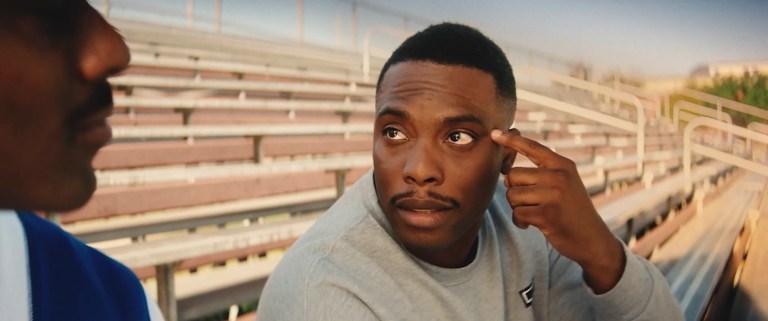
In a film crowded with violence and unanswered questions, Aunt Gladys emerges as the most unsettling presence precisely because she refuses to announce herself. She is not framed as a traditional monster or antagonist, but as a fixed point in the background of Weapons, a figure whose stillness feels heavier than the chaos unfolding around her. The film positions her less as a character who acts and more as a force that observes, waits, and endures.
Within the story’s fragmented structure, Aunt Gladys exists at the margins of the community, connected to its history in ways the film deliberately withholds. Her domestic routines, her sparse dialogue, and her unblinking gaze suggest someone who has outlived multiple cycles of trauma, possibly even caused them. Weapons never confirms whether she is supernatural, cursed, or simply shaped by generational violence, but the ambiguity is the point.
| # | Preview | Product | Price | |
|---|---|---|---|---|
| 1 |

|
Weapons (Blu-ray) | $9.99 | Buy on Amazon |
| 2 |

|
4 Film Favorites: Lethal Weapon (BD)(4FF) | $12.68 | Buy on Amazon |
| 3 |
![The Perfect Weapon (Special Edition) [Blu-ray]](https://m.media-amazon.com/images/I/41cJ1wYDL2L._SL160_.jpg)
|
The Perfect Weapon (Special Edition) [Blu-ray] | $12.49 | Buy on Amazon |
| 4 |
![Lethal Weapon 4-Movie Collection (Bonus Features Included) [Blu-ray] [Region Free]](https://m.media-amazon.com/images/I/51SHgEjQHPL._SL160_.jpg)
|
Lethal Weapon 4-Movie Collection (Bonus Features Included) [Blu-ray] [Region Free] | $54.99 | Buy on Amazon |
What makes Aunt Gladys so central is how the narrative bends around her without ever fully explaining her influence. She becomes a symbolic anchor for the film’s larger horror framework, representing inherited guilt, suppressed knowledge, and the quiet transmission of harm across time. In a story obsessed with how violence begins and who is allowed to survive it, Aunt Gladys stands as the embodiment of what horror looks like when it learns to be patient.
Aunt Gladys’ Origins: Folklore, Family Trauma, and the Suggestion of Something Ancient
If Weapons resists giving Aunt Gladys a clear origin, it does so with intent. The film scatters clues through dialogue fragments, production design, and implied history, inviting viewers to read her less as a person who arrived at a specific moment and more as someone who has always been there. Her presence feels inherited rather than introduced, as though she belongs to the house, the land, and the unspoken rules governing the community’s violence.
Quick wins for a faster PC:
Fix the driver behind crashes, sound loss and screen glitchesFind Drivers →Clear out junk files and repair common Windows errorsFree Scan →Scan for outdated or missing drivers - takes under a minuteDriver Scan →#1 Best Overall
Rather than offering a single explanatory backstory, Weapons layers multiple interpretive frameworks on top of one another. Folklore, generational trauma, and hints of something pre-human all coexist, none fully canceling the others out. Aunt Gladys becomes a narrative crossroads where these possibilities overlap.
Echoes of Folk Horror and Rural Myth
The film’s visual language quietly aligns Aunt Gladys with folk horror traditions rooted in isolation and inherited belief systems. Her home feels removed from time, decorated with objects that suggest ritual use without ever naming a ritual outright. This ambiguity places her in the lineage of figures who act as custodians of old rules rather than practitioners of overt magic.
Weapons never references a specific myth, but the implication is clear: Aunt Gladys operates according to a logic older than the characters around her. She behaves like someone bound to a covenant or duty that predates modern morality. In folk horror terms, she resembles the village elder who remembers what happens when boundaries are crossed, not because she was told, but because she has seen it repeat.
Family Trauma as a Living Legacy
Equally compelling is the idea that Aunt Gladys is the end result of accumulated family violence rather than its supernatural source. The film hints that she has endured loss, abuse, and moral compromise across decades, possibly generations. Her emotional restraint reads less as cruelty and more as adaptation, a survival mechanism honed through repetition.
The Tool Desk
Outbyte Driver Updater FREEFix the driver behind crashes, sound loss and screen glitchesFind Drivers →Outbyte PC Repair FREEClear out junk files and repair common Windows errorsFree Scan →Within this framework, her “power” is knowledge: knowing how violence escalates, knowing who will break, and knowing when to remain silent. Weapons frames trauma not as something that fades, but as something that sharpens, turning people into repositories of pain. Aunt Gladys becomes the family’s memory incarnate, carrying forward lessons no one else wants to remember.
The Suggestion of Something Pre-Human
Yet the film consistently pushes beyond psychological realism, hinting that Aunt Gladys may be more than a survivor. Her agelessness is never confirmed, but subtly implied through contradictory timelines and characters who speak of her as though she has not changed. She watches rather than reacts, as if human urgency does not fully apply to her.
This opens the door to a more unsettling possibility: that Aunt Gladys is not shaped by violence, but synchronized with it. She feels less like a witch or demon and more like an embodiment of something ancient and patient, an intelligence that understands cycles because it exists outside of them. Weapons never names this force, allowing it to remain abstract, but the implication lingers that Aunt Gladys did not learn to endure horror. She was built to.
The Nature of Her Powers: What Aunt Gladys Can Do — and What the Film Refuses to Show
What makes Aunt Gladys so unnerving is not a catalogue of supernatural feats, but the way the film frames her as functionally powerful without ever letting that power fully surface. Weapons resists spectacle, choosing implication over demonstration. Her abilities are inferred through effect, not action, leaving viewers to piece together what she can do by watching what happens around her.
PC Slower Than It Used to Be?
A free scan shows the junk files, broken settings and background clutter dragging Windows down - then fixes them in one click.Free scan · Windows 10 & 11Crashes, No Sound, or Screen Glitches?
Random freezes, missing sound and display glitches usually trace back to one bad driver. Find and replace yours safely.Free scan · under a minuteAuthority Without Action
Aunt Gladys rarely intervenes directly, yet events seem to align with her presence. When she enters a space, characters alter their behavior, conflicts stall, and momentum shifts. This suggests a form of influence that operates passively, as though she does not need to impose her will because the world already anticipates it.
In folk horror tradition, this is a familiar archetype: the figure whose power lies in permission rather than force. She does not chase, threaten, or command. She simply allows things to happen, and that allowance carries terrifying weight.
Foreknowledge, Not Prophecy
The film hints that Aunt Gladys knows what will happen long before it occurs, but never frames this as supernatural foresight in a conventional sense. She does not predict outcomes; she recognizes patterns. Her calm responses to escalating violence imply that nothing unfolding is new to her, only repeated.
This distinction matters. Weapons positions her knowledge as experiential rather than mystical, which keeps her grounded even as it pushes her into mythic territory. She understands cause and effect so intimately that the future becomes legible, stripping choice from those who believe they still have it.
Selective Immunity to Violence
Notably, Aunt Gladys is untouched by the chaos that consumes others. Whether this is literal invulnerability or symbolic insulation is left unresolved. The film never shows her harmed, threatened, or even emotionally destabilized by the horrors that unravel around her.
This absence is deliberate. By refusing to depict her suffering, Weapons implies that whatever rules govern violence do not apply to her in the same way. She stands outside the cycle, not because she is protected, but because she belongs to it.
Ritual Power Through Restraint
If Aunt Gladys has a supernatural ability, it may be her mastery of restraint. She knows when not to speak, when not to act, and when to let events reach their inevitable conclusion. In horror mythology, this is often the most dangerous kind of power: the wisdom to withhold intervention until the cost is irreversible.
Weapons reinforces this by denying the audience visual confirmation of her “doing” anything at all. There are no rituals shown, no explicit acts of magic, no moment where the camera reveals her hand behind the curtain. The horror emerges from the realization that nothing needs to be shown for her influence to be absolute.
What the Film Refuses to Show — and Why It Matters
By never defining the limits of Aunt Gladys’ abilities, Weapons preserves her ambiguity as a thematic weapon. Clear rules would humanize her; spectacle would diminish her. Instead, the film keeps her power abstract, forcing viewers to confront the discomfort of not knowing where agency ends and inevitability begins.
Rank #2
- Shrinkwrapped
This refusal is central to what Aunt Gladys represents within the story’s horror framework. She is not a monster to be defeated or a mystery to be solved. She is the presence that remains when explanations fail, embodying the idea that some forces do not announce themselves through violence, but through patience, memory, and silence.
The Rules of Her Abilities: Limitations, Costs, and the Horror of Restraint
For all her implied power, Weapons is careful to suggest that Aunt Gladys operates under rules that are as restrictive as they are terrifying. She does not act freely, decisively, or visibly. Her influence emerges only within narrow conditions, reinforcing the sense that whatever she is, she is bound to a system older and less forgiving than individual choice.
Power That Requires Permission
One of the film’s quiet implications is that Aunt Gladys cannot intervene unless something has already been set in motion. She never initiates violence, grief, or collapse; she arrives after belief has taken root. This positions her less as a cause and more as a custodian of consequence, enforcing outcomes that others have already invited.
This limitation reframes her apparent passivity as a rule rather than a preference. She waits because she must. The horror lies in realizing that once she appears, the threshold has already been crossed.
The Cost of Knowing Without Acting
If Aunt Gladys pays a price for her abilities, it is the burden of knowledge without agency. She understands what will happen, yet is seemingly forbidden from preventing it. The film’s lingering shots of her silent observation suggest endurance rather than dominance, as though foresight itself is a form of punishment.
In mythological terms, this aligns her with figures cursed to witness outcomes they cannot alter. Weapons transforms that trope into something colder: the idea that restraint is not mercy, but obligation. Her stillness is not compassion; it is compliance with a rule the film refuses to name.
Restraint as the Engine of Horror
Traditional horror escalates through action, but Aunt Gladys’ presence halts momentum instead of accelerating it. Scenes involving her often slow the film’s rhythm, draining moments of urgency and replacing them with dread. This deceleration becomes a narrative signal that the story is no longer driven by human panic, but by something patient and inexorable.
By denying her explosive displays of power, Weapons reframes restraint itself as monstrous. The audience is conditioned to fear not what she might do, but what she will allow to happen. In that waiting, the film locates its most unsettling truth: the most terrifying forces are not those that lash out, but those that never need to.
Why Her Limits Make Her More Dangerous
Aunt Gladys’ boundaries prevent her from becoming an all-powerful antagonist, but they also make her unavoidable. Because she cannot overstep her role, she never exposes herself. There is no moment of excess, no mistake, no spectacle that could be exploited or resisted.
Her limitations render her absolute in a different way. She cannot be bargained with, reasoned with, or provoked into revealing herself. Within the world of Weapons, that is the ultimate horror: a force defined not by what it can do, but by what it will never stop allowing.
Weaponized Care: How Aunt Gladys Twists Protection, Motherhood, and Authority
Aunt Gladys is most unsettling not when she predicts harm, but when she frames that harm as care. Weapons repeatedly places her in positions associated with safety—guardian, caretaker, elder—then corrodes those roles from within. What should shield the vulnerable instead becomes the mechanism by which vulnerability is managed, observed, and ultimately preserved.
What’s actually slowing this PC down?
Pick the symptom - the matching free tool is one click away.
Her power operates through familiarity. The film leans on the cultural shorthand of the “concerned aunt,” someone granted trust without question, to disguise a presence that never intervenes. By the time her intentions feel suspect, the damage has already been normalized.
Motherhood Without Mercy
Weapons strips motherhood of warmth and recasts it as obligation without empathy. Aunt Gladys embodies a version of maternal authority that prioritizes order over protection, continuity over individual survival. She watches children suffer not because she hates them, but because their suffering fits within a larger, unseen necessity.
This inversion is critical. The film suggests that care, when severed from compassion, becomes indistinguishable from cruelty. Aunt Gladys does not abuse; she withholds rescue, allowing harm to fulfill its purpose under the guise of inevitability.
Protection as Containment
Rather than shielding characters from danger, Aunt Gladys seems to define the boundaries within which danger is allowed to operate. Her presence often coincides with rules, routines, and domestic spaces that feel safe but function as traps. Bedrooms, kitchens, and classrooms become zones of managed exposure rather than refuge.
Free tools Windows power users keep installed
One-click scans. No signup required.
This reframing turns protection into containment. Safety is not about preventing harm, but about ensuring harm occurs in a controlled, almost ceremonial way. The horror lies in how reasonable this logic appears when spoken by someone who looks like she belongs there.
Authority That Never Raises Its Voice
Aunt Gladys never commands, threatens, or punishes outright. Her authority is quieter, rooted in social roles that rarely require justification. When she speaks, characters listen not because they fear her, but because they are conditioned to obey figures like her.
Rank #3
Weapons uses this dynamic to critique institutional power writ small. Aunt Gladys represents systems that harm through policy, tradition, and procedural calm rather than overt violence. She does not need to enforce; compliance is already built into the relationship.
Care as the Final Disguise
By cloaking her function in care, Aunt Gladys becomes almost impossible to confront. To challenge her is to question the very idea of protection, motherhood, and guidance itself. The film exploits that hesitation, forcing both characters and viewers to sit with the discomfort of doubting something that looks benevolent.
Do these 3 things before closing this tab:
1Clear out junk files and repair common Windows errors2Scan for outdated or missing drivers - takes under a minute3Repair Windows errors before they cause bigger problemsIn this way, her greatest power is symbolic. She embodies the horror of realizing that what raised you, watched over you, and told you everything would be fine may have been complicit all along. Weapons doesn’t ask whether Aunt Gladys is evil; it asks how often evil survives by calling itself care.
Symbolism and Mythology: Aunt Gladys as Curse-Bearer, Gatekeeper, and Living Weapon
If Aunt Gladys unsettles, it’s because Weapons frames her less as a person than as a function. She operates on a mythic register, occupying roles that feel ancient even when dressed in contemporary domesticity. The film invites viewers to read her not just as an antagonist, but as a symbolic mechanism through which horror is permitted to enter the world.
Rather than breaking reality, Aunt Gladys enforces it. Her power is not supernatural spectacle, but narrative gravity, pulling characters toward outcomes that feel preordained. In that sense, her mythology is closer to folklore than fantasy, rooted in archetypes audiences recognize even if they can’t name them.
The Curse-Bearer
Aunt Gladys does not cast curses in any traditional sense, yet misfortune seems to organize itself around her presence. She arrives after something has already gone wrong, or just before it becomes irreversible. The implication is that she doesn’t create the curse, but carries it, ensuring it completes its cycle.
Recommended Free Tools
This positions her as a vessel for inherited harm. Like figures in folk horror who absorb communal sin or generational guilt, Aunt Gladys appears burdened with something older than herself. The film subtly suggests that whatever power she has was not chosen, but assigned, passed down through systems that require someone to hold the blame so others can feel absolved.
The Gatekeeper Between Harm and Meaning
As a gatekeeper, Aunt Gladys controls thresholds rather than outcomes. She decides when intervention is allowed and when suffering must be endured to “mean” something. Doors are left unlocked, warnings are phrased too late, and opportunities for escape dissolve under her watchful calm.
This aligns her with mythic sentinels who guard sacred or forbidden spaces. Except here, the threshold is trauma itself. Aunt Gladys ensures that characters cross into pain under the illusion of choice, transforming random violence into something that feels sanctioned, almost necessary.
A Living Weapon Without Violence
The title Weapons gains its sharpest irony through Aunt Gladys. She never strikes, chases, or threatens, yet she is among the film’s most effective instruments of harm. Her weaponization comes from her ability to normalize danger, to make catastrophic outcomes feel like the natural order of things.
In this way, she embodies institutional violence personified. Schools, families, and caretakers do not harm by accident in Weapons; they harm by design, and Aunt Gladys is the delivery system. She turns passivity into force, patience into pressure, and reassurance into a trigger.
Mythology Without the Supernatural
What makes Aunt Gladys especially disturbing is that Weapons never fully confirms her as supernatural. She exists in the gray space where myth overlaps with social reality. Like urban legends rooted in real injustice, her power feels believable because it mirrors how harm often operates off-screen, through neglect, policy, and moral deferral.
By grounding her mythology in recognizable roles, the film suggests that Aunt Gladys does not need magic to function as a monster. She is empowered by belief, routine, and the collective agreement not to look too closely. In Weapons, that agreement is the oldest myth of all, and Aunt Gladys is its most faithful servant.
Independent reader supportYour contribution helps us test, update, and keep practical guides available for everyone.Narrative Function: Why ‘Weapons’ Needs Aunt Gladys More Than a Traditional Villain
Traditional villains impose threat from the outside. Aunt Gladys operates from within the story’s moral infrastructure, making her far more dangerous to the film’s intent. Weapons is not about stopping an evil force; it is about recognizing how violence becomes acceptable long before it becomes visible.
Quick wins for a faster PC:
Clear out junk files and repair common Windows errorsFree Scan →Fix the driver behind crashes, sound loss and screen glitchesFind Drivers →By refusing a clear antagonist, the film denies the audience catharsis. There is no final confrontation where order is restored, only a growing awareness of how harm has already been authorized. Aunt Gladys exists to make that authorization feel calm, reasonable, and irrevocable.
Conflict Without Confrontation
A conventional villain would give Weapons a shape to fight against. Aunt Gladys gives it something worse: a presence that cannot be challenged because it never openly attacks. Her power lies in how she dissolves resistance before it can form.
Characters do not argue with Aunt Gladys because she never demands anything outright. She simply reframes danger as inevitability and fear as immaturity. In doing so, the film replaces external conflict with internal surrender, which is far more aligned with its themes of systemic failure.
Making the Audience Complicit
Aunt Gladys also serves a critical meta-function. She mirrors the audience’s own desire for explanation, order, and reassurance. When she speaks, she sounds like the voice that wants to believe everything will be fine if the rules are followed.
This creates a subtle complicity. Viewers may find themselves agreeing with her logic even as they sense its cruelty. A traditional villain would let the audience feel morally superior; Aunt Gladys forces them to question how easily they accept harm when it arrives politely.
Preserving Horror Through Ambiguity
Weapons depends on uncertainty to sustain its dread. A defined villain with clear motives would collapse that ambiguity into something manageable. Aunt Gladys keeps the horror unresolved because her intentions are never fully legible.
Is she protecting order, enforcing a belief system, or simply maintaining her role? The film never answers, and that refusal is the point. Horror lingers not because something is chasing the characters, but because nothing is stopping what’s already in motion.
Thematic Precision Over Narrative Comfort
Ultimately, Aunt Gladys allows Weapons to remain thematically precise rather than narratively comforting. She embodies the idea that the most destructive forces are those we refuse to label as villains. Institutions, caretakers, and traditions rarely see themselves as monstrous, and the film honors that reality by refusing to personify evil in obvious ways.
Free tools Windows power users keep installed
One-click scans. No signup required.
A traditional villain would have narrowed the film’s scope. Aunt Gladys expands it, turning Weapons into a story about how violence survives not through aggression, but through approval, delay, and silence.
What Aunt Gladys Ultimately Represents: Fear Passed Down, Not Chosen
At her core, Aunt Gladys is not a monster born from malice or ambition. She is the end result of fear that has been normalized, inherited, and quietly ritualized over time. Weapons positions her as someone who did not invent the rules she enforces, but learned them so thoroughly that they became indistinguishable from morality itself.
That distinction matters. The film repeatedly suggests that Aunt Gladys did not choose her role in the way a villain chooses domination. She absorbed it, adapted to it, and eventually became its most reliable vessel.
An Origin Rooted in Survival, Not Power
While Weapons never offers a literal backstory for Aunt Gladys’ abilities, it strongly implies an origin tied to endurance rather than empowerment. Her knowledge, her foresight, and her eerie composure feel less like supernatural gifts and more like the byproduct of having lived too long inside a broken system. She knows what happens when people resist, and she has learned that survival depends on compliance.
What’s actually slowing this PC down?
Pick the symptom - the matching free tool is one click away.
This reframes her powers as cumulative. Each generation that submits adds to her authority, not because she grows stronger, but because resistance grows weaker. Fear becomes tradition, and tradition becomes law.
Fear as Inheritance
Aunt Gladys represents fear that is passed down under the guise of protection. She teaches children not how to escape danger, but how to anticipate it and accept it as inevitable. In doing so, she ensures that terror outlives any single threat.
This is why her presence feels suffocating rather than explosive. She doesn’t need to scare anyone directly. The fear arrives pre-installed, taught early, and reinforced gently until it feels like common sense.
Power Without Desire
One of the most unsettling aspects of Aunt Gladys is her apparent lack of desire. She doesn’t seek control for pleasure, revenge, or recognition. She simply maintains the structure she was given, believing that stability, even violent stability, is preferable to chaos.
Do these 3 things before closing this tab:
1Clear out junk files and repair common Windows errors2Fix the driver behind crashes, sound loss and screen glitches3Repair Windows errors before they cause bigger problemsThis makes her power feel more realistic and more frightening. Systems endure not because people love them, but because no one believes they can be dismantled without making things worse. Aunt Gladys is that belief personified.
The True Horror of Weapons
By the film’s end, it becomes clear that Aunt Gladys is not the source of evil within Weapons, but its proof of concept. She demonstrates how horror persists when it is framed as care, wisdom, or necessity. Violence doesn’t need to roar if it can whisper convincingly enough.
In that sense, Aunt Gladys is Weapons’ most devastating idea. She embodies the terror of realizing that the greatest threats are not imposed by force, but inherited without question. The film doesn’t ask whether she could have chosen differently. It asks how many people never realized there was a choice at all.
Quick Recap
Product prices and availability are accurate as of the date/time indicated and are subject to change. Any price and availability information displayed on Amazon at the time of purchase will apply.
Recommended Free Tools