Quick wins for a faster PC:
Scan for outdated or missing drivers - takes under a minuteDriver Scan →Repair Windows errors before they cause bigger problemsFix Now →Fix the driver behind crashes, sound loss and screen glitchesFind Drivers →Released in 1996, The Ghost and the Darkness arrived with a chilling promise: this was not just an adventure film, but a dramatization of real events so brutal they bordered on myth. Set against the unforgiving plains of colonial East Africa, the movie framed its horror through isolation, vulnerability, and the unnerving idea that nature itself had turned predatory. For many viewers, the claim that the story was true made the fear linger long after the credits rolled.
Directed by Stephen Hopkins and anchored by performances from Val Kilmer and Michael Douglas, the film depicted the construction of the Tsavo railway bridge as a descent into terror. Workers vanish in the night, dragged from their tents by unseen forces, while British authority proves powerless against an enemy that does not obey human rules. The lions are not portrayed as animals but as calculating, almost supernatural entities, earning the names that would define their legend.
| # | Preview | Product | Price | |
|---|---|---|---|---|
| 1 |

|
The Ghost and the Darkness | $6.83 | Buy on Amazon |
| 2 |
|
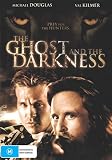
The Ghost And The Darkness | $19.99 | Buy on Amazon |
| 3 |

|
The Ghost and the Darkness | $8.99 | Buy on Amazon |
| 4 |

|
The Ghost And The Darkness | $18.56 | Buy on Amazon |
| 5 |

|
Ghost and The Darkness | Buy on Amazon |
Yet beneath the film’s operatic tension lies a far more complex and unsettling reality. The real Tsavo man-eaters were not folklore or colonial exaggeration, but documented killers whose attacks halted an imperial project and traumatized an entire workforce. To understand why the story still resonates, and where the film bends history to heighten its nightmare, it is essential to look beyond the screen and into the grim facts that inspired one of cinema’s most haunting survival tales.
The Real Tsavo Lions: What Actually Happened in Kenya in 1898
In early 1898, the British Empire pushed its railway deeper into what was then British East Africa, driving a steel artery from the coast toward Lake Victoria. At the Tsavo River crossing in present-day Kenya, construction stalled under conditions already brutal: disease, heat, floods, and a transient labor force brought in from India. Then the lions arrived, and the danger escalated from environmental hardship to nightly terror.
Crashes, No Sound, or Screen Glitches?
Random freezes, missing sound and display glitches usually trace back to one bad driver. Find and replace yours safely.Free scan · under a minutePC Slower Than It Used to Be?
A free scan shows the junk files, broken settings and background clutter dragging Windows down - then fixes them in one click.Free scan · Windows 10 & 11#1 Best Overall
- Shrink-wrapped
- The Ghost and the Darkness DVD - Actors: Val Kilmer, Michael Douglas, Tom Wilkinson
These were not ordinary predators encroaching at the margins of a camp. The attacks were brazen, repetitive, and focused on human beings, pulling men from tents or striking those who slept by fires. Word spread quickly among workers that the lions were no longer animals but something unnatural, earning them the names that would endure long after the killings stopped.
The Lions and the Railway Camp
The project was overseen on site by Lieutenant Colonel John Henry Patterson, a British officer tasked with building a bridge over the Tsavo River. His journals describe a workforce paralyzed by fear as the lions returned night after night, often ignoring livestock to target people instead. Entire crews refused to work, desertions mounted, and the bridge site was repeatedly abandoned.
Patterson documented elaborate attempts to stop the attacks, from thorn fences known as bomas to elevated platforms and baited traps. None worked for long. The lions appeared to learn quickly, bypassing defenses and striking with unsettling precision, often dragging victims away without a sound.
How Many People Were Really Killed?
The most enduring point of debate is the body count. Patterson claimed the lions killed 135 people, a figure repeated for decades and woven into the film’s narrative of near-apocalyptic carnage. Modern historians and scientists, however, have cast doubt on that number.
A 2009 study examining isotopic signatures in the lions’ remains, now housed at the Field Museum in Chicago, estimated the true number of human victims at closer to 28 to 31. While significantly lower, the revised figure does little to diminish the horror. Even at the minimum estimate, the Tsavo attacks remain one of the deadliest recorded series of lion attacks in history.
Why the Lions Turned to Man-Eating
Unlike the film’s suggestion of pure malevolence, the real explanation appears rooted in ecological collapse and opportunity. In the years leading up to 1898, East Africa had been ravaged by a rinderpest epidemic that wiped out vast numbers of cattle and wild herbivores. Drought followed, leaving predators desperate.
Adding to this grim equation was the presence of human bodies along caravan routes, casualties of the slave trade and disease, which may have conditioned lions to feed on human flesh. One of the Tsavo lions also showed severe dental damage, likely making it painful to hunt traditional prey and easier to attack unarmed humans.
The End of the Man-Eaters
After months of failed attempts, Patterson finally killed the first lion in December 1898 after a prolonged nighttime stakeout. The second was shot days later after surviving multiple wounds and continuing to stalk the camp. Their deaths allowed construction to resume, and the Tsavo bridge was eventually completed.
The lions’ skins were later turned into rugs before being reconstructed as museum specimens. Today, they remain on display, their presence a reminder that the events dramatized on screen were not born of cinematic excess, but of a very real moment when colonial ambition collided violently with a landscape pushed to its limits.
Colonial Ambition and Catastrophe: Building the Uganda Railway Under Siege
The Tsavo killings did not occur in isolation. They unfolded amid one of the British Empire’s most audacious and controversial infrastructure projects: the Uganda Railway, a steel artery intended to bind the Kenyan coast to the interior of East Africa. Conceived as a tool of imperial control rather than economic necessity, the railway was meant to secure British interests against rival European powers and suppress local resistance.
Dubbed the “Lunatic Line” by critics in Parliament, the railway cut through some of the most unforgiving terrain in the region. Tsavo, with its heat, disease, and wildlife, became a pressure point where imperial ambition met ecological reality. The lions were only the most visible threat in a landscape already stacked against its builders.
An Empire Built on Imported Labor
The workforce that built the Uganda Railway was overwhelmingly composed of indentured laborers from British India. More than 30,000 men were recruited, many with little understanding of where they were going or what awaited them. They faced malaria, dysentery, smallpox, and brutal working conditions long before the lions arrived.
The Tool Desk
Outbyte PC Repair FREERepair Windows errors before they cause bigger problemsFix Now →Outbyte Driver Updater FREEScan for outdated or missing drivers - takes under a minuteDriver Scan →Deaths were frequent and often unrecorded, a grim footnote in official reports. The film portrays a largely unified camp under siege, but in reality the labor force was fragmented by language, caste, and colonial hierarchy. European officers were insulated by privilege, while Indian and African workers bore the greatest risks.
Tsavo: A Construction Site Turned Killing Ground
By the time Patterson arrived in Tsavo in 1898, morale was already eroding. Camps were poorly defended, medical care was minimal, and traditional safety practices were ill-suited to the environment. Nighttime brought not only fear of predators, but the very real possibility of workers simply vanishing from their tents.
Rank #2
Construction stalled repeatedly as laborers fled the site, convinced the area was cursed. Some local workers believed the lions were manifestations of evil spirits, a belief the film leans into symbolically, though colonial officials dismissed such explanations outright. What they could not dismiss was the mounting loss of manpower and the financial hemorrhaging that followed.
Order, Authority, and the Limits of Control
The Ghost and the Darkness amplifies the role of fictional big-game hunter Charles Remington, played by Michael Douglas, as a stabilizing force amid chaos. In reality, no such American hunter arrived to save the project. Authority rested with British engineers like Patterson, who were expected to impose order despite being woefully underprepared for the conditions they faced.
The lions exposed the fragility of colonial control. Rifles, rail schedules, and imperial confidence meant little when night fell and the camp’s perimeter failed. For months, the railway existed in a state of suspended progress, its steel rails advancing by day and retreating in terror by night.
When Progress Became a Death Sentence
The Uganda Railway would eventually be completed, but Tsavo left a permanent scar on its legacy. The deaths attributed to the lions were only a fraction of the human cost paid in the name of imperial expansion. Thousands more would die from disease and exhaustion along the line, their stories largely absent from both film and official history.
In framing the lions as singular monsters, the film narrows a catastrophe that was, in truth, systemic. Tsavo was not just a battle between men and beasts, but a moment when colonial ambition pushed human bodies into an environment already on the brink, and paid for that arrogance in blood.
Fact vs. Fiction: How ‘The Ghost and the Darkness’ Changed the True Story
The Ghost and the Darkness markets itself as a historical thriller, but its power comes from selective reshaping rather than strict accuracy. The film draws from real events, journals, and later scientific findings, yet it also simplifies, exaggerates, and invents characters to fit a classical survival narrative. Understanding where the film diverges from history reveals not only what was changed, but why the truth was, in some ways, even more disturbing.
Recommended Free Tools
The Myth of the Lone American Hunter
The most conspicuous invention is Charles Remington, the seasoned American big-game hunter portrayed by Michael Douglas. No such figure existed at Tsavo, and no outside expert arrived to rescue the railway project. His character serves a cinematic function, providing a hardened counterbalance to Patterson and a familiar Western hero archetype for audiences.
Historically, the burden fell entirely on Colonel John Henry Patterson, who had limited experience hunting dangerous game. Patterson organized traps, armed patrols, and night watches while still overseeing construction. The absence of a Remington-like figure meant the real crisis dragged on longer, with more failed attempts and deeper psychological strain than the film suggests.
Body Count: Inflated Numbers vs. Documented Deaths
The film implies that the lions killed well over a hundred workers, sometimes suggesting numbers approaching mythic proportions. Patterson himself later claimed 135 victims, a figure that shaped popular imagination for decades. Modern research, including forensic analysis of the lions’ remains, paints a more restrained but still horrifying picture.
Current estimates suggest the lions killed between 30 and 40 people directly, though the exact number remains uncertain. This does not account for indirect deaths caused by panic, abandonment of medical care, or exposure during mass desertions. The film amplifies the toll for dramatic impact, but even the lower figures represent an unprecedented pattern of sustained predation on humans.
From Clever Predators to Supernatural Evil
The Ghost and the Darkness leans heavily into myth, portraying the lions as near-supernatural entities that move silently, evade bullets, and seem to understand human psychology. This approach reflects how workers at Tsavo perceived the animals at the time, interpreting their behavior through spiritual and cultural frameworks. The film treats these beliefs with reverence, allowing fear itself to become a character.
In reality, the lions’ behavior can be partially explained by environmental and biological factors. The Tsavo region had few trees suitable for traditional lion ambushes, forcing the animals to adapt. One of the lions also suffered severe dental damage, making human prey easier to kill than large game. These explanations do not lessen the horror, but they ground it in nature rather than legend.
Simplified Timelines and Sanitized Suffering
The film condenses months of terror into a tightly paced narrative, giving the impression of constant escalation toward a climactic showdown. Historically, the attacks were sporadic, unpredictable, and stretched across nearly nine months. Long periods of false calm were punctuated by sudden violence, which proved psychologically devastating for the workers.
What the film largely omits is the broader suffering beyond the lion attacks. Disease, malnutrition, and brutal labor conditions claimed far more lives than the predators. By focusing narrowly on the lions, the film isolates horror into a single threat, rather than portraying Tsavo as a convergence of systemic neglect and environmental hostility.
What’s actually slowing this PC down?
Pick the symptom - the matching free tool is one click away.
Rank #3
The Ending History Didn’t Get
In the film, the lions are defeated in a definitive, cathartic confrontation that restores order and allows the railway to resume. The real aftermath was quieter and more unsettling. Patterson killed both lions weeks apart, with no triumphant moment witnessed by the camp as a whole.
Even after their deaths, fear lingered, and construction resumed slowly. The sense of vulnerability Tsavo exposed never fully disappeared. The railway moved forward, but the illusion of imperial mastery had already been permanently fractured.
Meet the Real Man Behind the Legend: Lieutenant Colonel John Henry Patterson
The cinematic version of John Henry Patterson presents him as a stoic engineer thrust unwillingly into myth. The real man was far more complicated, shaped by empire, ambition, and a keen awareness of legacy. Patterson was not merely a victim of circumstance at Tsavo; he was an active architect of how the story would later be told.
Born in 1867 to an Anglo-Irish Protestant family, Patterson was trained as a military engineer in the British Army. By the time he arrived in British East Africa, he was already steeped in imperial frontier culture, where survival, authority, and personal reputation were tightly bound. Tsavo was not his first brush with danger, but it would become the defining chapter of his life.
Do these 3 things before closing this tab:
1Clear out junk files and repair common Windows errors2Fix the driver behind crashes, sound loss and screen glitches3Repair Windows errors before they cause bigger problemsAn Engineer in a Colonial Pressure Cooker
Patterson was appointed chief engineer overseeing the construction of the Tsavo bridge, a critical link in the Uganda Railway. The project was a linchpin of British colonial strategy, designed to secure economic control and military access deep into the interior of East Africa. Failure was not an option, and delays were viewed as both financial liabilities and political embarrassments.
When the lion attacks began, Patterson found himself navigating far more than a predator crisis. He was managing a terrified workforce, skeptical superiors, and an imperial system that expected order in a landscape that resisted it. His authority depended on restoring control, not just over the railway, but over fear itself.
The Hunter Who Wrote His Own Myth
Unlike the film’s restrained portrayal, the real Patterson was an avid hunter and meticulous chronicler. His 1907 memoir, The Man-Eaters of Tsavo, became the primary source for nearly every adaptation that followed. Written in confident, often dramatic prose, the book framed the events as a personal duel between man and nature.
Historians have long debated Patterson’s reliability as a narrator. His reported death toll attributed to the lions was likely exaggerated, and his own heroism carefully foregrounded. Yet his account also conveys genuine exhaustion, isolation, and creeping dread, suggesting a man both shaping a legend and struggling to survive it.
Free tools Windows power users keep installed
One-click scans. No signup required.
After Tsavo: A Life Forged by Conflict
Tsavo did not end Patterson’s career in danger; it elevated it. He later served in World War I, where he played a key role in forming the Zion Mule Corps, a Jewish military unit that fought for the British at Gallipoli. This chapter of his life earned him admiration in some circles and controversy in others, reflecting his complex political and cultural alignments.
By the time Patterson retired with the rank of lieutenant colonel, Tsavo had become inseparable from his identity. The lions followed him in lectures, articles, and public memory. Whether viewed as a brave engineer, a colonial opportunist, or a master self-mythologizer, Patterson remains central to why the story endures.
His voice, more than the lions themselves, shaped how the world would remember Tsavo. And like all legends born of empire, it exists in the uneasy space between documented fact and carefully curated myth.
Why the Lions Became Man-Eaters: Science, Environment, and Modern Theories
For decades, the Tsavo lions were framed as aberrations, predators that crossed an invisible moral line. Early colonial accounts, including Patterson’s own, leaned toward the inexplicable, feeding the idea that something unnatural stalked the railway camps. Modern science, however, paints a far more unsettling picture: these lions were shaped by injury, environment, and human disruption rather than madness or myth.
The Broken-Tooth Theory
The most influential modern explanation comes from forensic analysis of the lions’ remains, now housed at Chicago’s Field Museum. One of the two lions suffered from severe dental damage, including a fractured canine and a painful jaw infection that would have made hunting large, struggling prey excruciating. Humans, slower and easier to overpower, became a grimly practical alternative.
This discovery reframes man-eating not as a preference, but as adaptation under duress. In this light, the lions were not rogue killers but injured predators responding to physical limitation. The horror lies not in their cruelty, but in their efficiency.
Rank #4
Ecological Collapse and Vanishing Prey
The Tsavo attacks occurred in the aftermath of the rinderpest epidemic of the 1890s, which devastated East Africa’s ungulate populations. Buffalo, wildebeest, and other key prey species were wiped out on a massive scale, leaving predators scrambling for sustenance. The ecosystem Patterson entered was already destabilized, long before the railway arrived.
With natural prey scarce, lions were forced to expand their dietary boundaries. Human labor camps, packed with hundreds of workers, offered an abundant and concentrated food source. In ecological terms, Tsavo had become a trap, not just for men, but for the predators drawn to them.
Railway Camps and the Geography of Death
The construction of the Uganda Railway unintentionally created ideal hunting conditions. Workers slept in flimsy tents or open-air bomas that provided little protection against nocturnal predators. Fires burned low, guards were inexperienced, and the camps remained stationary for weeks at a time.
Even more disturbingly, local burial practices and the high death rate among workers meant human remains were sometimes left exposed. This normalized the scent and presence of human flesh, lowering the psychological barrier that typically keeps predators from targeting people. Once that line was crossed, it was not easily uncrossed.
Tsavo’s Lions: Built for Stealth
Tsavo lions are biologically distinct, often lacking the full manes seen in other regions. This trait, likely an adaptation to heat and terrain, gives them a sleeker, almost spectral appearance. In the film, this becomes a visual metaphor for their otherness, but in reality, it made them better ambush predators in dense scrub.
The landscape itself worked in the lions’ favor. Tall grass, thorny bush, and the constant noise of construction masked their movements. The environment did not just hide the lions; it enabled them.
Separating Cinema from Evidence
The Ghost and the Darkness leans into the idea of malevolence, portraying the lions as near-mythic forces of evil. While effective on screen, this framing strips away the ecological and human factors that made Tsavo possible. The real story is less supernatural, but arguably more disturbing.
Scientific studies using isotope analysis of hair and bone suggest the lions consumed fewer people than Patterson claimed. Yet even reduced estimates confirm that human flesh became a sustained part of their diet. The terror was real, even if the numbers were shaped by memory, fear, and colonial storytelling.
Understanding why the lions became man-eaters does not diminish the horror of Tsavo. It deepens it. The tragedy lies in how easily environmental collapse, human expansion, and animal survival instincts aligned, turning a railway project into one of the most infamous predator attacks in recorded history.
Independent reader supportYour contribution helps us test, update, and keep practical guides available for everyone.From Campfire Horror to Museum Specimens: The Fate of the Tsavo Lions
Once the lions were finally stopped, their story did not end in the bush. Instead, it shifted from whispered campfire terror to documented history, preserved in skin, bone, and scientific scrutiny. The same animals that halted an empire’s railway would eventually become museum artifacts, stripped of myth but not of menace.
Do these 3 things before closing this tab:
1Clear out junk files and repair common Windows errors2Fix the driver behind crashes, sound loss and screen glitches3Repair Windows errors before they cause bigger problemsThe Kill That Ended the Terror
After months of failed traps and close calls, Lieutenant Colonel John Henry Patterson killed the first lion in December 1898, following a night-long standoff near the railway camp. The second lion fell weeks later, after a prolonged pursuit that nearly cost Patterson his life. The film condenses this into a tightly choreographed climax, but the reality was messier, slower, and deeply exhausting.
These were not clean victories. Both lions absorbed multiple gunshots before dying, reinforcing the belief among workers that they were unnatural, nearly invulnerable creatures. In truth, their resilience reflected desperation, pain, and the brutal difficulty of hunting predators in dense Tsavo terrain.
From Trophies to Scientific Evidence
Patterson initially treated the lions as trophies, skinning them and using the pelts as rugs for years. Only later did he sell the skins and skulls to Chicago’s Field Museum of Natural History in the 1920s. By then, time and use had altered them, forcing curators to reconstruct the animals into lifelike forms using additional material.
Today, the mounted Tsavo lions still stand in the museum’s halls. They are smaller than audiences often expect, a quiet but unsettling contrast to their oversized reputation. Seeing them in person collapses the myth into something tangible, and arguably more disturbing.
Free tools Windows power users keep installed
One-click scans. No signup required.
Best Value
What the Bones Revealed
Modern science reopened the case nearly a century later. Detailed examinations of the lions’ skulls revealed severe dental damage, including broken canines and jaw infections that would have made hunting typical prey agonizing. For these lions, humans were not just abundant; they were easier to kill.
Isotope analysis of hair and bone further clarified the truth. While Patterson’s original claims of over 130 victims were likely exaggerated, evidence confirms that both lions consumed multiple humans over an extended period. The man-eating was not a momentary aberration. It was a sustained survival strategy.
Legacy Beyond the Film
The Ghost and the Darkness ends with catharsis, positioning the lions’ deaths as a restoration of order. History is less comforting. The railway continued, colonial expansion accelerated, and Tsavo remained a contested space between human ambition and animal survival.
What lingers is not just the image of predatory lions, but the realization that they were shaped by human actions long before they turned on humans themselves. Preserved behind glass, the Tsavo lions no longer hunt, but they still accuse.
Legacy of Fear: Why This True Story Still Haunts History and Cinema
The Tsavo lions endure because they sit at the crossroads of myth, memory, and documented horror. Their story resists tidy moral resolution, lingering instead as an uncomfortable reminder of how quickly civilization’s promises unravel under pressure. Unlike fictional monsters, these predators were real, named, measured, and preserved. That truth gives the fear a permanence cinema alone cannot manufacture.
The Birth of the Modern “Man-Eater” Myth
Long before The Ghost and the Darkness reached theaters, the Tsavo lions helped define the modern idea of the man-eating predator. Colonial newspapers, adventure memoirs, and later Hollywood adaptations framed them as unnatural aberrations, animals that had crossed an invisible moral line. This framing proved irresistible to storytellers, embedding the idea that nature itself could turn malevolent when challenged.
Yet history complicates that narrative. The lions were not demons but damaged animals navigating a landscape destabilized by disease, overhunting, and colonial construction. Their legacy exposes how easily fear transforms survival into legend.
Colonial Anxiety on Screen
The film’s enduring power lies in how it channels deeper colonial unease. The railway represented control, progress, and imperial order, while the lions embodied everything that resisted it. By focusing on a small group of besieged men, the story distills a larger truth about empire: dominance was never as absolute as it claimed.
Modern audiences sense this tension even if they cannot articulate it. The horror works because it is rooted in historical vulnerability, not fantasy. The lions win for as long as they do because the environment, and history itself, is on their side.
Cinema’s Necessary Distortions
The Ghost and the Darkness undeniably dramatizes events. It amplifies body counts, simplifies timelines, and turns John Henry Patterson into a near-mythic hunter. These choices heighten suspense but also risk obscuring the systemic forces at play, reducing a complex ecological and colonial crisis into a battle between men and monsters.
What the film preserves, however, is emotional truth. The isolation, dread, and psychological toll depicted on screen mirror historical accounts with chilling accuracy. Even when facts bend, the fear remains authentic.
Why the Story Refuses to Fade
More than a century later, the Tsavo lions still command attention because they challenge comforting assumptions. They force us to confront the consequences of environmental disruption, the fragility of human control, and the stories we tell to justify both. Each retelling, cinematic or scholarly, becomes a negotiation between explanation and terror.
Quick wins for a faster PC:
Clear out junk files and repair common Windows errorsFree Scan →Scan for outdated or missing drivers - takes under a minuteDriver Scan →Repair Windows errors before they cause bigger problemsFix Now →Standing in the Field Museum, or watching the lions stalk through moonlit grass on screen, the effect is the same. These were not creatures born of darkness. They were shaped by it, and their legacy reminds us that history’s most haunting horrors often emerge where human ambition collides with the natural world.
Quick Recap
Product prices and availability are accurate as of the date/time indicated and are subject to change. Any price and availability information displayed on Amazon at the time of purchase will apply.

