PC Slower Than It Used to Be?
A free scan shows the junk files, broken settings and background clutter dragging Windows down - then fixes them in one click.Free scan · Windows 10 & 11Outdated Drivers Are Slowing You Down
One free scan finds every outdated or missing driver and matches the right update for your exact hardware.Free scan · exact hardware matchNo single style defined popular music in the 1960s. Rock and pop were the most visible forces, but folk, rhythm and blues, soul and Motown, country, and jazz all mattered, and their prominence shifted over the decade and varied by audience and country. Early-1960s pop did not sound like the British Invasion that followed in 1964, and neither sounded like the psychedelic rock that gained ground later in the decade.
The short answer: a decade of overlapping styles
If you need one phrase, the 1960s were the era of rock and pop, but that label hides a great deal. In the United States and the wider Anglo-American pop scene, folk and folk-rock, rhythm and blues, soul and Motown, country, and jazz were all part of the mix. Musicians moved between these traditions constantly, so the decade is better understood as a set of overlapping strands than as a sequence of genres taking turns at the top.
The main styles and how they connected
Rock and pop: the British Invasion
The Library of Congress describes a cycle in which British musicians first imitated American rock and roll, then sent their own version back across the Atlantic in the 1960s. The Beatles’ breakthrough in the United States at the end of 1963 opened the door for other British groups, including the Rolling Stones. The institution’s exhibition notes that the success of the Beatles and their compatriots prompted American disc jockeys to coin the phrase “the British Invasion.”
The clearest chart marker is March 1964, when the Beatles held the top five positions on the nation’s singles charts, according to the Library of Congress. That is a specific moment in one country’s chart history. It shows how dominant the group was in early 1964, but it does not establish that rock outsold every other genre across the decade.
#1 Best Overall

- 【Vintage Record Player】Bluetooth Input & AUX Audio input & RCA line-out & Headphone jack. 2 Built in stereo speakers,with Bluetooth wireless technology,elegantly listen to the music from your smart phone.Use Aux cable input to directly play the music. Or enjoy your time with headphone. For better or louder sound, connect external speaker via RCA cable.
- 【Belt Drive Vinyl Turntable】Easy to use, simple setup and operation. Great ideal for vinyl lovers. Three-speed Turntable (33, 45, 78 RPM) plays all of your 7" 10" 12" vinyl records.TIPS:When placing a 12-inch vinyl record on the turntable, gently tilt it toward the tonearm to ensure proper playback.
- 【Record Player Bluetooth】 Built-in Bluetooth receiver & 2 stereo speakers,,you can listen to your favorite music from your Bluetooth compatible device like smartphone with ease. Just Bluetooth in connect and play!
- 【Portable Record Player with Built in Speaker】It creates a warm atmosphere when family gatherings. When you are alone, it can help you relax. Even if you don't use it, it can be one of the home's premium decorations. As a gift, it also allows the recipient to feel your heart.
- 【Retro Vinyl Record Player】There is a removable cover on the top to protect vinyl and turntable plat. You can shut the cover shields and keep the dust out. And the beautiful textured exterior are a perfect fit for any environment.
Folk and folk-rock
The Library of Congress says a self-conscious folk-rock style emerged in the early 1960s. Its success drew musicians from acoustic folk and blues toward electric rock, and it helped shape psychedelic rock, blues-rock, and country-rock later in the decade. Folk and rock therefore influenced each other rather than sitting in separate camps.
Folk also carried social weight. Smithsonian Folkways’ collection of 1960s recordings highlights Civil Rights Movement repertoire, original folk recordings, and peace songs. It is a strong archival entry point for hearing how folk functioned in public life, though it is not a measure of how many people bought or heard folk compared with other styles.
Rank #2

- VINTAGE LOOKING&GREAT IDEA OPTIONS - As a music player combined age and modern sense, A vintage and fashion style record player is a great idea for your loving family and friends at all festivals. No matter to awake a good time in memory, start an elementary musical education, or just prepare a birthday surprise
- THREE SPEED THREE SIZES OPTIONS - Balanced tonearm with lifting arm control, support adjusting 3 listening speeds(33-1/3, 45 and 78 RPM) and playing 3 sizes(7'', 10'' and 12'') of records, let you enjoy your entire record collection
- WIRELESS INPUT PAIRING - Not only can play vinyl records to experience the retro-style music and atmosphere, but you can also play all your favorite music at any time via a Wireless connection, playing music from mobile phones or other audio devices
- BELT-DRIVEN ANTI-VIBRATION SYSTEM - The turntable base is equipped with a spring and belt-driven design to provide shock absorption and improve sound quality. An easily removable dust cover protects your vinyl records from damage
- BUILT-IN SPEAKER AND VERSATILE - Dynamic full range stereo speaker provide sound for daily leisure listening. Don't worry if you don't have extra speakers. Or your can connect to external powered speakers via RCA output to get better sound. AUX and BT playback is also a way to play music. All-in-one turntable - Easy to set up and use, suitable for beginners
Rhythm and blues, soul, and Motown
The Library of Congress describes postwar rhythm and blues as a blend of pop, gospel, blues, and jazz built on a strong backbeat, with a wide youth audience. It describes soul as a secularized form of gospel and cites “My Cherie Amour” as an example of the sound that brought Motown fame in the 1960s. For that reason, soul and Motown belong in any fair account of the decade’s popular music, not as a side note to rock.
Country
Country was one of the styles active in the American pop scene, and it fed into the country-rock that developed from folk-rock in the later 1960s. The sources reviewed for this overview do not provide a figure for country’s share of sales or airplay, so its relative weight should be judged against chart and industry data rather than assumed.
Recommended Free Tools
Rank #3

- Exquisite Appearance, Built from wood and metal materials with a unique sense of layering, The streamlined corner design is truly atmospheric and stylish
- All in 1, This turntable spins at both 33 and 45 RPM speeds, the turntable’s speaker can play other devices’ music wirelessly or using the Aux-in port, and the built-in amplifier allows connection to your own externally powered speakers
- Magnet type Cartridge and Adjustable Counterweight, Essentials for any serious classic turntable, These work to balance each channel and produce rich and warm audio, releasing authentic sound so you can find freedom from noise and distortion
- Wireless Streaming, Pair and play music from all your favorite devices like iPhone and Android smartphones, tablets, PCs, usb mp3 players through the turntable’s speakers using Bluetooth connection
- Audio-Technica Stylus, The diamond-tipped Audio-Technica stylus cartridge is designed to produce rich sound and outstanding clarity, tracking your record’s grooves with precision for accurate, high-definition audio
Jazz
Jazz kept absorbing outside influences. Smithsonian Music describes an acceleration of cross-cultural synthesis beginning in the 1960s, including Brazilian bossa nova, Indian raga, and Eastern European klezmer. Jazz was therefore an evolving style during the decade, though this source does not rank its popularity against rock or soul.
Independent reader supportYour contribution helps us test, update, and keep practical guides available for everyone.How the sound shifted across the decade
The decade did not stand still. The table below groups the developments documented by the sources above into rough periods. The dates are approximate, and the periods overlap.
Rank #4
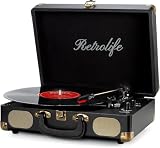
- 【Retrolife INDIVIDUAL SUITCASE RECORD PLAYER】A satisfying combo of modern and vintage elements. Black classic PU leather outlook with retro bronze metal screws and nets, you can take it everywhere with its solid handle. Be ready to create your own music memories
- 【FOUR AVAILABLE CONNECTION CHOICES】Music streaming digital audio via turntable built-in Bluetooth speakers. Hook up external speakers through RCA output or Aux-in line for non-Bluetooth devices like MP3. You can use your headphones to get private listening. Just seize the day with music
- 【THREE-SPEED & THREE-SIZES TURNTABLE】Support 3-Size of 7/10/12″records and 3-Speed of 33/45/78 RMP playing speeds. Belt-driven system matches technical Anti-Resonance design to achieve better sound quality to you
- 【NO EXTRA EQUIPMENT REQUIRED】Set up easily and get started in minutes. Ideal for beginners and vinyl enthusiasts to get your fun time. Suitable for your bedroom/living room/office thanks to the perfect size and premium sound quality
- 【USEFUL KNOBS INCLUDED】An Auto-stop switch that stops spinning once the record playing at the end of the record. Quick mode switch(Bluetooth/Aux-in/Phono) for your simple use. Great to use it when you need relaxation, party and gathering etc
| Period | Documented development | Source |
|---|---|---|
| Early 1960s | Folk-rock emerges as a self-conscious style, drawing musicians from acoustic folk and blues toward rock | Library of Congress |
| Late 1963 to 1964 | The Beatles’ U.S. success opens the door for British groups; “the British Invasion” is coined; the Beatles hold the top five U.S. singles positions in March 1964 | Library of Congress |
| Across the decade | Rhythm and blues, soul, and Motown remain central strands, with Motown cited as a prominent 1960s soul sound | Library of Congress |
| Across the decade | Folk and civil rights and peace repertoire circulates alongside popular styles | Smithsonian Folkways |
| Across the decade | Jazz absorbs bossa nova, raga, and klezmer influences | Smithsonian Music |
| Mid to late 1960s | Rock branches into psychedelic rock, blues-rock, and country-rock, shaped partly by folk-rock; the Beatles’ Sgt. Pepper’s Lonely Hearts Club Band is released in 1967 | Library of Congress |
What the evidence does and does not establish
- The evidence supports describing rock, pop, folk, R&B, soul, Motown, country, and jazz as prominent and varied. It does not support a single ranking of genres for the whole decade.
- The March 1964 chart result is a specific U.S. singles chart moment. It should not be generalized into a claim about any other year or country.
- The sources concentrate on the United States and Anglo-American exchange. They should not be read as describing uniform tastes worldwide.
- No consistent year-by-year sales or radio-play dataset across countries was established in these sources, so claims about which genre led in a given year need to be checked against national chart or industry sales data for that country.
Where to start listening
- Early folk-rock and the folk tradition: Begin with Smithsonian Folkways’ 1960s collection, which gathers Civil Rights Movement songs, original folk recordings, and peace songs.
- Soul and Motown: Listen to “My Cherie Amour” as the Library of Congress example of the Motown sound, then trace soul’s gospel roots through other recordings of the period.
- The British Invasion: Compare the Beatles’ 1964 singles with the rock-and-roll records they were imitating to hear the exchange the Library of Congress describes.
- Late-decade rock: Listen to Sgt. Pepper’s Lonely Hearts Club Band (1967) as an example of how far rock had moved from its early-decade roots.
- Jazz’s cross-cultural turn: Explore recordings that draw on bossa nova, raga, or klezmer to hear the synthesis Smithsonian Music describes.
Taken together, these starting points show that the 1960s had no single sound. The decade’s popular music was a set of connected traditions, and each one changed the others.
Quick Recap
Product prices and availability are accurate as of the date/time indicated and are subject to change. Any price and availability information displayed on Amazon at the time of purchase will apply.
Free tools Windows power users keep installed
One-click scans. No signup required.