The piano’s natural notes are A, B, C, D, E, F, and G, repeating across the keyboard. Find them by using the groups of two and three black keys as landmarks; then connect those same names to notes on the treble and bass staves.
What are the piano notes?
The seven natural note names are A, B, C, D, E, F, and G. After G, the sequence starts again at A in a higher register. On a standard 88-key piano, this pattern spans seven octaves and a minor third; each octave contains seven white keys and five black keys, according to Baylor University Libraries’ Baylor Piano Basics.
The white keys carry the natural note names. Black keys are named in relation to nearby white keys: they can be sharps or flats, depending on the musical context. The physical layout repeats, so learning one section helps you find notes elsewhere on the keyboard.
How to find notes on the keyboard
Use the black keys as visual landmarks. They appear in repeating groups of two and three. Baylor’s keyboard lesson identifies the white-key groups around them: C-D-E around a pair of black keys, and F-G-A-B around a group of three.
What’s actually slowing this PC down?
Pick the symptom - the matching free tool is one click away.
#1 Best Overall

- 61 key keyboard piano kit: complete beginner set with stand, bench, headphones and note stickers.
- Expressive playing: pitch bend wheel and LED panel with 200 rhythms, 200 tones and demo songs.
- Learn faster: Simply Piano lessons and keynote stickers guide kids and adults note by note.
- Quiet practice: headphones keep sessions private in shared rooms and family spaces.
- Everything included: start playing on day one with fewer extra purchases.
- Find a pair of black keys. The white key immediately to its left is C.
- Move right across the next two white keys to find D and E.
- Find a group of three black keys. The white key immediately to its left is F.
- Move right across the next three white keys to find G, A, and B.
- After B, the sequence begins again at C in the next octave.
This layout is the same on a full-size piano and a compact keyboard, though a smaller instrument has fewer octaves. Yamaha’s introductory piano guide also explains the recurring white- and black-key arrangement and the relationship between pressing a key and producing a note.
Middle C and octave numbers
C4 is commonly called middle C. In octave-register terminology, the number changes after B: B4 is followed by C5. On an 88-key piano, C4 is near the center, but a compact keyboard has fewer keys, so key position alone is not a dependable way to identify it. Find the two-black-key group and use the note sequence instead.
Rank #2
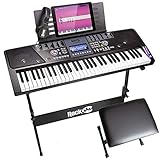
- 61 key keyboard piano kit: complete beginner set with stand, stool, headphones and stickers.
- 100 rhythms and 50 tones: plus teaching functions and demo songs for engaging practice.
- Learn faster: keynote stickers and lesson access guide kids and adults note by note.
- Quiet practice: headphones keep sessions private in shared rooms.
- Everything included: a first piano setup with fewer extra purchases.
On sheet music, middle C is written on a short ledger line below the treble staff or above the bass staff. The University of Puget Sound’s octave-register guide explains this placement and how the two staves relate.
Reading notes on the treble and bass staves
Piano music commonly uses a grand staff: a treble staff above a bass staff, joined together. Each staff has five lines and four spaces. Read the lines and spaces from bottom to top:
Recommended Free Tools
Rank #3

- 【Multifunctional 61 Keys Piano】The 61-key keyboard piano integrates professional-grade features including microphone output, rhythm programming, recording/playback functionality, single-finger/multi-finger chord systems, and dynamic sound effects (sustain, vibrato, echo).6q
- 【Rich Teaching Content】Features 100 demonstration tracks + 100 timbres + 10 rhythms + 8 percussion panels to immerse learners in diverse musical genres. This portable electronic digital piano serves as an advanced musical exploration tool for developing rhythmic awareness and melodic creativity.
- 【Safe And Durable Material】Crafted from premium-grade, eco-friendly ABS material with precision-molded curved surfaces and rounded edges for safe handling. The color-coded interface (61 white keys + red/blue function controls) enhances visual engagement and intuitive operation on this 61 keys piano.
- 【Portable Electronic Digital Piano】Dual power compatibility (adapter/4 AA batteries, not included) supports mobile creativity. Its slim-profile, lightweight design ensures easy transport for studio practice, outdoor performances, or on-the-go rehearsals with this portable electronic digital piano.
- 【Recording And Playback Function】Built-in microphone integration enables real-time performance capture, creating opportunities for self-expression through simulated concert experiences. This 61 key keyboard piano encourages musicians to refine articulation, explore soundscapes, and develop confidence in their creative voice.
| Staff | Lines, bottom to top | Spaces, bottom to top |
|---|---|---|
| Treble | E, G, B, D, F | F, A, C, E |
| Bass | G, B, D, F, A | A, C, E, G |
These note names help you identify written pitches; they do not dictate which hand must play every note. Treble notes are usually associated with the right hand and bass notes with the left, but the clef tells you how to read the staff, while the music itself determines what to play. The Basic Music Course: Keyboard Course covers the grand staff and note-to-key practice.
Sharps, flats, and black-key names
A sharp raises a note by a half step; a flat lowers it by a half step. A single piano key can therefore have two names: C-sharp and D-flat, for example, refer to the same physical key on a piano. Which spelling is appropriate depends on the musical context, so do not assume each black key has only one permanent name. See piano.org’s piano notes chart for an explanation of these alternate spellings.
Rank #4

- UNLIMITED CONNECTION: This true full size 61 key keyboard piano is made of premium material. The LCD display can simply and clearly displays the status of the functions being used. With audio input/output/microphone jack(with UDISK port),you can connect microphone and headphone(included), you will not interfere with others when practicing singing and playing late at night, fully enjoy the music
- TIMBRE AND RHYTHM: JIKADA 61-key electronic music keyboard has two built-in stereo speakers, provide 255 tones, 255 rhythms, 50 demo songs and 61 types of keyboard percussion and give you premium sounds and effects. With status memory function, you can save the tone, rhythm, tempo and other parameters to be changed during playing, for fast shifting
- 3 TEACHING MODES: JIKADA 61 light-up keys keyboard piano with 3 powerful teaching modes, lead you to step by step. And piano note stickers help you more easily to learn and memorize the music theory, musical notations and keys positions
- MULTI FUNCTIONS: This electronic keyboard has master volume/ accom volume/ tempo control, single-finger chords, fingered chords, sustain, vibrato, split, transposition, metronome, volume or transpose control. With record and playback function, and the playback function can also help the performer recall the performance effect and make targeted connections to improve the performance next time
- SUPER BUNDLE: Includes a keyboard (size: 36.4in * 13.4in * 3.5in), a x-shaped stand, a soft stool, headphones, a microphone, a music rest and a power adapter. And the stool can be folded for convenient storage and space-saving. This item is not intended for users under 12 years old
A simple way to practise
- On a piano or keyboard, find every C by locating the white key to the left of each pair of black keys.
- Find each F using the white key immediately left of a group of three black keys.
- Play the neighboring white keys in order and say each note name aloud.
- Use middle C to orient yourself on a printed grand staff, then identify notes on both staves and locate them on the keyboard.
- For a recall check, use note cards: point to a written note, name it, and play the matching key. The keyboard course recommends this kind of note-to-key practice.
A physical piano or keyboard lets you connect the written note to its sound and location. You do not need an 88-key instrument just to learn the repeating note pattern; the keyboard landmarks work across instruments with fewer keys.
Quick Recap
Best Value
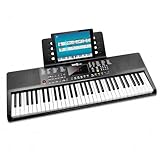
- Compact 61 key keyboard piano: space saving design with full learning features for beginners.
- 200 sounds and 200 rhythms: a wide palette for practice, play-along and creativity.
- Sustain and vibrato effects: plus record and playback to capture and review your progress.
- Learn faster: keynote stickers and Simply Piano lessons included.
- Ready to play: power supply and sheet music stand in the box.
Product prices and availability are accurate as of the date/time indicated and are subject to change. Any price and availability information displayed on Amazon at the time of purchase will apply.




