What’s actually slowing this PC down?
Pick the symptom - the matching free tool is one click away.
Robert Capa used small-format 35 mm cameras, but the surviving records cited here do not point to one model for every assignment. An International Center of Photography caption identifies him with a Contax in China in 1938; the Smithsonian recounts a Leica loan; and a 2026 report describes a Contax II and Rolleiflex among cameras used for his Paris work in August 1944. For D-Day, the Metropolitan Museum of Art’s record identifies Capa’s Omaha Beach print but does not name the camera.
Why the small 35 mm camera mattered to Capa
The International Center of Photography (ICP) connects Capa’s use of a small 35 mm camera with his ability to approach people and work close to communities affected by war. That is a useful explanation of the format’s relevance to his photojournalism: it supported a mobile, close working approach. It does not establish that he used a particular make or model for every photograph.
Model-specific records describe particular moments and assignments. They should be read as evidence of those associations, not as a complete equipment inventory.
Documented cameras, by assignment
| When and where | Camera evidence | What the record establishes |
|---|---|---|
| China, April 1938 | 35 mm Contax | An ICP exhibition image caption identifies Capa holding a Contax in Tai’erzhuang. It documents that setting, not his camera use throughout his career. |
| Loan described by the Smithsonian | Leica 35 mm camera | The Smithsonian’s Photographic History Collection says a director lent Capa a Leica. The account does not identify the precise model or establish it as his sole camera. |
| Paris, August 1944 | Contax II and Rolleiflex | A 2026 Le Monde report about an exhibition at the Musée de la Libération describes contact sheets from 24 rolls shot with these cameras for Capa’s Paris work. The association is specific to that assignment. |
The accounts are not contradictory: they associate Capa with different cameras in different contexts. The Paris report also shows why his tools should not be reduced to a single 35 mm model; it names a Rolleiflex alongside a Contax II.
Windows Errors? Fix Them Before They Spread
Repair common Windows errors and clear accumulated junk for a smoother, more stable PC - no reinstall needed.Free scan · no reinstallCrashes, No Sound, or Screen Glitches?
Random freezes, missing sound and display glitches usually trace back to one bad driver. Find and replace yours safely.Free scan · under a minute#1 Best Overall

- Classic Design: Experience the timeless appeal of this Black Canon EOS REBEL X S, a 35mm film SLR camera that combines vintage charm with robust functionality
- Manual Control: Enjoy complete creative freedom with manual focus, exposure control, and aperture modes, allowing you to capture images exactly as you envision
- Versatile Lens: Equipped with a 35-80mm zoom lens, this camera offers a range of focal lengths to suit various shooting scenarios
- Full Frame Photography: Capture stunning, high-quality images with the camera's full frame (35mm) photo sensor, perfect for professional and enthusiast photographers
- Unisex Appeal: This camera is designed to appeal to a wide range of users, making it an excellent choice for both men and women
What camera did Capa use on D-Day?
The Metropolitan Museum of Art catalogs Capa’s Omaha Beach photograph as a 1944 gelatin silver print. Its collection entry supports the work’s attribution, subject, date and photographic medium, but does not identify the camera used for the image. It is therefore not evidence for assigning a particular Contax, Leica or other model to that frame.
ICP’s broader account can explain why a small 35 mm camera suited Capa’s close, mobile approach, but it cannot fill the gap in the Met’s image-specific record. A precise D-Day camera claim requires a source that links a named camera to the particular photograph or its negative.
Rank #2
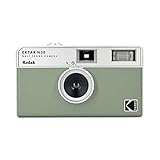
- 📷 Film-saving: You can have twice as many images per roll. For example, a film roll with 36 exposures can yield around 72 half-frame photos - doubled!
- 📷 Lightweight and Easy-to-use: The pocket-size camera is light and tiny, and hence convenient for you to bring along daily. Since its instructions are simple, it is suitable for all analog hobbyists.
- 📷 Built-in Flash: Turning on the flash by adjusting the silver ring around the lens so that you can use KODAK EKTAR H35 during days and nights, outdoor and indoor.
- 📷 Perfect for Beginners: The point-and-shoot camera is easy to use for new analogue hobbyists.
- 📷 Five colors: Off-white, black, brown, sage and sand. Neat and natural.
How to read the camera records
- Separate the evidence by assignment. A caption showing a Contax in China, an account of a Leica loan, and Paris contact-sheet reporting describe separate associations.
- Do not infer a camera from the print medium. “Gelatin silver print” describes the print process, not the camera model that exposed the negative.
- Distinguish broad working style from exact equipment. ICP supports the significance of Capa’s small 35 mm camera; it does not identify the camera behind every famous image.
For a first-person account of Capa’s wartime experience, his memoir Slightly Out of Focus is relevant further reading. The ICP exhibition biography links the title to a caption for a D-Day photograph published in Life on June 19, 1944.
Quick Recap
Best Value
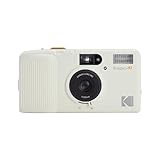
- 3-Element Glass Lens - Create photo images with sharpness and details
- 2-Zone Focus - Eff ortlessly switch between two focuses for optimal shots in any environment
- Built-in Auto Flash - Users can select auto flash function with red-eye reduction
- Multiple Exposure - Capture layered images, blending two di erent scenes on a single photo
Rank #4

- Shutter Speed: The AE-1 offers a range of shutter speeds from 1/1000 to 2 seconds, along with a Bulb mode for long exposures, allowing for creative control over your shots.
- TTL Metering: Its built-in Through-The-Lens (TTL) metering system ensures accurate exposure readings, helping you capture the perfect shot in various lighting conditions.
- Interchangeable Lenses: Compatible with Canon FD lenses, the AE-1 opens up a world of photographic possibilities, from wide-angle to telephoto.
- Auto and Manual Modes: With both automatic and manual exposure settings, photographers can easily switch between point-and-shoot convenience and hands-on control.
- Durable Design: The camera features a robust metal body and a sleek, classic aesthetic, making it not only functional but also a stylish accessory.
Rank #3
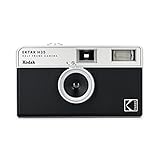
- 📷 Film-saving: You can have twice as many images per roll. For example, a film roll with 36 exposures can yield around 72 half-frame photos - doubled!
- 📷 Lightweight and Easy-to-use: The pocket-size camera is light and tiny, and hence convenient for you to bring along daily. Since its instructions are simple, it is suitable for all analog hobbyists.
- 📷 Built-in Flash: Turning on the flash by adjusting the silver ring around the lens so that you can use KODAK EKTAR H35 during days and nights, outdoor and indoor.
- 📷 Four colours: Black, brown, sage and sand. Neat and natural.
- 📷 Perfect for Beginners: The point-and-shoot camera is easy to use for new analogue hobbyists.
Product prices and availability are accurate as of the date/time indicated and are subject to change. Any price and availability information displayed on Amazon at the time of purchase will apply.




