The Tool Desk
Outbyte PC Repair FREEClear out junk files and repair common Windows errorsFree Scan →Outbyte Driver Updater FREEScan for outdated or missing drivers - takes under a minuteDriver Scan →In the 1950s, a home television received a broadcast through an antenna, tuned to a channel, and used a cathode-ray tube (CRT) to turn the signal into a picture. Most sets showed black and white. Color broadcasting and compatible color receivers arrived around 1953–54, but black-and-white viewing remained common.
How did a 1950s television make a picture?
A television was a receiver, not a screen that stored or projected a finished image. A station sent a broadcast; an antenna brought it into the home set, which selected a channel and reproduced the picture on its CRT. The precise electronics varied by model, so this high-level description should not be mistaken for a circuit diagram.
The CRT was the defining display technology of the period. In a black-and-white set, it produced a monochrome picture. The receiver had to be built for the broadcast system it was meant to receive: standards discussions covered picture brightness and contrast, the number of lines, frame rate, and sound. Transmitters and receivers needed compatible standards for a set to display a broadcast correctly. The Smithsonian’s overview of broadcasting and the National Archives’ account of the FCC’s color-television decisions describe that wider context.
Why did reception vary from one home to another?
Reception depended in part on the antenna, the signal reaching it, and the receiver’s sensitivity. The SFO Museum’s collection includes a 1950s double-bowtie antenna and notes that limited station transmitter power and poor receiver sensitivity could make reception difficult. Its antenna exhibit illustrates why installing or adjusting an antenna mattered, even though it does not provide a circuit-by-circuit account of a television.
#1 Best Overall
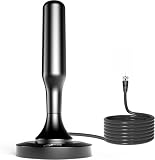
- 𝗡𝗲𝘃𝗲𝗿 𝗣𝗮𝘆 𝗠𝗼𝗻𝘁𝗵𝗹𝘆 𝗕𝗶𝗹𝗹: Watching local channels with this HD digital tv antenna for smart tv indoor 4K, you can watch crystal HDTV channels without cable service and enjoy local tv channels.
- 𝗜𝗻𝗱𝘂𝘀𝘁𝗿𝘆 𝗟𝗲𝗮𝗱𝗶𝗻𝗴 𝗧𝗲𝗰𝗵𝗻𝗼𝗹𝗼𝗴𝘆: This digital indoor tv antenna for local channels is made of eco-friendly flame-retardant dual PC soft material (not ordinary PVC), providing moisture resistance and lightning protection for indoor use.
- 𝗢𝗺𝗶𝗻𝗶-𝗱𝗶𝗿𝗲𝗰𝘁𝗶𝗼𝗻𝗮𝗹 𝗥𝗲𝗰𝗲𝗽𝘁𝗶𝗼𝗻 & 𝗠𝗮𝗴𝗻𝗲𝘁𝗶𝗰 𝗕𝗮𝘀𝗲: The indoor HDTV antenna brings omini-directional Reception; Whether hd digital tv antenna indoor is installed on the TV stand or on the table, you can receive the crystal clear picture
- 𝗖𝗼𝗺𝗽𝗮𝗰𝘁 𝗮𝗻𝗱 𝘀𝗺𝗮𝗹𝗹 𝗗𝗲𝘀𝗶𝗴𝗻: The indoor antenna for tv without cable features a compact and slim design, making it easy to hide without taking up space. The lightweight build allows you to move it conveniently and adapt to different living environments effortlessly.
- 𝗡𝗼𝘁𝗲 𝗮𝗻𝗱 𝗖𝘂𝘀𝘁𝗼𝗺𝗲𝗿 𝗦𝗲𝗿𝘃𝗶𝗰𝗲 : Read the manual first, set up your TV properly, and scan for channels. 𝐅𝐨𝐫 𝐨𝐩𝐭𝐢𝐦𝐚𝐥 𝐫𝐞𝐜𝐞𝐩𝐭𝐢𝐨𝐧, 𝐭𝐞𝐬𝐭 𝐛𝐨𝐭𝐡 𝐯𝐞𝐫𝐭𝐢𝐜𝐚𝐥 𝐚𝐧𝐝 𝐡𝐨𝐫𝐢𝐳𝐨𝐧𝐭𝐚𝐥 𝐩𝐥𝐚𝐜𝐞𝐦𝐞𝐧𝐭. Mount the antenna high, near a window facing local broadcast towers (Check "dtv gov maps" for available channels), to avoid obstacles and interference. Actual Reception depends on location, terrain, and weather, always re-scan for channels after moving the antenna. If you have any issues, please contact us. We will provide professional service and a satisfactory solution for you.
What did television sets look like in the home?
Sets ranged from tabletop receivers to large consoles designed as living-room furniture. Some consoles combined television with other entertainment equipment. The Smithsonian’s DuMont Revere, Model 101, for example, was a 1947 set—not a 1950s introduction—with an AM-FM-shortwave radio receiver, high-fidelity amplifier, and record changer. It shows how a television could be part of a broader home entertainment system. The Smithsonian collection record describes the receiver.
Television’s rapid postwar spread helps explain its growing place in the home. The Museum of the Moving Image reports that 10,000 U.S. homes had a television in 1946 and one million in 1948. Those figures predate the 1950s; they are evidence of the expansion leading into the decade, not a count of 1950s ownership. The museum’s receiver overview also describes television’s emergence as a centerpiece of domestic life.
Rank #2

- Enjoy More Tv antenna for Local Channels: Get more channels by antenna for smart TV, receive local broadcasting, ABC, CBS, NBC, CPS, FOX, CW, ION, UMAS, etc.
- HD Antenna for TV: Our digital TV antenna indoor adopts an upgraded Smart IC Chip, receives TV broadcasts including 4K, UHD and 1080 HDTV for the hd picture.
- 16FT Coax Cable: Coaxial cable is composed of a solid center conductor, dielectric insulation, three aluminum shielding layers, and a durable outer layer. so that you will never lose signal or suffer distortion even in bad weather.
- Compatibility and Usage Tips: Not suitable for older analog televisions; supports smart TVs and digital TVs. For optimal signal reception, try placing the antenna near a window or in other locations, and test both vertical and horizontal orientations.
- Easy to Install: Plug the coaxial cable from your digital indoor HDTV antenna into the ANT/IN connector on the back of your TV, point the TV antenna toward your local TV tower and scan for channels. (Check "dtv gov maps" for available channels).
How did color television work in the 1950s?
Color television had to solve two problems at once: how to transmit color and how to make the system work alongside the black-and-white sets already in use. In 1950, the FCC selected CBS’s field-sequential color system, which was not compatible with existing monochrome receivers. The standards dispute was about more than color itself; regulators also weighed picture characteristics, line count, frame rate, sound, and whether transmitters and receivers could operate together.
In December 1953, the FCC accepted a compatible all-electronic color system. The Smithsonian says color broadcasts began in January 1954. The Museum of the Moving Image identifies RCA’s CT-100, available in 1954, as the first mass-produced color television set. The Smithsonian’s account of early color television and the Museum of the Moving Image’s receiver history document these milestones.
Rank #3
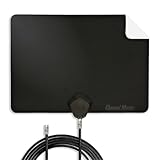
- Clear Reception with Realistic Range: The FLATenna captures HD and digital signals with a 35-mile range, designed to accommodate real-world factors such as obstructions and interference, making it suitable for urban and suburban environments.
- Access to Free Local Channels: Provides access to local networks such as ABC, CBS, FOX, NBC, PBS, Univision, and Telemundo without requiring a subscription.
- Practical and Flexible Design: Features an ultra-thin, lightweight, and reversible black-and-white design for easy integration into various home setups, with multiple mounting options for walls, windows, or tabletops.
- Future-Ready Compatibility: Supports ATSC 3.0 NextGen TV and 4K broadcasts, and includes a 12' professional-grade RG6 coaxial cable with enhanced shielding for improved signal reliability.
- Established Manufacturer: Developed by Channel Master, a long-standing provider of TV antenna technology since 1949, designed for reliable over-the-air TV reception.
Color broadcasts did not mean every living room had a color picture. Many households continued watching on black-and-white receivers, while color hardware was expensive and color viewing took years to become commonplace. The decade’s television experience was therefore mostly monochrome, even as compatible color broadcasting and sets began to appear.
Quick Recap
Product prices and availability are accurate as of the date/time indicated and are subject to change. Any price and availability information displayed on Amazon at the time of purchase will apply.




