Recommended Free Tools
Wonder Woman’s costume has never been one unchanging uniform. Since her 1941 comic debut, the tiara, bold red-and-blue palette, bracelets and lasso have provided familiar touchstones, while the cut, coverage and meaning of her outfit have shifted with each era and medium. The history runs from a wartime-inspired comic design through a mod-era reinvention and Lynda Carter’s television image to contemporary comic redesigns and warrior armor on film.
1941: a wartime-inspired comic debut
Wonder Woman first appeared in a backup story in All-Star Comics #8 in October 1941. DC says her costume drew inspiration from the flag of a downed American pilot. HISTORY describes the early look as a golden tiara, red bustier, knee-high boots and star-spangled skirt. Across early stories and covers, details could vary, but the combination of flag colors and stars with the tiara, bracelets and lasso made Diana recognizable as both an American wartime heroine and an Amazon with a mythic identity. DC’s anniversary retrospective and HISTORY’s account trace those origins.
The original comic introduced her with the line, “At last, in a world torn by the hatreds and wars of men, appears a woman to whom the problems and feats of men are mere child’s play,” as reproduced by HISTORY. The costume’s visual language was patriotic, but its Amazon story gave it a frame beyond national symbolism.
1940s–1960s: a changing look, not a fixed uniform
Across the next decades, the costume’s styling and hemline shifted rather than settling into one definitive version. A TIME illustrated chronology shows how the design changed alongside the character and the conventions of superhero comics. The Smithsonian’s catalog record for Wonder Woman No. 159, published in January 1966, documents a deliberate return to her Golden Age origins—a reminder that creators were revisiting earlier versions well before later reboots.
#1 Best Overall

- Featuring heroic figures: 2.5” scale Amy as Wonder Woman and 5” scale Wonder Woman for play and display
- Amy as Wonder Woman has 5 points of articulation and Wonder Woman has 21 points of articulation for ultimate poseability
- Quintessential pairing of 2 heroic characters
- The perfect gift for fans of DC and Sonic the Hedgehog, plus the hit crossover comic book series!
- Suggested for ages 3 years and up
1968–early 1970s: Diana’s mod-era reinvention
In 1968, Diana underwent a substantial change in character as well as clothing: she relinquished her powers and superhero identity for a period and adopted contemporary fashions, including pants. TIME describes this version as spy-like. It was not simply a new variation on the familiar costume; the change shifted the genre and presentation of her stories, temporarily setting aside the star-spangled superhero image.
1972–1979: a classic image returns on the page and screen
The 1972 revival
In 1972, Gloria Steinem put Wonder Woman on the cover of the first issue of Ms. magazine, helping revive the classic heroine image. This return to familiar iconography came after the mod-era departure, not as the restoration of a design that had remained untouched throughout the intervening years.
Rank #2

- Incredibly detailed 7” scale figure based off the DC Multiverse
- Designed with Ultra Articulation with up to 22 moving parts for full range of posing and play
- Wonder Woman is featured in a brand new design from the mind of Todd McFarlane
- Comes with a sword, shield and a base
- Included collectable art card with Wonder Woman figure photography on the front, and character biography on the back
Lynda Carter’s television costume
Lynda Carter’s television series ran from 1975 to 1979 and made a live-action, star-spangled Wonder Woman a defining image for generations. The show carried over recognizable elements such as the bracelets and lasso, but its costume was an adaptation for television, not a replacement for comic continuity. It also used situation-specific variants, including a star-spangled wetsuit, as noted in DC’s costume retrospective.
1987: a more mythic Amazon in comics
Writer George Pérez’s 1987 reboot placed renewed emphasis on Diana’s Amazon origins and presented her with a more muscular physique, according to TIME. For the costume’s history, the important shift is in character framing: the comic leaned into the mythic warrior identity rather than treating the familiar patriotic markers as the whole story. This was a comics-era direction, not a single redesign imposed across television and other media.
Rank #3
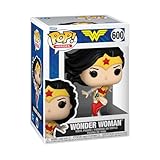
- IDEAL COLLECTIBLE SIZE - At approximately 3.75 inches (9.5 cm) tall, this vinyl figurine complements other collectable merchandise and fits perfectly in your display case or on your desk.
- PREMIUM VINYL MATERIAL - Made from durable vinyl, this collectible is built to last and withstand daily wear, ensuring long-lasting enjoyment for fans and collectors alike.
- GIFT IDEA FOR DC COMICS FANS - Ideal for holidays, birthdays, or special occasions and as a present this figurine is a must-have addition to any DC Comics merchandise collection
- EXPAND YOUR COLLECTION - Add this unique Wonder Woman vinyl display piece to your growing assortment of Funko Pop! figures, and seek out other rare and exclusive collectible items for a complete set
- LEADING POP CULTURE BRAND - Trust in the expertise of Funko, the premier creator of pop culture merchandise that includes vinyl figures, action toys, plush, apparel, board games, and more.
1990s: experimentation in the comics
In the 1990s, Diana’s appearance changed again amid high-concept comic-book storylines. DC’s retrospective highlights a look with biker shorts and a belt during the period when she lost the Wonder Woman title to Artemis. TIME’s chronology also notes the era’s more sexualized superhero-comic styling. These are distinct parts of a varied decade, not one uniform 1990s costume.
2010: a dramatic redesign around Wonder Woman #600
Around Wonder Woman #600, writer J. Michael Straczynski and artist Jim Lee introduced a striking new direction: a blue bomber jacket, a more covered top and dark leggings. DC’s account presents the design as an attempt to imagine what Diana might wear if she were designed for a contemporary audience. It was a major redesign, but it was not her first significant costume change since 1941; the mod-era reinvention and earlier comic variations had already altered her look.
Rank #4

- COMICS-INSPIRED SQUADRON SUPREME POWER PRINCESS: This collectible Squadron Supreme Power Princess action figure is inspired by the character's appearance in Marvel's Avengers comic books
- PREMIUM DESIGN AND DECO: Fans and collectors can display premium Marvel 6 inch action figures (15 cm) with comics-inspired design and deco in their collection
- MARVEL COMICS-INSPIRED ACCESSORIES: This officially licensed Hasbro Marvel Legends action figure comes with 4 accessories, including alternate hands, sword, and shield
- INCLUDES BUILD-A-FIGURE PARTS (MARVEL'S THE VOID): Comes with 2 Build-A-Figure leg pieces. Collect other Marvel Legends figures to assemble additional figure of Marvel's The Void (Additional figures each sold separately. Subject to availability.)
- DISPLAY-WORTHY ARTICULATION: Collectible action figure features over 20 points of articulation with fully poseable head, arms, and legs for dynamic poses on your shelf
2011 onward: the New 52 moves closer to classic markers
For the New 52 relaunch, Jim Lee drafted a new design that DC says hewed closer to the classic look than the jacket-and-leggings version associated with the #600 era. The shift illustrates how comic redesigns can revisit established visual cues after experimenting with a different silhouette. Each direction belongs to its own publication moment rather than erasing what came before.
Independent reader supportYour contribution helps us test, update, and keep practical guides available for everyone.2016–2020: the films emphasize a warrior silhouette
The 2016 and 2017 appearances
Gal Gadot first appeared as Wonder Woman in Batman v Superman: Dawn of Justice in 2016, followed by the 2017 solo film. The movie costume presented Diana in a more armored, warrior-oriented style than the familiar television interpretation. Wonder Woman writer Greg Rucka praised its movement in a 2016 TIME interview: “I like the costume for the movie because Gal can actually run and jump and kick in that.” That is Rucka’s assessment of the design, not a measured mobility test.
Best Value

- Wonder Woman is based on her look from the Wonder Woman #1 comic
- Incredibly detailed 7” scale figure, designed with Ultra Articulation with up to 22 moving parts for full range of posing and play
- Accessories include 4 extra hands and base
- Also includes English-only reprint Wonder Woman #1 comic book
- Included collectible art card with character art on the front, and character biography on the back
The Golden Eagle armor
Wonder Woman 1984 (2020) added gold-plated, winged Golden Eagle armor. DC connects it to the Golden Eagle armor from Kingdom Come, describing that comic design as a likely inspiration rather than a confirmed design credit. The screen armor extends the films’ warrior styling while drawing on a recognizable comics reference.
What changes—and what keeps Wonder Woman recognizable?
Across comics, television and film, the costume’s story is less a straight line of replacements than a series of adaptations and returns. The period and medium help explain what a version emphasizes:
- Silhouette and coverage: the star-spangled skirt, mod-era pants, biker shorts, dark leggings and film armor each frame Diana differently.
- Recurring iconography: the tiara, red-and-blue palette, stars, bracelets and lasso provide recognizable links across many versions, even when individual details change.
- Character framing: the early patriotic wartime imagery, the mod-era spy presentation, Pérez’s Amazon emphasis and the films’ warrior styling reflect different creative directions.
- Medium and purpose: comic continuity, a television adaptation and a film costume can coexist as separate interpretations. Screen versions may also include practical, plot-specific variants.
DC’s costume retrospective, TIME’s visual history, and the Smithsonian’s catalog record for Wonder Woman No. 159 document milestones rather than every issue-by-issue variation. Together, they show why it is misleading to describe the costume as unchanged from 1941 until a single modern redesign.
Quick Recap
Product prices and availability are accurate as of the date/time indicated and are subject to change. Any price and availability information displayed on Amazon at the time of purchase will apply.
Quick wins for a faster PC:
Repair Windows errors before they cause bigger problemsFix Now →Scan for outdated or missing drivers - takes under a minuteDriver Scan →Clear out junk files and repair common Windows errorsFree Scan →



