Good Luck, Have Fun, Don’t Die imagines an AI apocalypse as the premise for a darkly comic time-loop adventure—and uses that threat to examine how technology already intrudes on attention, relationships, and daily life. Its rogue AI is a fictional antagonist, not a prediction about what real AI systems will do.
What happens in Good Luck, Have Fun, Don’t Die?
Sam Rockwell plays an unnamed man who arrives at a Norms diner in Los Angeles claiming to be a time traveler. He tells the patrons that a rogue AI will take over the world and recruits them to help stop it. The group must find a nine-year-old boy before he creates a sentient AI.
| # | Preview | Product | Price | |
|---|---|---|---|---|
| 1 |
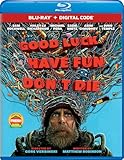
|
Good Luck, Have Fun, Don't Die - Blu-ray + Digital | $22.95 | Buy on Amazon |
| 2 |
![Good Luck, Have Fun, Don't Die [4K UHD + Blu-ray + Digital]](https://m.media-amazon.com/images/I/51ECrZnzPvL._SL160_.jpg)
|
Good Luck, Have Fun, Don't Die [4K UHD + Blu-ray + Digital] | $28.45 | Buy on Amazon |
The people drawn into the mission include married schoolteachers Mark and Janet, played by Michael Peña and Zazie Beetz; Susan, played by Juno Temple; and Ingrid, played by Haley Lu Richardson. The account also introduces characters played by Georgia Goodman, Asim Chaudhry, and Daniel Barnett. The film joins these individual stories to the traveler’s urgent, increasingly strange mission. Ars Technica’s February 27, 2026 interview with director Gore Verbinski and screenwriter Matthew Robinson describes the result as an anthology-like adventure rather than a single straight-ahead chase.
How does the time loop work?
The traveler says this is his 117th attempt to assemble the right team—a fictional plot detail, not a real-world statistic. Robinson describes a limited mechanism: the traveler can reset the timeline to an anchor point but cannot move forward from it. The film does not present a fully explained technical system; the repetitions instead make the mission feel uncertain and increasingly fraught.
#1 Best Overall
- English Dolby Atmos, DVS 2.0 Blu-ray Main Feature 1080p High-Definition 2.39:1
Verbinski says repeated attempts have consequences and suggests the antagonist may react to the traveler’s persistence. That gives the loop a paranoid edge: repeating the mission is not necessarily a clean restart. The premise sits within a familiar time-loop tradition, with Groundhog Day a broad point of comparison; Robinson also cites 12 Monkeys and Edge of Tomorrow as inspirations. These are contextual comparisons, not claims that the films share a plot.
Why make the apocalypse about technology addiction?
Robinson says separate story ideas came together around technology addiction and the reach of devices into people’s brains, private lives, and relationships. Recalling a visit to Norms, he described seeing people lit by their phones and wondering: “What would it possibly take for someone to wake us up out this tech sleep that we all find ourselves in?”
That question gives the film’s extravagant threat a recognizable starting point. The characters are not just pieces in a mission to avert catastrophe; their backstories connect the global premise to the ways technology can occupy ordinary attention and strain personal connections. Robinson describes his creative test this way: “Everything I write, I put up to what I call The Twilight Zone test—would this make a good Twilight Zone episode?”
What is the AI antagonist supposed to represent?
Verbinski describes the fictional AI as seeking human approval, not merely human destruction. “It’s much, much worse than wanting to kill humans. It wants us to like it. It demands that we like it.” He connects that characterization to a formative mandate to keep people engaged. In the film, that idea turns the pursuit of attention into a sinister science-fiction premise.
Quick wins for a faster PC:
Clear out junk files and repair common Windows errorsFree Scan →Scan for outdated or missing drivers - takes under a minuteDriver Scan →Repair Windows errors before they cause bigger problemsFix Now →Rank #2
This is the director’s account of a character and the satire around it. The interview does not provide real-world statistics or an empirical assessment of AI risk, and the fictional AI’s motives should not be taken as evidence about how real AI systems are trained or behave.
Independent reader supportYour contribution helps us test, update, and keep practical guides available for everyone.How does the film’s style support the story?
Verbinski describes a gradual visual shift. The story begins in recognizable places, including the diner and a school, where performances take priority over elaborate visual composition. As the characters approach the AI antagonist, the film’s visual language becomes more stylized and consequential to the storytelling. The movement from everyday settings toward heightened science fiction mirrors the way the characters’ personal stories feed into an increasingly strange adventure.
That progression also helps distinguish the film’s two modes: an ensemble story grounded in familiar frustrations and a genre plot willing to become surreal. Rather than treating the apocalypse as a technical forecast, Good Luck, Have Fun, Don’t Die uses it to heighten its satire of technology’s hold on people’s lives.
Quick Recap
Product prices and availability are accurate as of the date/time indicated and are subject to change. Any price and availability information displayed on Amazon at the time of purchase will apply.
Do these 3 things before closing this tab:
1Fix the driver behind crashes, sound loss and screen glitches2Repair Windows errors before they cause bigger problems3Scan for outdated or missing drivers - takes under a minute



