Recommended Free Tools
Thirteen Hellenic Armed Forces Marines wore a replica of the Dendra panoply through an 11-hour simulated combat protocol. They completed it, leading the researchers to conclude that the armor could be used for extended fighting by fit people under the conditions tested. The experiment shows physical feasibility—not how often ancient warriors wore this armor or what a real Bronze Age battle looked like.
What armor did the Marines test?
The artifact behind the experiment is the Dendra panoply, a bronze full-body suit found in 1960 in a tomb near Dendra in southern Greece, a few kilometers from ancient Mycenae. The study describes it as about 3,500 years old and among the oldest complete suits of European Bronze Age armor. Because the original metal is too fragile for experimental use, the researchers tested a replica instead. The peer-reviewed study revisited a long-standing question: was this distinctive armor practical equipment, or mainly ceremonial? Earlier replica work had indicated that it allowed movement, but its suitability for prolonged combat was unresolved.
| # | Preview | Product | Price | |
|---|---|---|---|---|
| 1 |
|
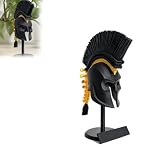
Agamemnon Helmet Mini Replica Compatible with The Odyssey Film Desk Decor | Buy on Amazon |
How did the 11-hour test work?
The researchers combined historical analysis, a human experiment, and numerical modeling. No detailed Late Bronze Age Greek account survives that explains the scope and use of this kind of armor, so the team used the Iliad and scholarly literature to construct a hypothetical sequence of combat activities. They analyzed themes in the epic and used that reconstruction to shape the protocol.
The Iliad is a layered literary work, not a straightforward contemporary record of Late Bronze Age warfare. The researchers acknowledged that its material comes from different periods and that some descriptions of weapons, armor, and tactics are problematic. Their protocol was therefore a reasoned reconstruction, not a surviving ancient drill or battle manual.
#1 Best Overall
- MOVIE-ACCURATE AGAMEMNON HELMET REPLICA: Inspired by the imposing black helmet worn by King Agamemnon in 2026 film The Odyssey
- ICONIC DESIGN WITH GOLD VERTEBRAE DETAIL: Features the signature black armor finish with a golden detail trailing from the back of the helmet, resembling vertebrae
- PERFECT DESKTOP DISPLAY PIECE: Compact mini size makes it ideal for display on office desks, bookshelves, gaming setups, or home theaters
- GREAT GIFT FOR FANS AND COLLECTORS: A must-have for enthusiasts, film memorabilia collectors, and Greek mythology fans who appreciate cinematic design
- IMPORTANT NOTE: This product is a third-party accessory inspired by the film. Our products are not affiliated with, endorsed, or sponsored by the film studio.
Data collection took place in 2019. Thirteen male Marines from the Hellenic Armed Forces volunteered; the study reports a mean age of 29.2 ± 7.9 years, mean height of 1.73 ± 0.05 metres, and mean body mass of 74.1 ± 6.8 kilograms. Those figures describe this small volunteer group, which was selected to resemble the age and physical characteristics attributed to elite warriors in the Iliad; they are not estimates of ancient warriors’ typical build.
Wearing the replica and carrying replica Late Bronze Age weapons, participants completed the 11-hour protocol in controlled conditions designed to approximate estimated summer battlefield conditions. The research team assessed physical strain and fighting movement. The University of Birmingham’s account of the study says measurements included heart rate, oxygen consumption, core temperature, fluid loss, and muscular function. Numerical models extended the thermal analysis across different environmental conditions and levels of fighting intensity.
What did the Marines’ test show?
The participants completed the protocol. The authors interpreted the results as evidence that the replica allowed extensive movement without intolerable physiological strain, and concluded that the Dendra armor was suitable for extended battle use by fit individuals under the studied conditions. Professor Andreas Flouris of the University of Thessaly summarized the finding in the University of Birmingham release: “We found that the armour allowed full flexibility of movement and did not exert excessive physiological stress on the body.”
The figure often highlighted alongside the test is a summer temperature range of 30–36°C, described by Flouris in the 2024 release. It gives context for the conditions discussed publicly, but should not be mistaken for a universal temperature at which the armor was tested or a finding about all battlefield environments.
What the experiment can—and cannot—tell us
The result is strongest as evidence of modern physical feasibility: a fit group of volunteers could carry out a demanding, reconstructed protocol in a replica. It is indirect evidence about ancient use. The experiment cannot establish how widespread the original suit’s use was, who wore it, how it performed against Bronze Age weapons, or how an actual battle unfolded. Nor does it prove that the Iliad is a literal account of Bronze Age combat.
That distinction matters because the evidence comes from several stages. The human experiment directly measured what these volunteers could do in the replica under controlled conditions. The historical reconstruction determined what activities they performed, and depends partly on how the Iliad and other scholarship are interpreted. Numerical simulation explored thermal exchanges under modeled conditions; it does not substitute for testing the original artifact or recreating a battlefield. The original suit itself could not be worn for the study because of its fragility.
The study’s public peer-review record shows that the Iliad’s mixed chronology and potentially mismatched descriptions were matters reviewers raised. The final paper addresses the issue by explaining how the researchers supplemented textual analysis with scholarly literature. The published peer-review history offers readers a view of that exchange.
Dr Ken Wardle, a classicist at the University of Birmingham, said the findings suggest descriptions of bronze armor in the Iliad may not simply be later interpolations or poetic license. That is the researchers’ historical interpretation, not an independent consensus or proof that every epic detail reflects Bronze Age practice.
Quick wins for a faster PC:
Scan for outdated or missing drivers - takes under a minuteDriver Scan →Clear out junk files and repair common Windows errorsFree Scan →Fix the driver behind crashes, sound loss and screen glitchesFind Drivers →Quick Recap
Product prices and availability are accurate as of the date/time indicated and are subject to change. Any price and availability information displayed on Amazon at the time of purchase will apply.




