It Came from Outer Space is Jack Arnold’s 1953 science-fiction film about an Arizona astronomer who witnesses a spacecraft crash—and a town unsettled by visitors taking human form. AFI identifies it as Universal’s first 3-D film. Here’s what the story involves, why the film mattered to its original exhibition, and what current format listings do—and do not—tell you about watching it today.
What is It Came from Outer Space about?
Amateur astronomer John Putnam and schoolteacher Ellen Fields witness a glowing object crash near Sand Rock, Arizona. Putnam sees a one-eyed alien before a landslide buries the spacecraft. The visitors later assume human forms and hold people, including Ellen, while trying to repair their ship. The resulting conflict turns on the town’s suspicion of the strangers and whether communication can replace fear.
Who made the film, and when was it released?
Jack Arnold directed, William Alland produced, and Harry Essex and Ray Bradbury are credited as writers. Universal-International Pictures Co., Inc. is listed as the production company. The film’s working title was The Strangers from Outer Space, according to the AFI Catalog.
Release records distinguish several dates: AFI lists a Los Angeles world premiere on May 27, 1953, a New York opening on June 17, and a general release in July 1953. The film is cataloged as science fiction and runs 80 minutes in AFI’s record. AFI Catalog
#1 Best Overall
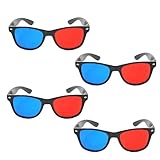
- 👓CLASSIC 3D VIEWING: Red and blue anaglyph glasses designed for watching 3D movies, playing 3D games, and viewing 3D images on compatible screens and media
- 👓COMPLETE SET: Package includes 3D glasses in black, perfect for family movie nights, gaming sessions, or sharing with friends for an immersive viewing experience
- 👓LIGHTWEIGHT DESIGN: Simple and light construction ensures comfortable wear during extended viewing sessions without causing pressure or discomfort on the nose and ears
- 👓UNIVERSAL COMPATIBILITY: Works with red-blue 3D content including classic 3D movies, video games, comic books, magazines, and online 3D videos
- 👓CONVENIENT ACCESSORY: Compact and portable design makes these glasses easy to store and carry, ideal for home entertainment or on-the-go 3D viewing
Why is its 3-D history notable?
AFI identifies It Came from Outer Space as Universal’s first 3-D film. Its catalog records black-and-white photography, a 1.85:1 aspect ratio, and 3-D presentation. AFI also notes that contemporary press coverage discussed combining 3-D with a large screen and stereoscopic sound; that is a record of the period’s coverage, not a claim about how the film compares technically with present-day formats.
The original exhibition format should not be confused with later home-video format names. A listing for a 4K edition alone does not establish that it presents the film stereoscopically in 3-D.
Rank #2

- These 3D glasses for movies at home are crafted from premium paper material, ensuring durability while providing comfort for long viewing sessions.
- These anaglyph 3D glasses are designed to comfortably fit smaller and larger head sizes. Equipped with red and cyan filters, they are ideal for various red-left or red-right relief images.
- The lightweight and foldable design of these red-blue 3D glasses makes them easy to carry around, perfect for enjoying 3D movies wherever you go. However, please note that they are not suitable for use as sunglasses.
- These red-blue 3D glasses are universally compatible with various 3D content, including movies, TV shows, and broadcasts, providing an immersive viewing experience at home.
- The package includes 5 pcs 3D viewer paper glasses. Each pair is lightweight, foldable, and measures approximately 5.7 x 5.12 x 1.5 inches, making them convenient to store and carry.
Which home-video formats are listed?
Universal Pictures At Home lists digital and physical formats including 4K Ultra HD + Blu-ray + Digital, a limited-edition Steelbook, and DVD. The listings establish the formats the studio currently presents, not retailer stock, the contents of every retailer’s package, or stereoscopic 3-D playback for the 4K edition. Check the specific edition’s packaging and specifications if 3-D is essential to your purchase.
| Choice | What the official listing establishes | What to verify |
|---|---|---|
| 4K Ultra HD + Blu-ray + Digital | Universal lists this physical format combination. | The listing reviewed does not establish stereoscopic 3-D presentation. |
| Limited-edition Steelbook | Universal lists a limited-edition Steelbook. | Check the exact edition’s included discs and format specifications. |
| DVD | Universal lists a DVD format. | Check the specific release details if presentation format matters. |
| Digital | Universal lists the film digitally. | Availability and playback options may depend on the service and territory. |
Why do sources give different running times?
Catalogs report slightly different figures, and the records do not explain the variation. AFI lists 80 minutes; BFI lists 81 minutes; Universal lists 1 hour 20 minutes. For UK classifications, BBFC records a 79-minute-59-second 3-D cinema version classified July 17, 2024, and a historical 2-D cinema entry dated July 16, 1953, at 79 minutes 58 seconds. These are source- and version-specific records, not evidence of one universally applicable exact runtime.
Recommended Free Tools
Rank #3

- 【Learn about 3D lenses】We have no use and comparison. It is difficult to know whether the 3D lens effect is the best. In fact, our manufacturers use the monomer transmittance to determine the pros and cons of 3D lens effects.Most manufacturers and almost all cinemas believe that they only need to provide users with parameters not exceeding 42%,but this parameter can't be clear and bright, AoHeng's lens has the highest parameter of 43.5%,so our lenses are clearer and brighter.
- 【AoHeng takes you to learn about eyeglass frames】1.Everything else you can see is hard plastic,and the glasses have very thin legs,which actually torments your cheeks when wearing them.2.AoHeng's TR90 high elastic frame,ultra wide glasses legs,and breathable surround design provide us with the better wearing and viewing experience.
- 【Both normal vision users and glasses wearing users can use it】- For normal vision users can easily wear it, with a large frame surround design for better visibility. For glasses wearing users, the frame width is 5.59 inches and the lens height is 1.57 inches,and most people wear small and medium-sized frame glasses,so it is suitable for most glasses users.For friends who don't like to wear two pairs of glasses,we can choose the eyeglass clip,which is also a better choice.
- 【Focus on a best customer experience】Because AoHeng believes that anything that can enhance the happiness of customers is our eternal pursuit. Therefore, our products will do their best to make detailed product descriptions and product advantages descriptions,timely feedback of customer dissatisfaction,so that you can choose more satisfactory products.
- 【Friendly tip】Almost all 3D TVs or 3D Projectors require active 3D glasses,Please make sure not to choose our passive 3D glasses.
BBFC’s UK guidance notes brief violence and threat. That classification advice applies to its UK entries. BBFC classification records · BFI film entry
Quick Recap
Best Value

- PRODUCT DETAILS - Brand: LYMGS; Owner: JQ Whale; Material: Paper Card; 3D Style: Red / Cyan; Size: 142x130x40mm / 5.59x5.12x1.57in; Package Inclues: 10 Pairs; Weight: About 52g.
- HIGH QUALITY - The paper 3D glasses is made of high quality material, comfortable to wear, attractive and durable.
- EASY TO CARRY - The 3D glasses is lightweight and foldable, you can carry it to anywhere to enjoy your 3D movies. NOTE: This product can not be used as sunglasses.
- SPECIAL DESIGN - With red and cyan filters, the glasses can be used for either red left or red right depending on which way you fold the temples. Two different fold-scores allow you to fit the glasses to smaller or larger viewer's heads.
- WIDELY USED - The 3D glasses universal fit for 3D image (Red and Cyan) viewing on Internet, DVDs, VHS tapes and broadcast TV (anaglyph). NOTE: These RED & CYAN anaglyph white cardboard glasses are unusually a one-time use.
Rank #4

- COMPATIBILITY: Universal design fits for most 3D movies, TV shows, and video games using red-blue anaglyph 3D technology
- PACKAGE CONTENTS: Set includes 4 pairs of classic red and blue 3D viewing glasses for group entertainment
- CONSTRUCTION: Lightweight frame with durable plastic construction and red-blue filtered lenses for optimal 3D viewing
- VERSATILE USE: Compatible with red-blue 3D content across various media including DVDs, gaming consoles, and television programming
- DESIGN FEATURES: Simple, comfortable frame design suitable for extended viewing sessions with minimal eye strain
Product prices and availability are accurate as of the date/time indicated and are subject to change. Any price and availability information displayed on Amazon at the time of purchase will apply.




