People in the 1970s listened to music on the radio, played records at home, and used recorded formats such as 8-track cartridges and compact cassettes. These options coexisted: radio brought broadcast music into the home or car, records let listeners choose an owned album or single, and cassettes made it possible to record, compile, copy, and share selections. Sony introduced the Walkman in 1979, near the decade’s end—not as a fixture throughout the 1970s.
Radio brought music into the home and car
Radio was a way to hear music without owning a particular recording. For cassette owners, it could also be a source: home cassette recorders let listeners capture songs or whole programs and play them later. Philips’ account of cassette history describes the familiar challenge of starting a recording after a presenter or DJ had finished speaking: Philips Museum: “Providing the soundtrack to people’s lives”.

Records made deliberate listening simple
Vinyl LPs and singles were played on home record players or turntables. A listener could choose a favorite record and play it, rather than rely on whatever a station was broadcasting. The Smithsonian’s National Museum of American History evokes placing a needle on a favorite record as a recognizable listening practice, but that example does not establish what every household owned: Smithsonian National Museum of American History: “Dolby’s Noise Reduction System / America’s Listening”.
8-track cartridges offered another way to play recorded music
8-tracks were cartridge recordings associated with both home and car playback. They existed alongside records and cassettes; they were not simply replaced everywhere at once. Historical accounts describe cassettes gaining ground as 8-tracks declined, but the available sources do not establish a reliable market-share figure for the whole decade. PBS FRONTLINE: “Technology and the Music Industry: Chronology”
#1 Best Overall
Cassettes let listeners make and share their own selections
Compact cassettes could be bought prerecorded or made at home. Philips introduced prerecorded Musicassettes in 1965 and describes cassette recorders incorporated into portable radios in 1966 and a car radio-cassette combination in 1967. By the 1970s, recording from radio and assembling compilations offered listeners more control over what they heard and in what order. Tapes could also be copied or exchanged, extending listening beyond broadcast schedules and purchased albums. Philips Company Archives characterizes the cassette’s longer history this way: “The compact cassette remained an important sound carrier for over 35 years and became the most widely used home recording system.” That retrospective description concerns its history over more than 35 years, not a measured ranking of 1970s formats.
The Walkman arrived at the end of the decade
Sony introduced the Walkman in 1979. The Library of Congress describes it as a palm-sized stereo cassette player that allowed people to listen through headphones while walking, traveling, or exercising: Library of Congress: “Historical Background: Timeline”. It marked a late-decade shift toward portable personal listening, but it should not be projected across the full decade.
Rank #2

- ★【Nostalgic Retro Design】Revisit the charm of classic vinyl records with our vintage-inspired coaster set, meticulously crafted to bring back the essence of the golden era of music. This collection includes six coasters designed as authentic vinyl records, complete with a holder resembling a vintage record player, creating a captivating throwback ambiance for your space.
- ★【Ideal Gifts for Music Lovers】These coasters capture the essence of the 80s in a cool manner, perfectly replicating the allure of classic records, our coasters serve as an ideal decorative touch, infusing any setting with a unique coolness that's particularly appealing for music enthusiasts seeking a nostalgic vibe.
- ★【Durability and Easy Maintenance】Crafted from high-quality vinyl material, our coasters boast durability and reliability. Each coaster features a non-slip rubber pad underneath, ensuring stability, heat resistance, lightweight handling, and effortless maintenance. Simply wipe away stains or wash them with water for a fuss-free cleanup.
- ★【Versatile and Protective】Accommodating various cup sizes and shapes, suitable for all types of cups, mugs, and glasses. our versatile coasters safeguard your furniture from beverage-induced damage. Elevate your space with a hint of nostalgia while preserving your tabletops.
- ★【Unmatched Sales Support】Backed by 5 years after-sales service guarantee, our commitment to customer satisfaction is unwavering. Please get in touch with us anytime for prompt assistance with any product-related issues.
How the listening options differed
| Format | What it offered | Typical listening context |
|---|---|---|
| Radio | Broadcast discovery; cassette owners could record programs or songs for later. | Home or car; listening followed the station’s schedule unless recorded. |
| Records | Playback of an owned LP or single, chosen by the listener. | Home record player or turntable. |
| 8-track cartridges | Playback of recorded music on a cartridge. | Associated with home and car playback. |
| Compact cassettes | Prerecorded listening or home recording, compiling, copying, and sharing. | Home and portable or car setups; personal headphone listening expanded with the 1979 Walkman. |
These are practical differences, not a universal popularity ranking. The cited material covers broad U.S. and European consumer-audio history, including Philips’ European corporate archive; it does not quantify use by country, income, age, or household. There was no single format everyone used, and the evidence does not support naming one as most popular across every country and year of the 1970s.
Quick Recap
Best Value

- Height: 7.75in / 20cm, Width: 6in / 15cm
- By Michael Ochs
- Hardcover
- 576 pages
- Imprint: Taschen
Rank #4

- 【Pack & Size】-- You will receive 6 pieces of fake blank vinyl records with different color stickers in the center, and each decorative record measures about 30 cm/ 12 inches in diameter, which is the right size for wall and party decoration to catch the attention of friends and guests. The quantity enough your daily use or arts, crafts and DIY projects, and you can share them with your family and friends.
- 【Durable Material】-- Our 12-inch fake retro vinyl records are made of sturdy and thick vinyl plastic, which is not cardboard, with smooth surface, reusable, not easy to wear and crack, serving your decor for a long time. Besides, the vintage vinyl records have clear texture on the front and back, and the edges are carefully polished to ensure a smooth, authentic texture, and beautiful retro appearance.
- 【Creative DIY Decor】-- This art decor vinyl record is medium sized and creatively shaped, you can use your imagination to draw or DIY graffiti directly on it, or you can paste your favorite stickers on the blank record. Each record has a different color center pattern, so you can create your own aesthetic masterpiece and unique personality and style.
- 【Easy to Use】-- The faux decorative vinyl CDs can be designed in your own unique style, and you can use double sided tape (double sided tape not included) to fix the records, or hang the records on a string as a decoration to make your home instantly look new, you can also present them as housewarming gifts to your friends to help them decorate their houses.
- 【Applicable Scene】-- These vintage vinyl records not only can be stuck or hung in bedroom, living room, corridor, bar, music room, cafe, restaurant, gallery walls etc. as wall display decorations; but also suitable for disco, hip hop ,rock, 70s 80s or 90s music theme parties decoration, creating a strong theme atmosphere and having funny memories for everyone.
Rank #3
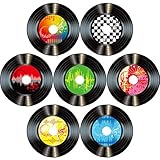
- Note: 1950’s rock and roll music party decorations record cutouts are made of paperboard, NOT vinyl or plastic; Hope these vivid colors and chic designs can build fun memories for your party
- Package includes: 35 pieces record signs cutouts in 7 different fashion design with 40 pieces glue points, each cardboard features colorful and vivid; These record sign cutouts are great props to decorate your party or activities
- Reusable and multipurpose: the music signs decoration are made of thick paperboard with surface laminated, which is reusable for various occasions, like party decorations, room decorations or other events
- Size: each retro paper vinyl records wall decor size is 7 inch with diverse designs for rock and roll party decoration; Big enough to catch the attention of friends and guests
- Record Cut-outs: Vintage disco records decorations great for rock and roll music party, 50's themed party, 70's party, or any scene and music theme home decoration; Adding active atmosphere for your party, suitable to match your event and build fun memories for the day
Product prices and availability are accurate as of the date/time indicated and are subject to change. Any price and availability information displayed on Amazon at the time of purchase will apply.
Quick wins for a faster PC:
Fix the driver behind crashes, sound loss and screen glitchesFind Drivers →Repair Windows errors before they cause bigger problemsFix Now →Scan for outdated or missing drivers - takes under a minuteDriver Scan →



