Windows Errors? Fix Them Before They Spread
Repair common Windows errors and clear accumulated junk for a smoother, more stable PC - no reinstall needed.Free scan · no reinstallCrashes, No Sound, or Screen Glitches?
Random freezes, missing sound and display glitches usually trace back to one bad driver. Find and replace yours safely.Free scan · under a minuteMilan Kundera’s The Unbearable Lightness of Being asks whether a life that happens only once is liberating—or so unrepeatable that it seems to have no lasting weight. Its answer is not that weight is good and lightness is bad: the novel calls the opposition mysterious and ambiguous. First published in France in 1984, the book reached its 40th anniversary in 2024.
What does “lightness” mean in the novel?
In the novel’s opening essay, Kundera’s narrator imagines a world in which everything happens again exactly as it happened before, and keeps recurring forever. This is the thought experiment of eternal return. If every action returned without end, each choice would carry immense responsibility: nothing could be dismissed as a passing event.


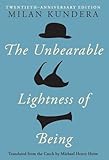

Against that imagined repetition stands the singular life. What happens once cannot be tested against another version or revisited; it vanishes. The narrator suggests that such a life may feel light, but also shadow-like, as though it were “dead in advance.” This is the novel’s literary framing of Nietzsche’s idea, not a comprehensive account of Nietzsche’s philosophy. In a 2006 scholarly reading, Jeremy Wattles describes the opening as asking whether eternal return might enslave or empower an individual.
How do weight and lightness differ?
Kundera makes the contrast more complicated than a choice between responsibility and freedom. Weight can be a burden, but it can also suggest rootedness, reality, truth, and fulfillment. Lightness can mean release and ascent, but also insignificance or a life that never fully settles into reality. The narrator invokes Parmenides’ association of lightness with the positive, then questions whether that valuation is right.
#1 Best Overall
| Lens | Weight | Lightness |
|---|---|---|
| Responsibility | An action bears consequence and moral seriousness. | An action may seem less binding when life is unrepeatable. |
| Experience | Closeness to the earth, reality, and fulfillment. | Freedom and ascent, but potentially half-reality or insignificance. |
| Time | Eternal return imagines every act recurring without end. | A one-time life leaves no second chance to confirm or revise its meaning. |
These are interpretive poles, not a verdict. Kundera put the point plainly in the opening essay published by The New Yorker on March 12, 1984: “The only certainty is: the weight/lightness opposition is the most mysterious, most ambiguous of all.”
How do the characters give the ideas human stakes?
The novel does not leave the question in abstraction. Faber’s synopsis describes Tomas, a successful surgeon divided between his love for Tereza and his womanizing; Sabina, his mistress, an artist who regards life as a series of betrayals; and Franz, another of Sabina’s lovers, whose noble qualities may cost him everything. The opening also shows Tomas unsure what to do after meeting Tereza, making a contingent encounter—and the choices that follow—part of the philosophical problem.
These characters are not simply labels for “weight” or “lightness.” Their attachments, betrayals, desires, and consequences let the reader feel what the concepts might mean in lived relationships. A choice can feel freeing in one moment and binding in another; a bond can be both a burden and a source of reality.
Why does political history matter?
Faber places the relationships amid communist Czechoslovakia and connects the novel to the Prague Spring, political acts, private desires, passion, the body, and the soul. That setting gives personal choices a public dimension: the meaning of freedom is not only romantic or private when political conditions shape what people can do and what their actions may cost.
Quick wins for a faster PC:
Clear out junk files and repair common Windows errorsFree Scan →Scan for outdated or missing drivers - takes under a minuteDriver Scan →Why does the book move between story and philosophy?
Kundera described the novel as a form able to bring philosophy, narrative, dream, and essay into one composition, with existence as its distinctive subject. That helps explain why the book can pause to consider an idea, then return to the uncertain course of a relationship. Its philosophical passages are part of its way of telling a story, not a detachable lecture. The account appears in Christian Salmon’s 1984 Paris Review interview with Kundera.
Independent reader supportYour contribution helps us test, update, and keep practical guides available for everyone.When was the novel published?
The Milan Kundera Library records the novel’s first publication in France in 1984, alongside New York and London editions published that year. The “forty years” framing therefore refers to its 2024 anniversary, not a current anniversary in 2026. Faber’s current catalog lists an ebook edition translated by Michael Henry Heim, published November 9, 2020, with ISBN 9780571367641; that identifier applies to that cataloged ebook, not automatically to every format or market.
Quick Recap
- Milan Kundera’s opening essay in The New Yorker
- Milan Kundera Library bibliographic record
- Christian Salmon’s interview with Kundera in The Paris Review
- Faber and Faber catalog entry for the ebook
- Jeremy Wattles’s 2006 scholarly reading
Product prices and availability are accurate as of the date/time indicated and are subject to change. Any price and availability information displayed on Amazon at the time of purchase will apply.




